
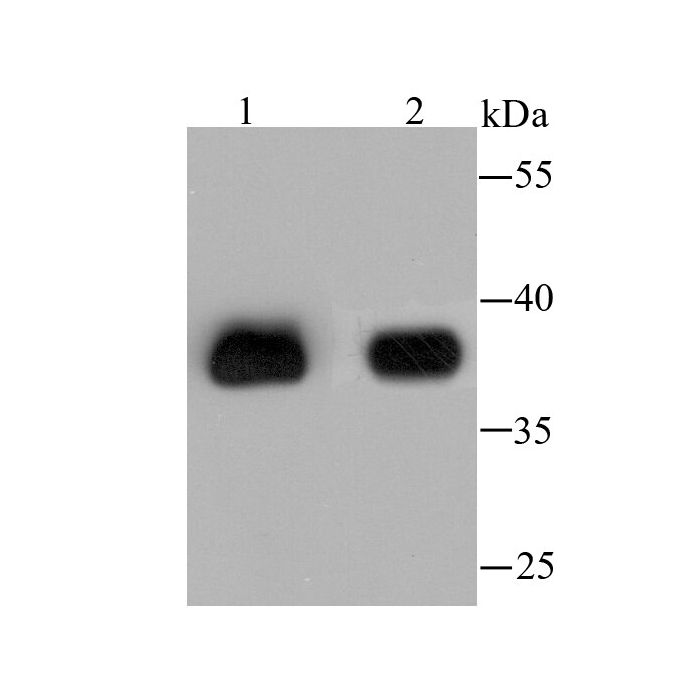
AKR1C1 (clone ), anti-human, mouse
€428.00
In stock
SKU
MB9044
Catalog Number: MB9044
Size: 100 µl
Other Size: 50 µl
Isotype: mouse IgG2a
Applications: WB, IHC, ICC, FC
Questions? Contact us!
Size: 100 µl
Other Size: 50 µl
Isotype: mouse IgG2a
Applications: WB, IHC, ICC, FC
Questions? Contact us!
Background:
Human liver contains isoforms of dihydrodiol dehydrogenase (DD1, DD2, DD3 and DD4), which belong to the aldo-oxo reductase / aldo-keto reductase (AKR) superfamily, have 20α- or 3α-hydroxysteroid dehydrogenase AKD1C3 and 3α-HSD are alternate designations for human DD3 (which is referred to as AKR1C18 in rodents), while DD4 is also designated as AKR1C1, DDH or DDH1, while DD2 also can be designated AKR1C2, dDD, BABP or DDH2. AKR1C4, CD, CHDR or AKR1C6 (in rodents). DD1 and DD2 are 20α-HSDs, DD3 and DD4 are the 3α-HSDs. The 20α-HSD catalyzes the reaction of progesterone to the inactive form 20α-hydroxyprogesterone. The 3α-HSD is a cytosolic, monomeric, NADPH-depen DD1 and DD2 are ubiquitously expressed, whereas DD4 mRNA is restricted to the liver. DD3 is a unique enzyme that can specifically catalyze the dehydrogenation of trans-benzene dihydrodiol and trans- naphthalenedihydrodiol.
Alternative Name:
20-alpha-HSD, DD1/DD2, HBAB, AKR1C1, DDH, DDH1, 2-dihydrobenzene-1, 2-diol dehydrogenase, 20 alpha (3 alpha) hydroxysteroid dehydrogenase, 20 ALPHA HSD, 20 alpha hydroxysteroid dehydrogenase, 20-alpha-HSD, 20-alpha-hydroxysteroid dehydrogenase, 20ALPHAHSD, 2ALPHAHSD, AK1C1, AK1C1, AKR1C1, Aldo keto reductase family 1 member C1, aldo-keto reductase C, Aldo-keto reductase family 1 member C1, Aldo-keto reductase family, 1 member 1, C9, Chlordecone reductase homolog, Chlordecone reductase homolog HAKRC, DD1, DD1/DD2, DDH, DDH1, Dihydrodiol dehydrogenase 1, Dihydrodiol dehydrogenase 1/2, dihydrodiol dehydrogenase 1, 20-alpha (3-alpha)-hydroxysteroid dehydrogenase, dihydrodiol dehydrogenase isoform DD1, Dihydrodiol dehydrogenase, type 1, H37, HAKRC, HBAB, Hepatic dihydrodiol dehydrogenase, High affinity hepatic bile acid-binding protein, High-affinity hepatic bile acid-binding protein, Indanol dehydrogenase, MBAB, MGC8954, Trans-1, Trans-1, 2 dihydrobenzene 1, 2 diol dehydrogenase, Type II 3 alpha hydroxysteroid dehydrogenase,
Application Dilution:
WB:1:2,000-1:10,000
ICC:1:50-1:200
IHC:1:50-1:200
FC:1:50-1:100
Specificity: AKR1C1 monoclonal antibody detects endogenous levels of AKR1C1 protein.
Immunogen:
Recombinant protein
MW: 37 kDa
Swiss-Prot: Q04828(Human)
Purification & Purity:
ProA affinity purified
Format:
Mouse IgG2a, 1mg/ml in PBS with 0.02% sodium azide, 50% glycerol, pH7.2
Storage:
Store at +4°C after thawing. Aliquot store at -20°C or -80°C. Avoid repeated freeze / thaw cycles.
For research use only, not for use in diagnostic procedure.
Human liver contains isoforms of dihydrodiol dehydrogenase (DD1, DD2, DD3 and DD4), which belong to the aldo-oxo reductase / aldo-keto reductase (AKR) superfamily, have 20α- or 3α-hydroxysteroid dehydrogenase AKD1C3 and 3α-HSD are alternate designations for human DD3 (which is referred to as AKR1C18 in rodents), while DD4 is also designated as AKR1C1, DDH or DDH1, while DD2 also can be designated AKR1C2, dDD, BABP or DDH2. AKR1C4, CD, CHDR or AKR1C6 (in rodents). DD1 and DD2 are 20α-HSDs, DD3 and DD4 are the 3α-HSDs. The 20α-HSD catalyzes the reaction of progesterone to the inactive form 20α-hydroxyprogesterone. The 3α-HSD is a cytosolic, monomeric, NADPH-depen DD1 and DD2 are ubiquitously expressed, whereas DD4 mRNA is restricted to the liver. DD3 is a unique enzyme that can specifically catalyze the dehydrogenation of trans-benzene dihydrodiol and trans- naphthalenedihydrodiol.
Alternative Name:
20-alpha-HSD, DD1/DD2, HBAB, AKR1C1, DDH, DDH1, 2-dihydrobenzene-1, 2-diol dehydrogenase, 20 alpha (3 alpha) hydroxysteroid dehydrogenase, 20 ALPHA HSD, 20 alpha hydroxysteroid dehydrogenase, 20-alpha-HSD, 20-alpha-hydroxysteroid dehydrogenase, 20ALPHAHSD, 2ALPHAHSD, AK1C1, AK1C1, AKR1C1, Aldo keto reductase family 1 member C1, aldo-keto reductase C, Aldo-keto reductase family 1 member C1, Aldo-keto reductase family, 1 member 1, C9, Chlordecone reductase homolog, Chlordecone reductase homolog HAKRC, DD1, DD1/DD2, DDH, DDH1, Dihydrodiol dehydrogenase 1, Dihydrodiol dehydrogenase 1/2, dihydrodiol dehydrogenase 1, 20-alpha (3-alpha)-hydroxysteroid dehydrogenase, dihydrodiol dehydrogenase isoform DD1, Dihydrodiol dehydrogenase, type 1, H37, HAKRC, HBAB, Hepatic dihydrodiol dehydrogenase, High affinity hepatic bile acid-binding protein, High-affinity hepatic bile acid-binding protein, Indanol dehydrogenase, MBAB, MGC8954, Trans-1, Trans-1, 2 dihydrobenzene 1, 2 diol dehydrogenase, Type II 3 alpha hydroxysteroid dehydrogenase,
Application Dilution:
WB:1:2,000-1:10,000
ICC:1:50-1:200
IHC:1:50-1:200
FC:1:50-1:100
Specificity: AKR1C1 monoclonal antibody detects endogenous levels of AKR1C1 protein.
Immunogen:
Recombinant protein
MW: 37 kDa
Swiss-Prot: Q04828(Human)
Purification & Purity:
ProA affinity purified
Format:
Mouse IgG2a, 1mg/ml in PBS with 0.02% sodium azide, 50% glycerol, pH7.2
Storage:
Store at +4°C after thawing. Aliquot store at -20°C or -80°C. Avoid repeated freeze / thaw cycles.
For research use only, not for use in diagnostic procedure.
| Is Featured? | No |
|---|
Write Your Own Review