
ALDOB Polyclonal Antibody
€0.00
In stock
SKU
E-AB-12963
Catalog Number: E-AB-12963
Isotype: Rabbit IgG
Reactivity: human, mouse, rat
Applications: WB,IHC,ELISA
Datasheet, Questions? Contact us!
Isotype: Rabbit IgG
Reactivity: human, mouse, rat
Applications: WB,IHC,ELISA
Datasheet, Questions? Contact us!
Background:
Fructose-1,6-bisphosphate aldolase (EC 4.1.2.13) is a tetrameric glycolytic enzyme that catalyzes the reversible conversion of fructose-1,6-bisphosphate to glyceraldehyde 3-phosphate and dihydroxyacetone phosphate. Vertebrates have 3 aldolase isozymes which are distinguished by their electrophoretic and catalytic properties. Differences indicate that aldolases A, B, and C are distinct proteins, the products of a family of related 'housekeeping' genes exhibiting developmentally regulated expression of the different isozymes. The developing embryo produces aldolase A, which is produced in even greater amounts in adult muscle where it can be as much as 5% of total cellular protein. In adult liver, kidney and intestine, aldolase A expression is repressed and aldolase B is produced. In brain and other nervous tissue, aldolase A and C are expressed about equally. There is a high degree of homology between aldolase A and C. Defects in ALDOB cause hereditary fructose intolerance.
Research Area: Cancer, Metabolism, Signal Transduction
Synonyms:
ALDB, ALDO B, ALDO2, ALDOB, ALDOB, Aldolase 2, Aldolase B, Aldolase B fructose bisphosphate, Aldolase2, AldolaseB, EC 4.1.2.13, Fructose bisphosphate aldolase B, Fructose-bisphosphate aldolase B, Liver type aldolase, Liver-type aldolase, MS1077
Immunogen: Synthetic peptide of human ALDOB
Swissprot: P05062
Gene Accession: NP_000026
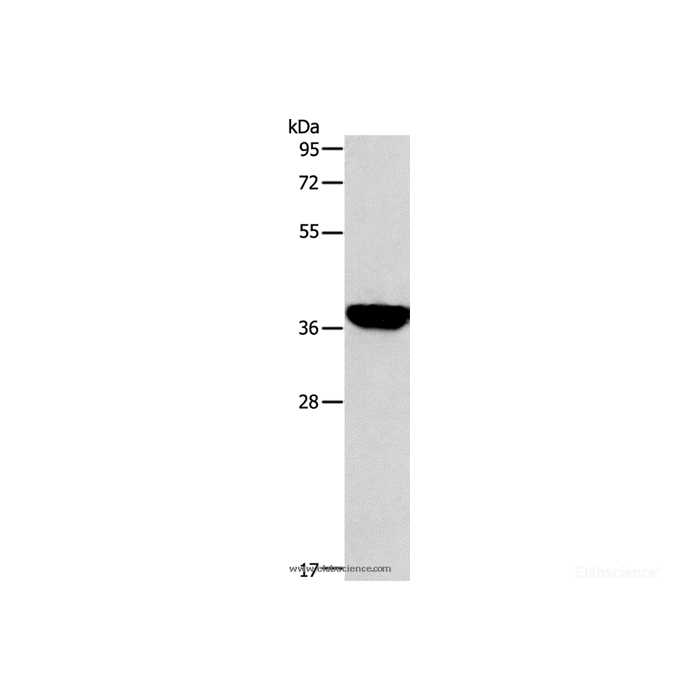
Calculated MW: 39 kDa
Purification Method: Affinity purification
Buffer: PBS with 0.05% sodium azide and 50% glycerol, PH7.4
Concentration: 0.3 mg/mL
Dilution: WB 1:500-1:2000, IHC 1:50-1:200
Storage:
Store at -20°C. Avoid freeze / thaw cycles.
Alternative for product with catalog number:
sc-12062/sc-12063/sc-30083
Fructose-1,6-bisphosphate aldolase (EC 4.1.2.13) is a tetrameric glycolytic enzyme that catalyzes the reversible conversion of fructose-1,6-bisphosphate to glyceraldehyde 3-phosphate and dihydroxyacetone phosphate. Vertebrates have 3 aldolase isozymes which are distinguished by their electrophoretic and catalytic properties. Differences indicate that aldolases A, B, and C are distinct proteins, the products of a family of related 'housekeeping' genes exhibiting developmentally regulated expression of the different isozymes. The developing embryo produces aldolase A, which is produced in even greater amounts in adult muscle where it can be as much as 5% of total cellular protein. In adult liver, kidney and intestine, aldolase A expression is repressed and aldolase B is produced. In brain and other nervous tissue, aldolase A and C are expressed about equally. There is a high degree of homology between aldolase A and C. Defects in ALDOB cause hereditary fructose intolerance.
Research Area: Cancer, Metabolism, Signal Transduction
Synonyms:
ALDB, ALDO B, ALDO2, ALDOB, ALDOB, Aldolase 2, Aldolase B, Aldolase B fructose bisphosphate, Aldolase2, AldolaseB, EC 4.1.2.13, Fructose bisphosphate aldolase B, Fructose-bisphosphate aldolase B, Liver type aldolase, Liver-type aldolase, MS1077
Immunogen: Synthetic peptide of human ALDOB
Swissprot: P05062
Gene Accession: NP_000026
Calculated MW: 39 kDa
Purification Method: Affinity purification
Buffer: PBS with 0.05% sodium azide and 50% glycerol, PH7.4
Concentration: 0.3 mg/mL
Dilution: WB 1:500-1:2000, IHC 1:50-1:200
Storage:
Store at -20°C. Avoid freeze / thaw cycles.
Alternative for product with catalog number:
sc-12062/sc-12063/sc-30083
| Is Featured? | No |
|---|
Write Your Own Review