
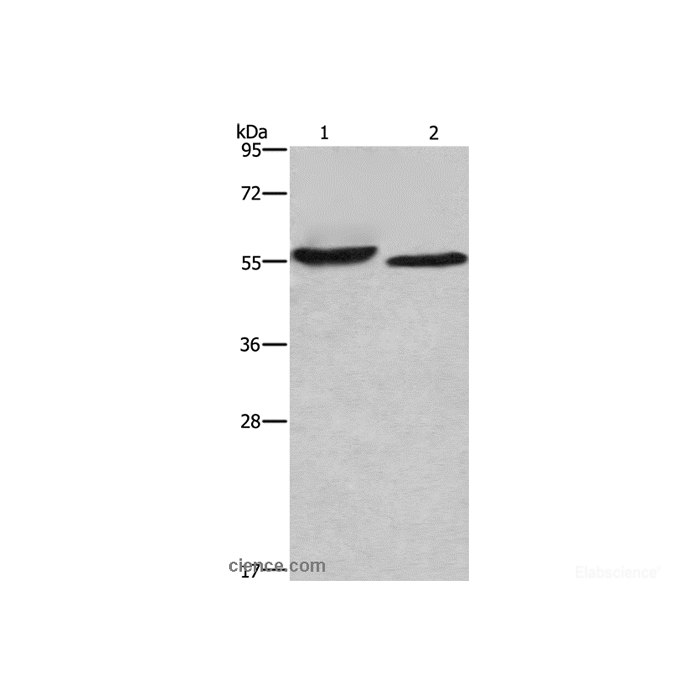
AMIGO2 Polyclonal Antibody
€0.00
In stock
SKU
E-AB-10790
Catalog Number: E-AB-10790
Isotype: Rabbit IgG
Reactivity: human, mouse, rat
Applications: WB,IHC,ELISA
Datasheet, Questions? Contact us!
Isotype: Rabbit IgG
Reactivity: human, mouse, rat
Applications: WB,IHC,ELISA
Datasheet, Questions? Contact us!
Background:
The amphoterin-induced gene and ORF (AMIGO) family of proteins consists of AMIGO-1, AMIGO-2 and AMIGO-3. All three members are single pass type I membrane proteins that contain several leucine-rich repeats, one IgG domain, and a transmembrane domain. The AMIGO proteins are specifically expressed on fiber tracts of neuronal tissues and participate in their formation. The AMIGO proteins can form complexes with each other, but can also bind itself. AMIGO-1, also designated Alivin-2, promotes growth and fasciculation of neurites and plays a role in myelination and fasciculation of developing neural axons. In cerebellar neurons, AMIGO-2 (Alivin-1) is crucial for depolarization-dependent survival. Similar to AMIGO-1 and AMIGO-2, AMIGO-3 (Alivin-3) plays a role in homophilic and/or heterophilic cell-cell interaction and signal transduction
Research Area: Neuroscience
Synonyms:
Adhesion molecule with Ig like domain 2, ALI 1, ALI1, Alivin 1, Alivin-1, Alivin1, AMGO2, AMIGO 2, AMIGO-2, Amigo2, Amphoterin induced gene 2, Amphoterin induced protein 2, Amphoterin-induced gene and open reading frame 2, Amphoterin-induced protein 2, DEGA, Differentially expressed in gastric adenocarcinoma, Differentially expressed in gastric adenocarcinomas, Transmembrane protein AMIGO 2, Transmembrane protein AMIGO2
Immunogen: Recombinant protein of human AMIGO2
Swissprot: Q86SJ2
Gene Accession: BC047595
Calculated MW: 58 kDa
Purification Method: Affinity purification
Buffer: PBS with 0.05% sodium azide and 50% glycerol, PH7.4
Concentration: 0.5 mg/mL
Dilution: WB 1:500-1:2000, IHC 1:50-1:200
Storage:
Store at -20°C. Avoid freeze / thaw cycles.
Alternative for product with catalog number:
sc-46759/sc-46761/sc-46760
The amphoterin-induced gene and ORF (AMIGO) family of proteins consists of AMIGO-1, AMIGO-2 and AMIGO-3. All three members are single pass type I membrane proteins that contain several leucine-rich repeats, one IgG domain, and a transmembrane domain. The AMIGO proteins are specifically expressed on fiber tracts of neuronal tissues and participate in their formation. The AMIGO proteins can form complexes with each other, but can also bind itself. AMIGO-1, also designated Alivin-2, promotes growth and fasciculation of neurites and plays a role in myelination and fasciculation of developing neural axons. In cerebellar neurons, AMIGO-2 (Alivin-1) is crucial for depolarization-dependent survival. Similar to AMIGO-1 and AMIGO-2, AMIGO-3 (Alivin-3) plays a role in homophilic and/or heterophilic cell-cell interaction and signal transduction
Research Area: Neuroscience
Synonyms:
Adhesion molecule with Ig like domain 2, ALI 1, ALI1, Alivin 1, Alivin-1, Alivin1, AMGO2, AMIGO 2, AMIGO-2, Amigo2, Amphoterin induced gene 2, Amphoterin induced protein 2, Amphoterin-induced gene and open reading frame 2, Amphoterin-induced protein 2, DEGA, Differentially expressed in gastric adenocarcinoma, Differentially expressed in gastric adenocarcinomas, Transmembrane protein AMIGO 2, Transmembrane protein AMIGO2
Immunogen: Recombinant protein of human AMIGO2
Swissprot: Q86SJ2
Gene Accession: BC047595
Calculated MW: 58 kDa
Purification Method: Affinity purification
Buffer: PBS with 0.05% sodium azide and 50% glycerol, PH7.4
Concentration: 0.5 mg/mL
Dilution: WB 1:500-1:2000, IHC 1:50-1:200
Storage:
Store at -20°C. Avoid freeze / thaw cycles.
Alternative for product with catalog number:
sc-46759/sc-46761/sc-46760
| Is Featured? | No |
|---|
Write Your Own Review