
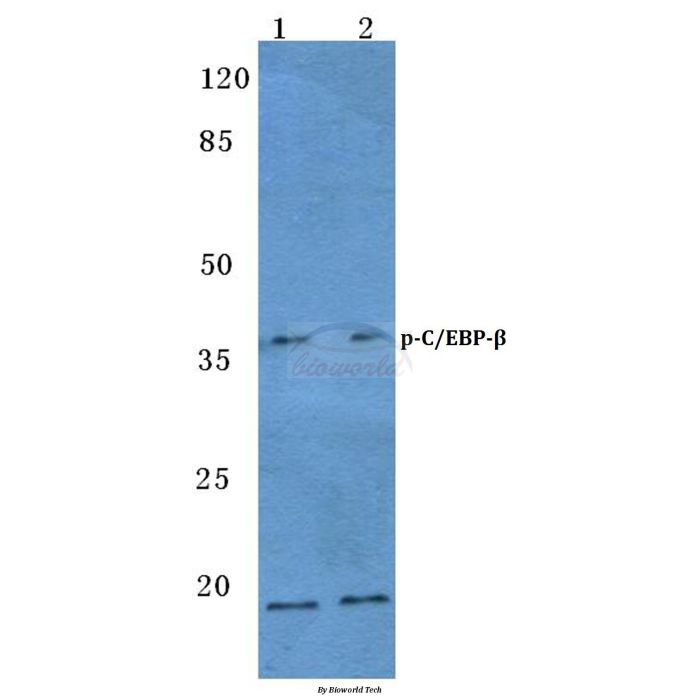
C/EBP-β (phospho-T235/188) polyclonal, anti-human, mouse, rat
€328.00
In stock
SKU
BS4029
Background:
C/EBP β is a member of the C/EBP transcription factor family. The C/EBP β gene encodes several isoforms, which have truncated transcription activation domains by the alternative translational initiation at multipe AUG start sites. Initiation of translation at the in-frame AUGs forms four C/EBP β isoforms. C/EBP β is also known as interleukin 6-dependent DNA-binding protein (IL6DBP), liver activator protein(LAP) or liver-enriched transcriptional activator protein transcription factor 5 (TCF5). C/EBP β contributes to the regulation of the acute phase response in hepatocytes. Stat3 has an important function in IL-6-mediated transcription of the C/EBP β gene that has direct implication for acute phase response in liver cells.The 35 kDa C/EBP β form requires phosphorylation for its DNA binding ability, and increased binding of C/EBP β isoforms during acute-phase reaction occurs through its upregulation and structural modification.
Alternative Name:
CCAAT/enhancer-binding protein beta, C/EBP β, C/EBPβ, C/EBP beta, Liver activator protein, LAP, Liver-enriched inhibitory protein, LIP, Nuclear factor NF-IL6, Transcription factor 5, TCF-5, CEBPB, TCF5, ORF Names: PP9092
Application Dilution: WB: 1:500~1:1000, IHC: 1:50~1:200
Specificity: p-C/EBP-β (T235/188) polyclonal antibody detects endogenous levels of human LAP only when phosphorylated at Thr235, mouse and rat LAP only when phosphorylated at Thr188, and LIP only when phosphorylated at Thr37.
Immunogen:
Synthetic phosphopeptide derived from human C/EBP-β around the phosphorylation site of Threonine 235.
MW: ~ 19, 36, 38 kDa
Swis Prot.: P17676
Purification & Purity:
The antibody was affinity-purified from rabbit antiserum by affinity-chromatography using epitope-specific immunogen and the purity is > 95% (by SDS-PAGE).
Format:
1 mg/ml in Phosphate buffered saline (PBS) with 0.05% sodium azide, approx. pH 7.2.
Storage:
Store at 4°C short term. Aliquot and store at -20°C long term. Avoid freeze-thaw cycles.
For research use only, not for use in diagnostic procedure.
C/EBP β is a member of the C/EBP transcription factor family. The C/EBP β gene encodes several isoforms, which have truncated transcription activation domains by the alternative translational initiation at multipe AUG start sites. Initiation of translation at the in-frame AUGs forms four C/EBP β isoforms. C/EBP β is also known as interleukin 6-dependent DNA-binding protein (IL6DBP), liver activator protein(LAP) or liver-enriched transcriptional activator protein transcription factor 5 (TCF5). C/EBP β contributes to the regulation of the acute phase response in hepatocytes. Stat3 has an important function in IL-6-mediated transcription of the C/EBP β gene that has direct implication for acute phase response in liver cells.The 35 kDa C/EBP β form requires phosphorylation for its DNA binding ability, and increased binding of C/EBP β isoforms during acute-phase reaction occurs through its upregulation and structural modification.
Alternative Name:
CCAAT/enhancer-binding protein beta, C/EBP β, C/EBPβ, C/EBP beta, Liver activator protein, LAP, Liver-enriched inhibitory protein, LIP, Nuclear factor NF-IL6, Transcription factor 5, TCF-5, CEBPB, TCF5, ORF Names: PP9092
Application Dilution: WB: 1:500~1:1000, IHC: 1:50~1:200
Specificity: p-C/EBP-β (T235/188) polyclonal antibody detects endogenous levels of human LAP only when phosphorylated at Thr235, mouse and rat LAP only when phosphorylated at Thr188, and LIP only when phosphorylated at Thr37.
Immunogen:
Synthetic phosphopeptide derived from human C/EBP-β around the phosphorylation site of Threonine 235.
MW: ~ 19, 36, 38 kDa
Swis Prot.: P17676
Purification & Purity:
The antibody was affinity-purified from rabbit antiserum by affinity-chromatography using epitope-specific immunogen and the purity is > 95% (by SDS-PAGE).
Format:
1 mg/ml in Phosphate buffered saline (PBS) with 0.05% sodium azide, approx. pH 7.2.
Storage:
Store at 4°C short term. Aliquot and store at -20°C long term. Avoid freeze-thaw cycles.
For research use only, not for use in diagnostic procedure.
| Is Featured? | No |
|---|
Write Your Own Review