
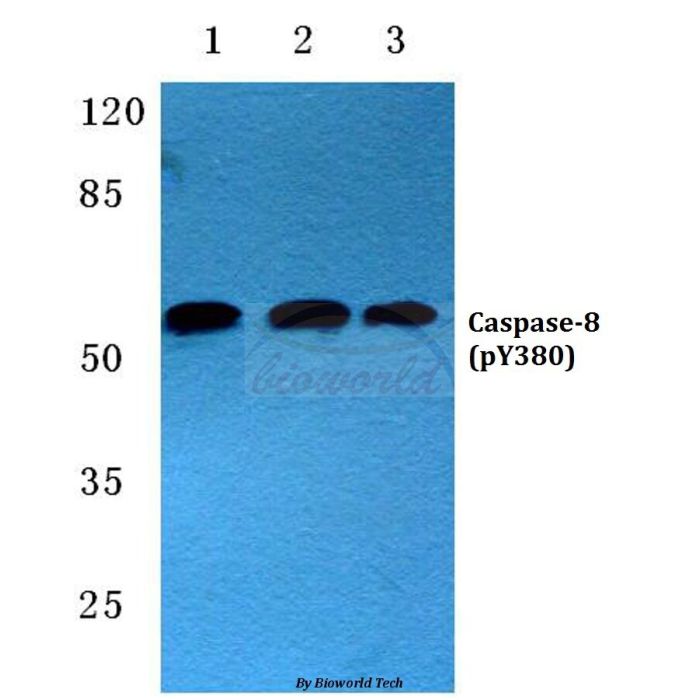
Caspase-8 (phospho-Y380) polyclonal, anti-human, mouse, rat
€328.00
In stock
SKU
BS4662
Background:
Caspases are cysteine proteases, expressed as inactive precursors, that mediate apoptosis by proteolysis of specific substrates. Caspases have the ability to cleave after aspartic acid residues. There are two classes of caspases involved in apoptosis; initiators (activation by receptor cluster) and effectors (activation by mitochondrial permeability transition). Proapoptotic signals autocatalytically activate initiator caspases, such as Caspase 8 and Caspase 9. Activated initiator caspases then process effector caspases, such as Caspase 3 and Caspase 7, which in turn cause cell collapse.
Alternative Name:
Caspase-8, Caspase8, Caspase 8, CASP-8, Apoptotic cysteine protease, Apoptotic protease Mch-5, CAP4, FADD-homologous ICE/ced-3-like protease, FADD-like ICE, FLICE, ICE-like apoptotic protease 5, MORT1-associated ced-3 homolog, MACH, Caspase-8 subunit p18, Caspase-8 subunit p10, CASP8, MCH5
Application Dilution: WB: 1:500~1:1000
Specificity: p-Caspase 8 (Y380) polyclonal antibody detects endogenous levels of Caspase 8 protein only when phosphorylated at Tyr380.
Immunogen:
Synthetic phosphopeptide derived from human Caspase-8 around the phosphorylation site of Tyrosine 380.
MW: ~ 38, 55 kDa
Swis Prot.: Q14790
Purification & Purity:
The antibody was affinity-purified from rabbit antiserum by affinity-chromatography using epitope-specific immunogen and the purity is > 95% (by SDS-PAGE).
Format:
1 mg/ml in Phosphate buffered saline (PBS) with 15 mM sodium azide, approx. pH 7.2.
Storage:
Store at 4°C short term. Aliquot and store at -20°C long term. Avoid freeze-thaw cycles.
For research use only, not for use in diagnostic procedure.
Caspases are cysteine proteases, expressed as inactive precursors, that mediate apoptosis by proteolysis of specific substrates. Caspases have the ability to cleave after aspartic acid residues. There are two classes of caspases involved in apoptosis; initiators (activation by receptor cluster) and effectors (activation by mitochondrial permeability transition). Proapoptotic signals autocatalytically activate initiator caspases, such as Caspase 8 and Caspase 9. Activated initiator caspases then process effector caspases, such as Caspase 3 and Caspase 7, which in turn cause cell collapse.
Alternative Name:
Caspase-8, Caspase8, Caspase 8, CASP-8, Apoptotic cysteine protease, Apoptotic protease Mch-5, CAP4, FADD-homologous ICE/ced-3-like protease, FADD-like ICE, FLICE, ICE-like apoptotic protease 5, MORT1-associated ced-3 homolog, MACH, Caspase-8 subunit p18, Caspase-8 subunit p10, CASP8, MCH5
Application Dilution: WB: 1:500~1:1000
Specificity: p-Caspase 8 (Y380) polyclonal antibody detects endogenous levels of Caspase 8 protein only when phosphorylated at Tyr380.
Immunogen:
Synthetic phosphopeptide derived from human Caspase-8 around the phosphorylation site of Tyrosine 380.
MW: ~ 38, 55 kDa
Swis Prot.: Q14790
Purification & Purity:
The antibody was affinity-purified from rabbit antiserum by affinity-chromatography using epitope-specific immunogen and the purity is > 95% (by SDS-PAGE).
Format:
1 mg/ml in Phosphate buffered saline (PBS) with 15 mM sodium azide, approx. pH 7.2.
Storage:
Store at 4°C short term. Aliquot and store at -20°C long term. Avoid freeze-thaw cycles.
For research use only, not for use in diagnostic procedure.
| Is Featured? | No |
|---|
Write Your Own Review