
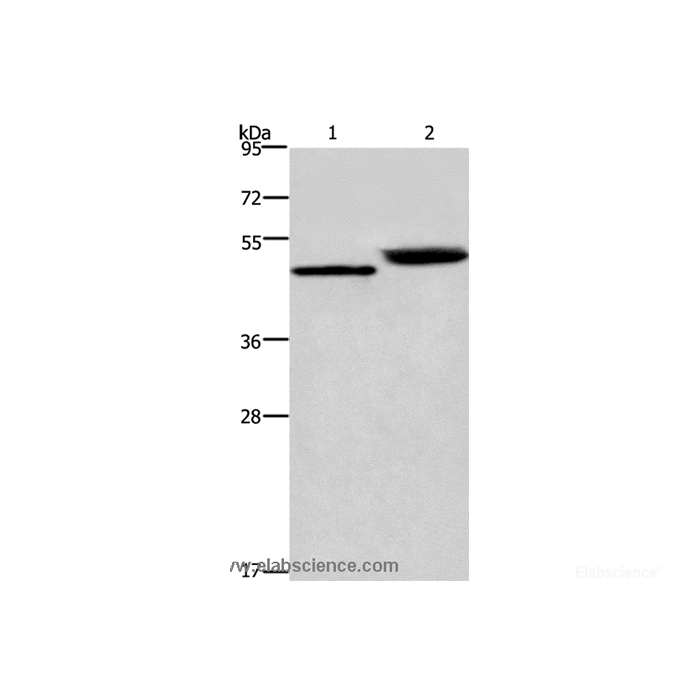
Cathepsin E Polyclonal Antibody
€0.00
In stock
SKU
E-AB-10209
Catalog Number: E-AB-10209
Isotype: Rabbit IgG
Reactivity: human, mouse, rat
Applications: WB,IHC,ELISA
Datasheet, Questions? Contact us!
Isotype: Rabbit IgG
Reactivity: human, mouse, rat
Applications: WB,IHC,ELISA
Datasheet, Questions? Contact us!
Background:
The protein encoded by this gene is a gastric aspartyl protease that functions as a disulfide-linked homodimer. This protease, which is a member of the peptidase C1 family, has a specificity similar to that of pepsin A and cathepsin D. It is an intracellular proteinase that does not appear to be involved in the digestion of dietary protein and is found in highest concentration in the surface of epithelial mucus-producing cells of the stomach. It is the first aspartic proteinase expressed in the fetal stomach and is found in more than half of gastric cancers. It appears, therefore, to be an oncofetal antigen. Transcript variants utilizing alternative polyadenylation signals and two transcript variants encoding different isoforms exist for this gene.
Research Area: Cancer, Immunology
Synonyms:
CATE, CATE, Cathepsin E, Cathepsin E form II, CTSE, Erythrocyte membrane aspartic proteinase, Slow moving proteinase
Immunogen: Recombinant protein of human CTSE
Swissprot: P14091
Gene Accession: BC042537
Calculated MW: 43 kDa
Purification Method: Affinity purification
Buffer: PBS with 0.05% sodium azide and 50% glycerol, PH7.4
Concentration: 0.4 mg/mL
Dilution: WB 1:500-1:2000, IHC 1:50-1:200
Storage:
Store at -20°C. Avoid freeze / thaw cycles.
Alternative for product with catalog number:
sc-6508/sc-6509/sc-30055
The protein encoded by this gene is a gastric aspartyl protease that functions as a disulfide-linked homodimer. This protease, which is a member of the peptidase C1 family, has a specificity similar to that of pepsin A and cathepsin D. It is an intracellular proteinase that does not appear to be involved in the digestion of dietary protein and is found in highest concentration in the surface of epithelial mucus-producing cells of the stomach. It is the first aspartic proteinase expressed in the fetal stomach and is found in more than half of gastric cancers. It appears, therefore, to be an oncofetal antigen. Transcript variants utilizing alternative polyadenylation signals and two transcript variants encoding different isoforms exist for this gene.
Research Area: Cancer, Immunology
Synonyms:
CATE, CATE, Cathepsin E, Cathepsin E form II, CTSE, Erythrocyte membrane aspartic proteinase, Slow moving proteinase
Immunogen: Recombinant protein of human CTSE
Swissprot: P14091
Gene Accession: BC042537
Calculated MW: 43 kDa
Purification Method: Affinity purification
Buffer: PBS with 0.05% sodium azide and 50% glycerol, PH7.4
Concentration: 0.4 mg/mL
Dilution: WB 1:500-1:2000, IHC 1:50-1:200
Storage:
Store at -20°C. Avoid freeze / thaw cycles.
Alternative for product with catalog number:
sc-6508/sc-6509/sc-30055
| Is Featured? | No |
|---|
Write Your Own Review