
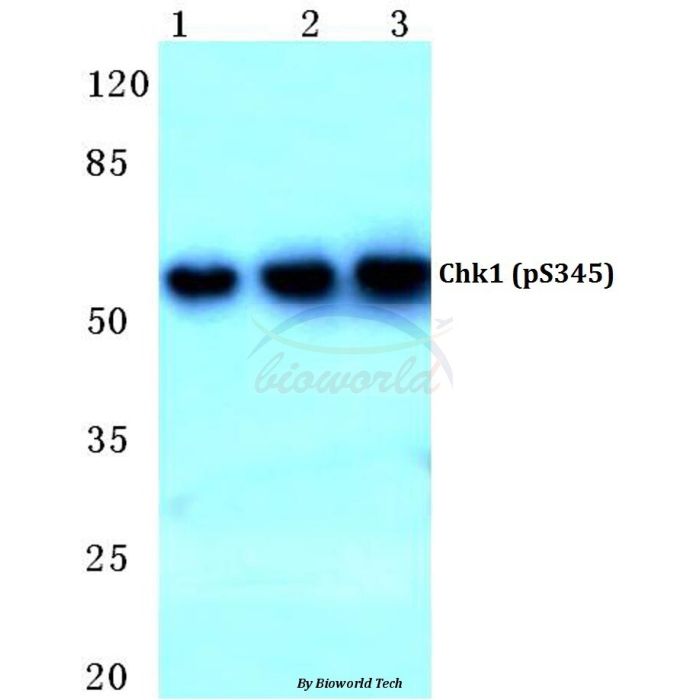
Chk1 (phospho-S345) polyclonal, anti-human, mouse, rat
€328.00
In stock
SKU
BS4041
Background:
Cell cycle events are regulated by the sequential activation and deactivation of cyclin dependent kinases (Cdks) and by proteolysis of cyclins. Chk1 and Chk2 are involved in these processes as regulators of Cdks. Chk1 and Chk2 both function as essential components in the G2 DNA damage checkpoint by phosphorylating Cdc25C in response to DNA damage. Phosphorylation inhibits Cdc25C activity, thereby blocking mitosis. Cdc25A, Cdc25B and Cdc25C protein tyrosine phosphatases function as mitotic activators by dephosphorylating Cdc2 p34 on regulatory tyrosine residues. It has also been shown that Chk1 can phosphorylate Wee 1 in vitro, providing evidence that the hyperphosphorylated form of Wee 1, seen in cells delayed by Chk1 overexpression, is due to phosphorylation by Chk1. Chk1 is phosphorylated on Serine 345 (S345) in response to UV, IR and hydroxyurea (HU). Chk1 plays an essential role in the mammalian DNA damage checkpoint, embryonic development and tumor suppression.
Alternative Name:
Serine/threonine-protein kinase Chk1, CHK1 checkpoint homolog, Cell cycle checkpoint kinase, Checkpoint kinase-1, CHEK1, CHK1
Application Dilution: WB: 1:500~1:1000, IHC: 1:50~1:200
Specificity: p-Chk1 (S345) polyclonal antibody detects endogenous levels of Chk1 protein when phosphorylated at Ser345.
Immunogen:
Synthetic phosphopeptide derived from human Chk1 around the phosphorylation site of Serine 345.
MW: ~ 56 kDa
Swis Prot.: O14757
Purification & Purity:
The antibody was affinity-purified from rabbit antiserum by affinity-chromatography using epitope-specific immunogen and the purity is > 95% (by SDS-PAGE).
Format:
1 mg/ml in Phosphate buffered saline (PBS) with 0.05% sodium azide, approx. pH 7.2.
Storage:
Store at 4°C short term. Aliquot and store at -20°C long term. Avoid freeze-thaw cycles.
For research use only, not for use in diagnostic procedure.
Cell cycle events are regulated by the sequential activation and deactivation of cyclin dependent kinases (Cdks) and by proteolysis of cyclins. Chk1 and Chk2 are involved in these processes as regulators of Cdks. Chk1 and Chk2 both function as essential components in the G2 DNA damage checkpoint by phosphorylating Cdc25C in response to DNA damage. Phosphorylation inhibits Cdc25C activity, thereby blocking mitosis. Cdc25A, Cdc25B and Cdc25C protein tyrosine phosphatases function as mitotic activators by dephosphorylating Cdc2 p34 on regulatory tyrosine residues. It has also been shown that Chk1 can phosphorylate Wee 1 in vitro, providing evidence that the hyperphosphorylated form of Wee 1, seen in cells delayed by Chk1 overexpression, is due to phosphorylation by Chk1. Chk1 is phosphorylated on Serine 345 (S345) in response to UV, IR and hydroxyurea (HU). Chk1 plays an essential role in the mammalian DNA damage checkpoint, embryonic development and tumor suppression.
Alternative Name:
Serine/threonine-protein kinase Chk1, CHK1 checkpoint homolog, Cell cycle checkpoint kinase, Checkpoint kinase-1, CHEK1, CHK1
Application Dilution: WB: 1:500~1:1000, IHC: 1:50~1:200
Specificity: p-Chk1 (S345) polyclonal antibody detects endogenous levels of Chk1 protein when phosphorylated at Ser345.
Immunogen:
Synthetic phosphopeptide derived from human Chk1 around the phosphorylation site of Serine 345.
MW: ~ 56 kDa
Swis Prot.: O14757
Purification & Purity:
The antibody was affinity-purified from rabbit antiserum by affinity-chromatography using epitope-specific immunogen and the purity is > 95% (by SDS-PAGE).
Format:
1 mg/ml in Phosphate buffered saline (PBS) with 0.05% sodium azide, approx. pH 7.2.
Storage:
Store at 4°C short term. Aliquot and store at -20°C long term. Avoid freeze-thaw cycles.
For research use only, not for use in diagnostic procedure.
| Is Featured? | No |
|---|
Write Your Own Review