
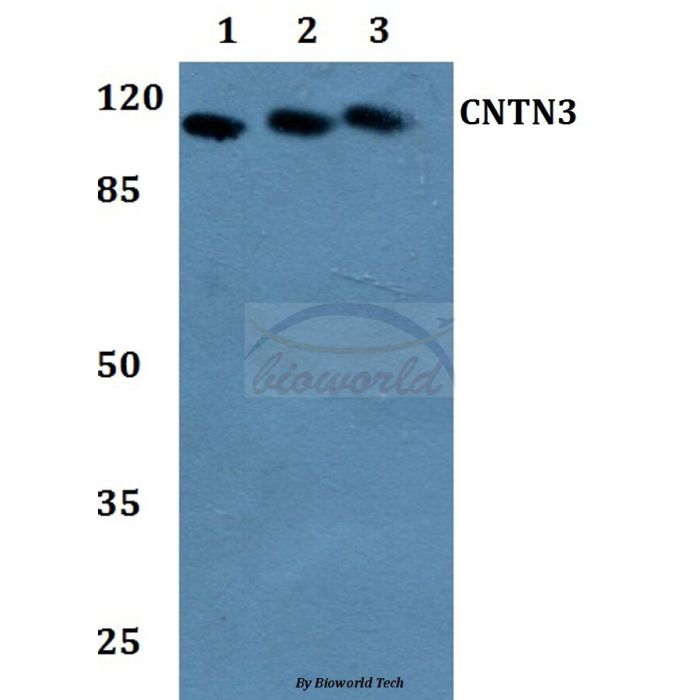
Contactin-3 polyclonal, anti-human, mouse, rat
€305.00
In stock
SKU
BS60135
Background:
Changes in synaptic efficacy can mediate crucial processes during learning and memory formation. Accumulating evidence implicates cell adhesion molecules in activity-dependent synaptic modifications associated with paired-pulse facilitation (PPF), long-term potentiation (LTP) and long-term depression (LTD). Among the cell adhesion molecules involved in these processes are the contactins. Contactins are immunoglobulin superfamily members that play a selective role in synaptic plasticity, PPF and LTD, and may regulate cell-cell interactions contributing to synaptic plasticity in conjunction with other synapse targeting molecules, including paranodin and phosphacan. In addition, contactins are essential components that control expression and distribution of Na+ channels in neurons, junctional attachment at the paranode, and ultimately the physiology of the myelinated nerve. The human Contactin 1 gene encodes a 1,018 amino acid protein. The human Contactin 3 gene encodes a 646 amino acid plasmacytoma-associated neuronal glycoprotein. The human Contactin 5 gene encodes a 1,100 amino acid neural adhesion molecule. The human Contactin 6 gene encodes a 1,028 amino acid neural adhesion molecule.
Alternative Name:
Contactin-3, Contactin3, Contactin 3, Brain-derived immunoglobulin superfamily protein 1, BIG-1, BIG1, Plasmacytoma-associated neuronal glycoprotein, CNTN3, KIAA1496, PANG
Application Dilution: WB: 1:500~1:1000
Specificity: Contactin-3 polyclonal antibody detects endogenous levels of Contactin-3 protein.
Immunogen:
A synthetic peptide corresponding to residues in Human Contactin-3.
MW: ~ 113 kDa
Swis Prot.: Q9P232
Purification & Purity:
The antibody was affinity-purified from rabbit antiserum by affinity-chromatography using epitope-specific immunogen and the purity is > 95% (by SDS-PAGE).
Format:
1mg/ml in PBS with 0.1% Sodium Azide, 50% Glycerol.
Storage:
Store at 4°C short term. Aliquot and store at -20°C long term. Avoid freeze-thaw cycles.
For research use only, not for use in diagnostic procedure.
Changes in synaptic efficacy can mediate crucial processes during learning and memory formation. Accumulating evidence implicates cell adhesion molecules in activity-dependent synaptic modifications associated with paired-pulse facilitation (PPF), long-term potentiation (LTP) and long-term depression (LTD). Among the cell adhesion molecules involved in these processes are the contactins. Contactins are immunoglobulin superfamily members that play a selective role in synaptic plasticity, PPF and LTD, and may regulate cell-cell interactions contributing to synaptic plasticity in conjunction with other synapse targeting molecules, including paranodin and phosphacan. In addition, contactins are essential components that control expression and distribution of Na+ channels in neurons, junctional attachment at the paranode, and ultimately the physiology of the myelinated nerve. The human Contactin 1 gene encodes a 1,018 amino acid protein. The human Contactin 3 gene encodes a 646 amino acid plasmacytoma-associated neuronal glycoprotein. The human Contactin 5 gene encodes a 1,100 amino acid neural adhesion molecule. The human Contactin 6 gene encodes a 1,028 amino acid neural adhesion molecule.
Alternative Name:
Contactin-3, Contactin3, Contactin 3, Brain-derived immunoglobulin superfamily protein 1, BIG-1, BIG1, Plasmacytoma-associated neuronal glycoprotein, CNTN3, KIAA1496, PANG
Application Dilution: WB: 1:500~1:1000
Specificity: Contactin-3 polyclonal antibody detects endogenous levels of Contactin-3 protein.
Immunogen:
A synthetic peptide corresponding to residues in Human Contactin-3.
MW: ~ 113 kDa
Swis Prot.: Q9P232
Purification & Purity:
The antibody was affinity-purified from rabbit antiserum by affinity-chromatography using epitope-specific immunogen and the purity is > 95% (by SDS-PAGE).
Format:
1mg/ml in PBS with 0.1% Sodium Azide, 50% Glycerol.
Storage:
Store at 4°C short term. Aliquot and store at -20°C long term. Avoid freeze-thaw cycles.
For research use only, not for use in diagnostic procedure.
| Is Featured? | No |
|---|
Write Your Own Review