
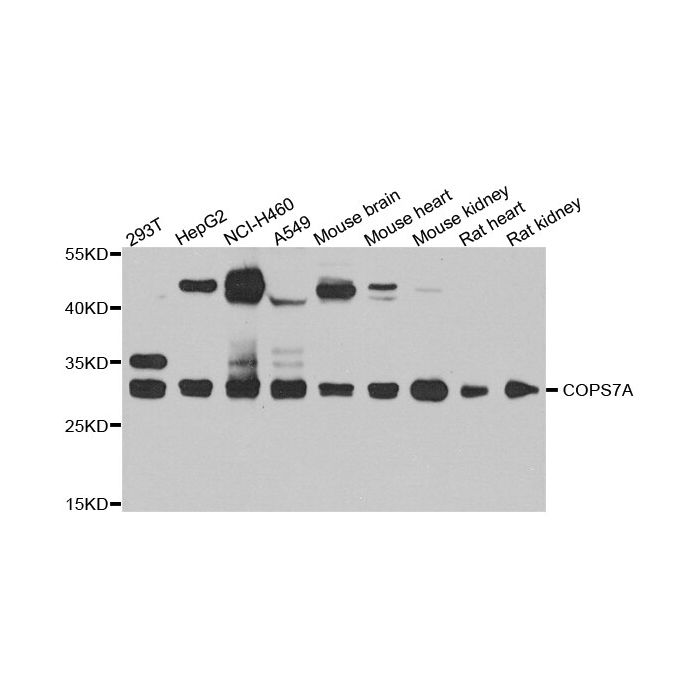
COPS7A polyclonal, anti-human, mouse, rat
€388.00
In stock
SKU
BS71123
Background:
The COP9 signalosome (CSN) complex is involved in several different developmental and cellular processes. The complex is made up of several widely expressed proteins: CSN1 (COPS1), CSN2 (COPS2), CSN3 (COPS3), CSN4 (COPS4), CSN5 (COPS5), CSN6 (COP6), CSN7a (COPS7, COPS7a) or CSN7b (COP7b) and CSN8 (COP8). The CSN complex acts as a regulator for the ubiquitin conjugation pathway by mediating the deneddylation of the SCF-type E3 ligase complexes, which leads to a decrease in ubiquitin ligase activity of SCF-complexes. It is also involved in the phosphorylation of p53, c-Jun, I˚Bα and IRF-8, as well as CSN-dependent phosphorylation of p53, and c-Jun protects and promotes degradation by the Ubl system. CSN7 is phosphorylated by CK2 and is composed of two subunits; a and b. CSN7a contains a PCI (Proteasome CSN9 initiation factor 3) region, as well as a coiled-coil region and is predicted to interact with CSN2, CSN3, CSN4, CSN5, CSN6, CSN8, and GPS1. CSN7b contains only a PCI region and is predicted to interact with INT6.
Alternative Name:
CSN7, CSN7A, SGN7a,
Application Dilution: WB: 1:500 - 1:2000, IF: 1:50 - 1:200
Specificity: COPS7A polyclonal antibody detects endogenous levels of COPS7A protein.
Immunogen:
Recombinant protein of human COPS7A.
MW: ~ 30 kDa
Swis Prot.: Q9UBW8
Purification & Purity:
The antibody was affinity-purified from rabbit antiserum by affinity-chromatography using epitope-specific immunogen and the purity is > 95% (by SDS-PAGE).
Format:
1mg/ml in PBS with 0.02% sodium azide, 50% glycerol, pH7.3.
Storage:
Store at 4°C short term. Aliquot and store at -20°C long term. Avoid freeze-thaw cycles.
For research use only, not for use in diagnostic procedure.
The COP9 signalosome (CSN) complex is involved in several different developmental and cellular processes. The complex is made up of several widely expressed proteins: CSN1 (COPS1), CSN2 (COPS2), CSN3 (COPS3), CSN4 (COPS4), CSN5 (COPS5), CSN6 (COP6), CSN7a (COPS7, COPS7a) or CSN7b (COP7b) and CSN8 (COP8). The CSN complex acts as a regulator for the ubiquitin conjugation pathway by mediating the deneddylation of the SCF-type E3 ligase complexes, which leads to a decrease in ubiquitin ligase activity of SCF-complexes. It is also involved in the phosphorylation of p53, c-Jun, I˚Bα and IRF-8, as well as CSN-dependent phosphorylation of p53, and c-Jun protects and promotes degradation by the Ubl system. CSN7 is phosphorylated by CK2 and is composed of two subunits; a and b. CSN7a contains a PCI (Proteasome CSN9 initiation factor 3) region, as well as a coiled-coil region and is predicted to interact with CSN2, CSN3, CSN4, CSN5, CSN6, CSN8, and GPS1. CSN7b contains only a PCI region and is predicted to interact with INT6.
Alternative Name:
CSN7, CSN7A, SGN7a,
Application Dilution: WB: 1:500 - 1:2000, IF: 1:50 - 1:200
Specificity: COPS7A polyclonal antibody detects endogenous levels of COPS7A protein.
Immunogen:
Recombinant protein of human COPS7A.
MW: ~ 30 kDa
Swis Prot.: Q9UBW8
Purification & Purity:
The antibody was affinity-purified from rabbit antiserum by affinity-chromatography using epitope-specific immunogen and the purity is > 95% (by SDS-PAGE).
Format:
1mg/ml in PBS with 0.02% sodium azide, 50% glycerol, pH7.3.
Storage:
Store at 4°C short term. Aliquot and store at -20°C long term. Avoid freeze-thaw cycles.
For research use only, not for use in diagnostic procedure.
| Is Featured? | No |
|---|
Write Your Own Review