
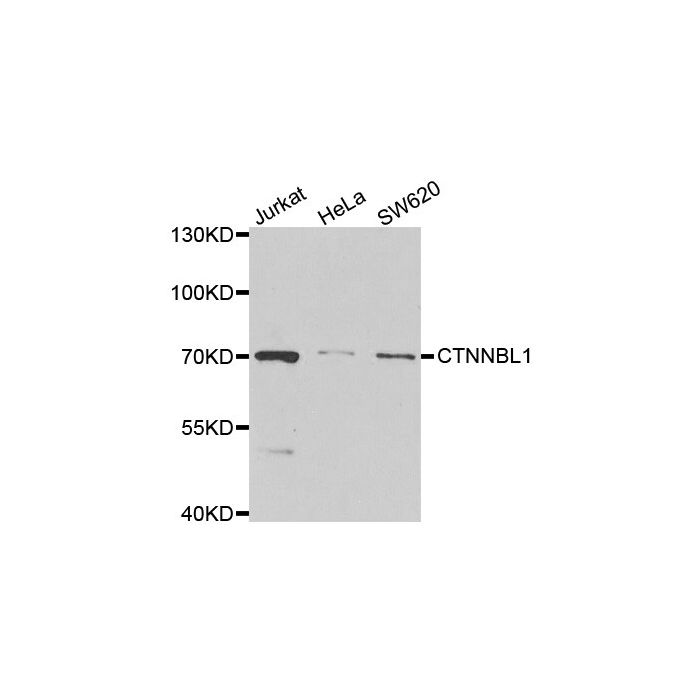
CTNNBL1 polyclonal, anti-human, mouse, rat
€388.00
In stock
SKU
BS6972
Background:
CTNNBL1 (catenin, β like 1), also known as NAP (nuclear-associated protein) or P14L, is an evolutionarily conserved protein with structural homology to members of the armadillo family, including β-catenin. CTNNBL1 is expressed in a variety of tissues with highest expression levels found in heart, spleen, testis, placenta, thyroid and skeletal muscle. Localizing to the nucleus, CTNNBL1 contains a bipartite nuclear localization signal, an acidic domain, a leucine-isoleucine zipper, an acidic domain and phosphorylation sites. Via its C-terminus, CTNNBL1 is believed to play a role in apoptosis. In addition, multiple SNPs (single nucleotide polymorphisms) in the CTNNBL1 have been associated with fat mass and body mass index (BMI), suggesting a possible role for CTNNBL1 in the development of obesity.
Alternative Name:
Beta-catenin-like protein 1, Nuclear-associated protein, NAP, Testis development protein NYD-SP19, CTNNBL1, C20orf33, PP8304
Application Dilution: WB: 1:500~1:2000, IF: 1:50~1:200
Specificity: CTNNBL1 polyclonal antibody detects endogenous levels of CTNNBL1 protein.
Immunogen:
Recombinant full length Human CTNNBL1.
MW: ~ 65 kDa
Swis Prot.: Q8WYA6
Purification & Purity:
The antibody was affinity-purified from rabbit antiserum by affinity-chromatography using epitope-specific immunogen and the purity is > 95% (by SDS-PAGE).
Format:
1mg/ml in PBS with 0.1% Sodium Azide, 50% Glycerol.
Storage:
Store at 4°C short term. Aliquot and store at -20°C long term. Avoid freeze-thaw cycles.
For research use only, not for use in diagnostic procedure.
CTNNBL1 (catenin, β like 1), also known as NAP (nuclear-associated protein) or P14L, is an evolutionarily conserved protein with structural homology to members of the armadillo family, including β-catenin. CTNNBL1 is expressed in a variety of tissues with highest expression levels found in heart, spleen, testis, placenta, thyroid and skeletal muscle. Localizing to the nucleus, CTNNBL1 contains a bipartite nuclear localization signal, an acidic domain, a leucine-isoleucine zipper, an acidic domain and phosphorylation sites. Via its C-terminus, CTNNBL1 is believed to play a role in apoptosis. In addition, multiple SNPs (single nucleotide polymorphisms) in the CTNNBL1 have been associated with fat mass and body mass index (BMI), suggesting a possible role for CTNNBL1 in the development of obesity.
Alternative Name:
Beta-catenin-like protein 1, Nuclear-associated protein, NAP, Testis development protein NYD-SP19, CTNNBL1, C20orf33, PP8304
Application Dilution: WB: 1:500~1:2000, IF: 1:50~1:200
Specificity: CTNNBL1 polyclonal antibody detects endogenous levels of CTNNBL1 protein.
Immunogen:
Recombinant full length Human CTNNBL1.
MW: ~ 65 kDa
Swis Prot.: Q8WYA6
Purification & Purity:
The antibody was affinity-purified from rabbit antiserum by affinity-chromatography using epitope-specific immunogen and the purity is > 95% (by SDS-PAGE).
Format:
1mg/ml in PBS with 0.1% Sodium Azide, 50% Glycerol.
Storage:
Store at 4°C short term. Aliquot and store at -20°C long term. Avoid freeze-thaw cycles.
For research use only, not for use in diagnostic procedure.
| Is Featured? | No |
|---|
Write Your Own Review