
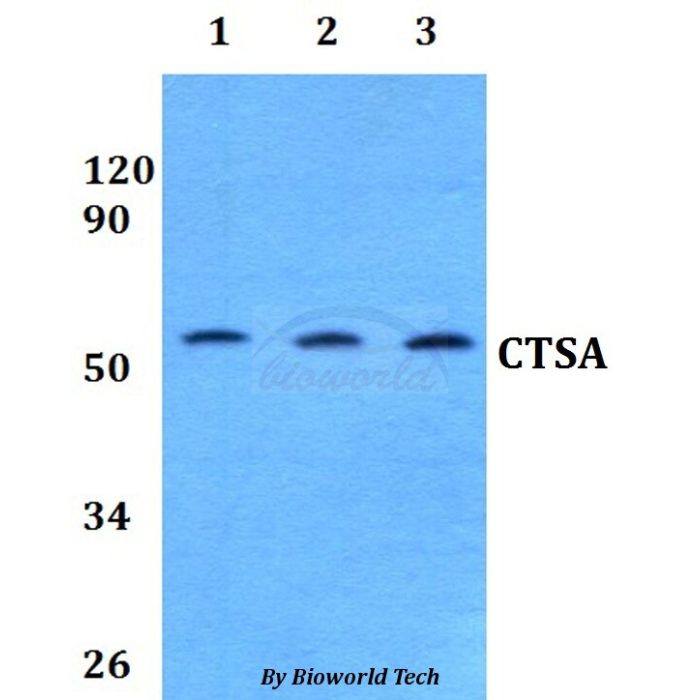
CTSA polyclonal, anti-human, mouse, rat
€305.00
In stock
SKU
BS60829
Background:
The cathepsin family of proteolytic enzymes include several diverse classes of proteases. Cathepsins B, L, H, K, S and O comprise the cysteine protease class. Cathepsins D and E comprise the aspartyle protease class. The serine protease class includes cathepsin G. Cathepsins function in cellular metabolism and participate in peptide biosynthesis and protein degradation. Cathepsin A, a serine carboxypeptidase, exists in a high molecular weight lysosomal complex with b-galactosidase (b-gal) and a-neuraminidase (Neu1). Cathepsin A functions to protect b-gal and Neu1 from intralysosomal proteolysis . Deficiencies in cathepsin A lead to deficiencies in b-gal and Neu1 . The gene encoding human cathepsin A maps to chromosome 20q13.12 . Mutations in this gene cause glactosialidosis, a lysosomal storage disorder resulting from the b-gal and Neu1 deficiencies.
Alternative Name:
Lysosomal protective protein, Carboxypeptidase C, Carboxypeptidase L, Cathepsin A, Protective protein cathepsin A, PPCA, Protective protein for beta-galactosidase, CTSA, PPGB
Application Dilution: WB: 1:500~1:1000
Specificity: CTSA polyclonal antibody detects endogenous levels of CTSA protein.
Immunogen:
A synthetic peptide corresponding to residues in Human CTSA.
MW: ~ 54 kDa
Swis Prot.: P10619
Purification & Purity:
The antibody was affinity-purified from rabbit antiserum by affinity-chromatography using epitope-specific immunogen and the purity is > 95% (by SDS-PAGE).
Format:
1 mg/ml in Phosphate buffered saline (PBS) with 15 mM sodium azide, approx. pH 7.2.
Storage:
Store at 4°C short term. Aliquot and store at -20°C long term. Avoid freeze-thaw cycles.
For research use only, not for use in diagnostic procedure.
The cathepsin family of proteolytic enzymes include several diverse classes of proteases. Cathepsins B, L, H, K, S and O comprise the cysteine protease class. Cathepsins D and E comprise the aspartyle protease class. The serine protease class includes cathepsin G. Cathepsins function in cellular metabolism and participate in peptide biosynthesis and protein degradation. Cathepsin A, a serine carboxypeptidase, exists in a high molecular weight lysosomal complex with b-galactosidase (b-gal) and a-neuraminidase (Neu1). Cathepsin A functions to protect b-gal and Neu1 from intralysosomal proteolysis . Deficiencies in cathepsin A lead to deficiencies in b-gal and Neu1 . The gene encoding human cathepsin A maps to chromosome 20q13.12 . Mutations in this gene cause glactosialidosis, a lysosomal storage disorder resulting from the b-gal and Neu1 deficiencies.
Alternative Name:
Lysosomal protective protein, Carboxypeptidase C, Carboxypeptidase L, Cathepsin A, Protective protein cathepsin A, PPCA, Protective protein for beta-galactosidase, CTSA, PPGB
Application Dilution: WB: 1:500~1:1000
Specificity: CTSA polyclonal antibody detects endogenous levels of CTSA protein.
Immunogen:
A synthetic peptide corresponding to residues in Human CTSA.
MW: ~ 54 kDa
Swis Prot.: P10619
Purification & Purity:
The antibody was affinity-purified from rabbit antiserum by affinity-chromatography using epitope-specific immunogen and the purity is > 95% (by SDS-PAGE).
Format:
1 mg/ml in Phosphate buffered saline (PBS) with 15 mM sodium azide, approx. pH 7.2.
Storage:
Store at 4°C short term. Aliquot and store at -20°C long term. Avoid freeze-thaw cycles.
For research use only, not for use in diagnostic procedure.
| Is Featured? | No |
|---|
Write Your Own Review