
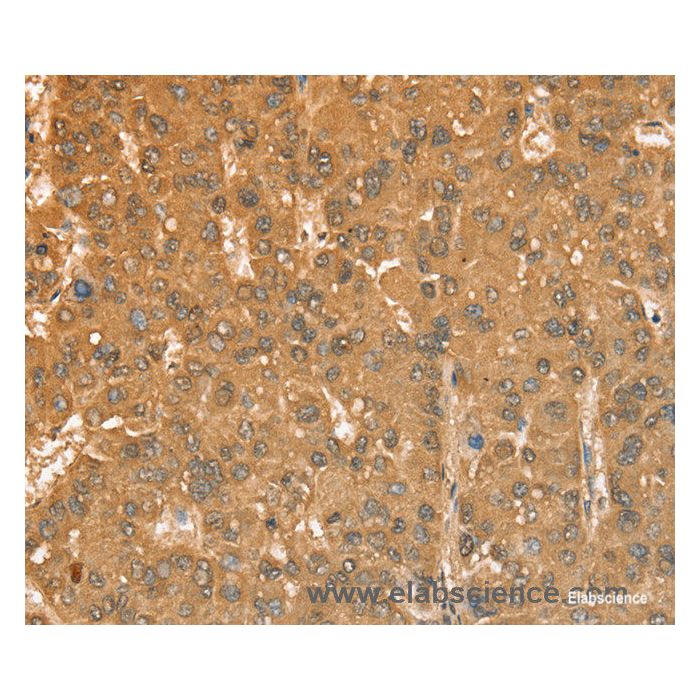
CXCR4 Polyclonal Antibody
€0.00
In stock
SKU
E-AB-11047
Catalog Number: E-AB-11047
Isotype: Rabbit IgG
Reactivity: human
Applications: IHC,ELISA
Datasheet, Questions? Contact us!
Isotype: Rabbit IgG
Reactivity: human
Applications: IHC,ELISA
Datasheet, Questions? Contact us!
Background:
This gene encodes a CXC chemokine receptor specific for stromal cell-derived factor-1. The protein has 7 transmembrane regions and is located on the cell surface. It acts with the CD4 protein to support HIV entry into cells and is also highly expressed in breast cancer cells. Mutations in this gene have been associated with WHIM (warts, hypogammaglobulinemia, infections, and myelokathexis) syndrome. Alternate transcriptional splice variants, encoding different isoforms, have been characterized.
Research Area: Cancer, Metabolism, Immunology, Microbiology, Neuroscience, Stem Cells
Synonyms:
C-X-C chemokine receptor type 4, CD184, CD184 antigen, Chemokine (C X C motif) receptor 4, Chemokine CXC Motif Receptor 4, CXC-R4, CXCR-4, CXCR4, CXCR4, D2S201E, FB22, Fusin, HM89, HSY3RR, LAP 3, LAP3, LCR1, LESTR, Leukocyte derived seven transmembrane domain receptor, Leukocyte-derived seven transmembrane domain receptor, Lipopolysaccharide associated protein 3, Neuropeptide Y receptor Y3, NPY3R, NPYR, NPYRL, NPYY3, NPYY3R, Probable G protein coupled receptor lcr1 homolog, SDF 1 receptor, SDF-1 receptor, SEVEN-TRANSMEMBRANE-SEGMENT RECEPTOR, Stromal cell derived factor 1 receptor, Stromal cell-derived factor 1 receptor, WHIM, WHIMS
Immunogen: Recombinant protein of human CXCR4
Swissprot: P61073
Gene Accession: BC020968
Purification Method: Affinity purification
Buffer: PBS with 0.05% sodium azide and 50% glycerol, PH7.4
Concentration: 0.5 mg/mL
Dilution: IHC 1:50-1:200
Storage:
Store at -20°C. Avoid freeze / thaw cycles.
Alternative for product with catalog number:
sc-6279/sc-6191/sc-6190/sc-9046
This gene encodes a CXC chemokine receptor specific for stromal cell-derived factor-1. The protein has 7 transmembrane regions and is located on the cell surface. It acts with the CD4 protein to support HIV entry into cells and is also highly expressed in breast cancer cells. Mutations in this gene have been associated with WHIM (warts, hypogammaglobulinemia, infections, and myelokathexis) syndrome. Alternate transcriptional splice variants, encoding different isoforms, have been characterized.
Research Area: Cancer, Metabolism, Immunology, Microbiology, Neuroscience, Stem Cells
Synonyms:
C-X-C chemokine receptor type 4, CD184, CD184 antigen, Chemokine (C X C motif) receptor 4, Chemokine CXC Motif Receptor 4, CXC-R4, CXCR-4, CXCR4, CXCR4, D2S201E, FB22, Fusin, HM89, HSY3RR, LAP 3, LAP3, LCR1, LESTR, Leukocyte derived seven transmembrane domain receptor, Leukocyte-derived seven transmembrane domain receptor, Lipopolysaccharide associated protein 3, Neuropeptide Y receptor Y3, NPY3R, NPYR, NPYRL, NPYY3, NPYY3R, Probable G protein coupled receptor lcr1 homolog, SDF 1 receptor, SDF-1 receptor, SEVEN-TRANSMEMBRANE-SEGMENT RECEPTOR, Stromal cell derived factor 1 receptor, Stromal cell-derived factor 1 receptor, WHIM, WHIMS
Immunogen: Recombinant protein of human CXCR4
Swissprot: P61073
Gene Accession: BC020968
Purification Method: Affinity purification
Buffer: PBS with 0.05% sodium azide and 50% glycerol, PH7.4
Concentration: 0.5 mg/mL
Dilution: IHC 1:50-1:200
Storage:
Store at -20°C. Avoid freeze / thaw cycles.
Alternative for product with catalog number:
sc-6279/sc-6191/sc-6190/sc-9046
| Is Featured? | No |
|---|
Write Your Own Review