
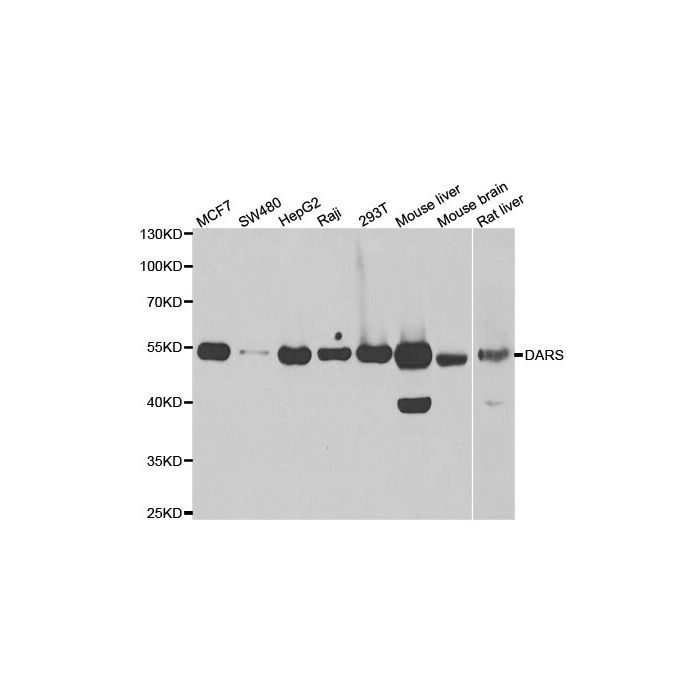
DARS polyclonal, anti-human, mouse, rat
€388.00
In stock
SKU
BS7261
Background:
Aminoacyl-tRNA synthetases consist of a family of enzymes that catalyze the specific aminoacylation of cognate tRNA in the initial step of ribosome-dependent protein biosynthesis. DaRS is part of a multisubunit complex of aminoacyl-tRNA synthetases and is involved in the transfer of Asp-tRNA to EF-1 α1 (elongation factor α 1). The N-terminus of DaRS in vertebrates is a newly evolved structure that contains a putative amphiphilic helix and is dissimilar between different species. The N-terminal extension acts as a switch that, when in its stretched form, reduces the rate of dissociation of Asp-tRNA from DaRS, thereby providing enough time for EF-1 α1 to interact with Asp-tRNA. This suggests that the N-terminus of DaRS plays a critical role in its catalytic function. DaRS contains two phosphorylations sites, forms homodimers and localizes to the cytoplasm.
Alternative Name:
Aspartate--tRNA ligase, cytoplasmic, Aspartyl-tRNA synthetase, AspRS, Cell proliferation-inducing gene 40 protein, DARS, PIG40
Application Dilution: WB: 1:500 - 1:2000, IHC: 1:50 - 1:200, IP: 1:50 - 1:100
Specificity: DARS polyclonal antibody detects endogenous levels of DARS protein.
Immunogen:
Recombinant full length Human DARS.
MW: ~ 57 kDa
Swis Prot.: P14868
Purification & Purity:
The antibody was affinity-purified from rabbit antiserum by affinity-chromatography using epitope-specific immunogen and the purity is > 95% (by SDS-PAGE).
Format:
1mg/ml in PBS with 0.1% Sodium Azide, 50% Glycerol.
Storage:
Store at 4°C short term. Aliquot and store at -20°C long term. Avoid freeze-thaw cycles.
For research use only, not for use in diagnostic procedure.
Aminoacyl-tRNA synthetases consist of a family of enzymes that catalyze the specific aminoacylation of cognate tRNA in the initial step of ribosome-dependent protein biosynthesis. DaRS is part of a multisubunit complex of aminoacyl-tRNA synthetases and is involved in the transfer of Asp-tRNA to EF-1 α1 (elongation factor α 1). The N-terminus of DaRS in vertebrates is a newly evolved structure that contains a putative amphiphilic helix and is dissimilar between different species. The N-terminal extension acts as a switch that, when in its stretched form, reduces the rate of dissociation of Asp-tRNA from DaRS, thereby providing enough time for EF-1 α1 to interact with Asp-tRNA. This suggests that the N-terminus of DaRS plays a critical role in its catalytic function. DaRS contains two phosphorylations sites, forms homodimers and localizes to the cytoplasm.
Alternative Name:
Aspartate--tRNA ligase, cytoplasmic, Aspartyl-tRNA synthetase, AspRS, Cell proliferation-inducing gene 40 protein, DARS, PIG40
Application Dilution: WB: 1:500 - 1:2000, IHC: 1:50 - 1:200, IP: 1:50 - 1:100
Specificity: DARS polyclonal antibody detects endogenous levels of DARS protein.
Immunogen:
Recombinant full length Human DARS.
MW: ~ 57 kDa
Swis Prot.: P14868
Purification & Purity:
The antibody was affinity-purified from rabbit antiserum by affinity-chromatography using epitope-specific immunogen and the purity is > 95% (by SDS-PAGE).
Format:
1mg/ml in PBS with 0.1% Sodium Azide, 50% Glycerol.
Storage:
Store at 4°C short term. Aliquot and store at -20°C long term. Avoid freeze-thaw cycles.
For research use only, not for use in diagnostic procedure.
| Is Featured? | No |
|---|
Write Your Own Review