
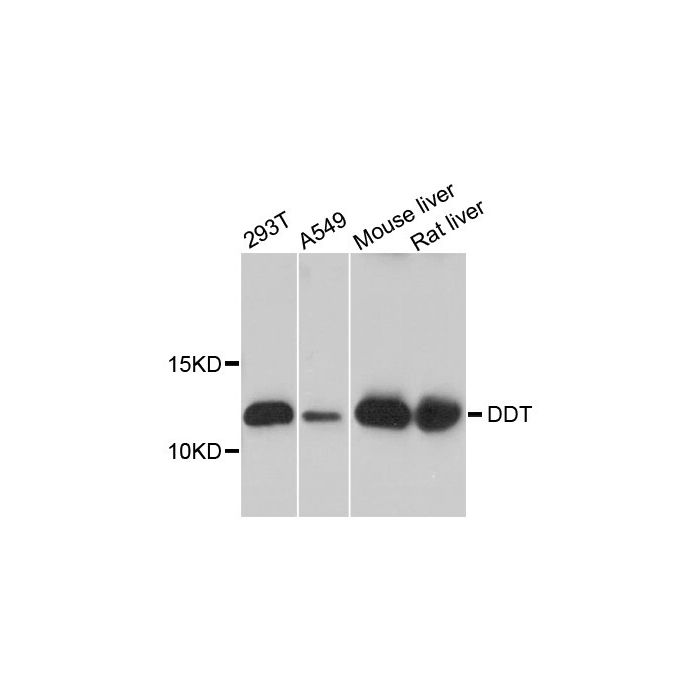
DDT polyclonal, anti-human, mouse, rat
€388.00
In stock
SKU
BS71473
Background:
D-dopachrome tautomerase converts D-dopachrome into 5,6-dihydroxyindole. The DDT gene is related to the migration inhibitory factor (MIF) in terms of sequence, enzyme activity, and gene structure. DDT and MIF are closely linked on chromosome 22. [provided by RefSeq, Jul 2008]
Alternative Name:
D-dopachrome decarboxylase, D-dopachrome tautomerase, Phenylpyruvate tautomerase II
Application Dilution: WB : 1:200 - 1:2000
Specificity: DDT polyclonal antibody detects endogenous levels of DDT protein.
Immunogen:
Recombinant protein of human DDT
MW: Predicted band size: 13 kDa, Observed band size: Refer to Figures
Swis Prot.: P30046
Purification & Purity:
The antibody was affinity-purified from rabbit antiserum by affinity-chromatography using epitope-specific immunogen and the purity is > 95% (by SDS-PAGE).
Format:
1mg/ml in PBS with 0.02% sodium azide, 50% glycerol, pH7.3.
Storage:
Store at 4°C short term. Aliquot and store at -20°C long term. Avoid freeze-thaw cycles.
For research use only, not for use in diagnostic procedure.
D-dopachrome tautomerase converts D-dopachrome into 5,6-dihydroxyindole. The DDT gene is related to the migration inhibitory factor (MIF) in terms of sequence, enzyme activity, and gene structure. DDT and MIF are closely linked on chromosome 22. [provided by RefSeq, Jul 2008]
Alternative Name:
D-dopachrome decarboxylase, D-dopachrome tautomerase, Phenylpyruvate tautomerase II
Application Dilution: WB : 1:200 - 1:2000
Specificity: DDT polyclonal antibody detects endogenous levels of DDT protein.
Immunogen:
Recombinant protein of human DDT
MW: Predicted band size: 13 kDa, Observed band size: Refer to Figures
Swis Prot.: P30046
Purification & Purity:
The antibody was affinity-purified from rabbit antiserum by affinity-chromatography using epitope-specific immunogen and the purity is > 95% (by SDS-PAGE).
Format:
1mg/ml in PBS with 0.02% sodium azide, 50% glycerol, pH7.3.
Storage:
Store at 4°C short term. Aliquot and store at -20°C long term. Avoid freeze-thaw cycles.
For research use only, not for use in diagnostic procedure.
| Is Featured? | No |
|---|
Write Your Own Review