
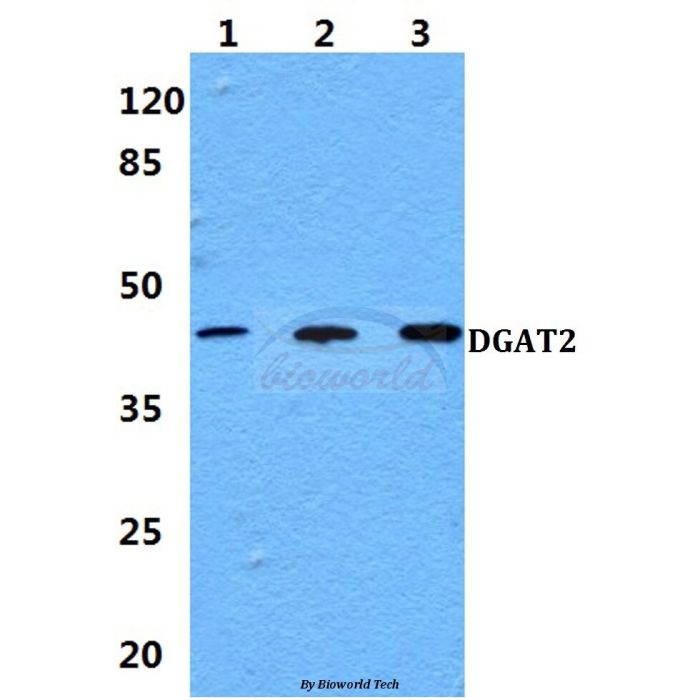
DGAT2 polyclonal, anti-human, mouse, rat
€305.00
In stock
SKU
BS60142
Background:
Acyl-coenzyme A:diacylglycerol acyltransferase, also known as DGAT1 and ARGP1, is a microsomal enzyme that assists in the synthesis of fatty acids into triglycerides. DGAT1 catalyzes the terminal and only committed step in triacylglycerol synthesis by using diacylglycerol (DAG) and fatty acyl CoA as substrates. DGAT1 plays a fundamental role in the metabolism of cellular diacylglycerol and is important in higher eukaryotes for physiologic processes involving triacylglycerol metabolism, such as intestinal fat absorption, lipoprotein assembly, adipose tissue form-ation and lactation. DGAT2, which has no homology to DGAT1, differs from DGAT1 in that its activity has been shown to be inhibited by MgCl in an in vitro assay. DGAT2 is expressed primarily in liver and white adipose tissue, which suggests that it plays an important role in mammalian triglyceride metabolism.
Alternative Name:
Diacylglycerol O-acyltransferase 2, Acyl-CoA retinol O-fatty-acyltransferase, ARAT, Retinol O-fatty-acyltransferase, Diglyceride acyltransferase 2, DGAT2, HMFN1045, UNQ738/PRO1433
Application Dilution: WB: 1:500~1:1000
Specificity: DGAT2 polyclonal antibody detects endogenous levels of DGAT2 protein.
Immunogen:
A synthetic peptide corresponding to residues in Human DGAT2.
MW: ~ 44 kDa
Swis Prot.: Q96PD7
Purification & Purity:
The antibody was affinity-purified from rabbit antiserum by affinity-chromatography using epitope-specific immunogen and the purity is > 95% (by SDS-PAGE).
Format:
1 mg/ml in Phosphate buffered saline (PBS) with 0.05% sodium azide, approx. pH 7.2.
Storage:
Store at 4°C short term. Aliquot and store at -20°C long term. Avoid freeze-thaw cycles.
For research use only, not for use in diagnostic procedure.
Acyl-coenzyme A:diacylglycerol acyltransferase, also known as DGAT1 and ARGP1, is a microsomal enzyme that assists in the synthesis of fatty acids into triglycerides. DGAT1 catalyzes the terminal and only committed step in triacylglycerol synthesis by using diacylglycerol (DAG) and fatty acyl CoA as substrates. DGAT1 plays a fundamental role in the metabolism of cellular diacylglycerol and is important in higher eukaryotes for physiologic processes involving triacylglycerol metabolism, such as intestinal fat absorption, lipoprotein assembly, adipose tissue form-ation and lactation. DGAT2, which has no homology to DGAT1, differs from DGAT1 in that its activity has been shown to be inhibited by MgCl in an in vitro assay. DGAT2 is expressed primarily in liver and white adipose tissue, which suggests that it plays an important role in mammalian triglyceride metabolism.
Alternative Name:
Diacylglycerol O-acyltransferase 2, Acyl-CoA retinol O-fatty-acyltransferase, ARAT, Retinol O-fatty-acyltransferase, Diglyceride acyltransferase 2, DGAT2, HMFN1045, UNQ738/PRO1433
Application Dilution: WB: 1:500~1:1000
Specificity: DGAT2 polyclonal antibody detects endogenous levels of DGAT2 protein.
Immunogen:
A synthetic peptide corresponding to residues in Human DGAT2.
MW: ~ 44 kDa
Swis Prot.: Q96PD7
Purification & Purity:
The antibody was affinity-purified from rabbit antiserum by affinity-chromatography using epitope-specific immunogen and the purity is > 95% (by SDS-PAGE).
Format:
1 mg/ml in Phosphate buffered saline (PBS) with 0.05% sodium azide, approx. pH 7.2.
Storage:
Store at 4°C short term. Aliquot and store at -20°C long term. Avoid freeze-thaw cycles.
For research use only, not for use in diagnostic procedure.
| Is Featured? | No |
|---|
Write Your Own Review