
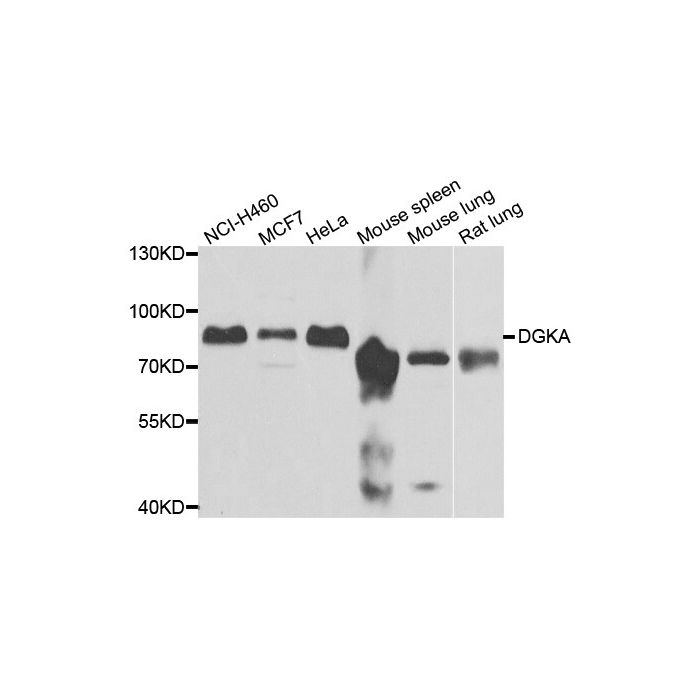
DGK-α polyclonal, anti-human, mouse, rat
€388.00
In stock
SKU
BS8566
Background:
Diacylglycerol kinases (DGKs) phosphorylate diacylglycerol (DAG) to produce phosphatidic acid. DAG and phosphatidic acid are lipids that act as second messengers in signaling cascades. DGK-alpha influences cell activation and secretion of lethal exosomes, which in turn control cell death. DGK-beta is abundant in restricted brain regions such as the caudate putamen and olfactory tubercle. DGK-gamma encodes full-length and truncated transcripts that are present in a range of human tissues, with greatest expression observed in retina. DGK-delta is most abundant in skeletal muscle. DGK-epsilon shows specificity for arachidonyl-containing diacylglycerol and is expressed predominantly in testis. DGK-zeta is most abundant in brain and muscle. DGK-eta is closely related to DGK-delta. DGK-theta is most abundant in the cerebellum and hippocampus.
Alternative Name:
Diacylglycerol kinase alpha, DAG kinase alpha, 80 kDa diacylglycerol kinase, Diglyceride kinase alpha, DGK-alpha, DGKA, DAGK, DAGK1
Application Dilution: WB: 1:500~1:1000, IHC: 1:50~1:200
Specificity: DGK-α polyclonal antibody detects endogenous levels of DGK-α protein.
Immunogen:
Recombinant full length Human DGK-α.
MW: ~ 83kDa
Swis Prot.: P23743
Purification & Purity:
The antibody was affinity-purified from rabbit antiserum by affinity-chromatography using epitope-specific immunogen and the purity is > 95% (by SDS-PAGE).
Format:
1mg/ml in PBS with 0.1% Sodium Azide, 50% Glycerol.
Storage:
Store at 4°C short term. Aliquot and store at -20°C long term. Avoid freeze-thaw cycles.
For research use only, not for use in diagnostic procedure.
Diacylglycerol kinases (DGKs) phosphorylate diacylglycerol (DAG) to produce phosphatidic acid. DAG and phosphatidic acid are lipids that act as second messengers in signaling cascades. DGK-alpha influences cell activation and secretion of lethal exosomes, which in turn control cell death. DGK-beta is abundant in restricted brain regions such as the caudate putamen and olfactory tubercle. DGK-gamma encodes full-length and truncated transcripts that are present in a range of human tissues, with greatest expression observed in retina. DGK-delta is most abundant in skeletal muscle. DGK-epsilon shows specificity for arachidonyl-containing diacylglycerol and is expressed predominantly in testis. DGK-zeta is most abundant in brain and muscle. DGK-eta is closely related to DGK-delta. DGK-theta is most abundant in the cerebellum and hippocampus.
Alternative Name:
Diacylglycerol kinase alpha, DAG kinase alpha, 80 kDa diacylglycerol kinase, Diglyceride kinase alpha, DGK-alpha, DGKA, DAGK, DAGK1
Application Dilution: WB: 1:500~1:1000, IHC: 1:50~1:200
Specificity: DGK-α polyclonal antibody detects endogenous levels of DGK-α protein.
Immunogen:
Recombinant full length Human DGK-α.
MW: ~ 83kDa
Swis Prot.: P23743
Purification & Purity:
The antibody was affinity-purified from rabbit antiserum by affinity-chromatography using epitope-specific immunogen and the purity is > 95% (by SDS-PAGE).
Format:
1mg/ml in PBS with 0.1% Sodium Azide, 50% Glycerol.
Storage:
Store at 4°C short term. Aliquot and store at -20°C long term. Avoid freeze-thaw cycles.
For research use only, not for use in diagnostic procedure.
| Is Featured? | No |
|---|
Write Your Own Review