
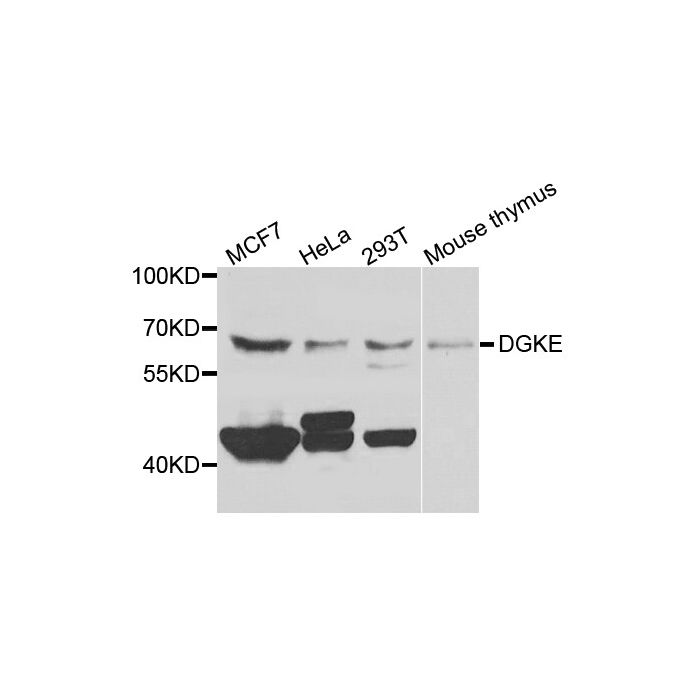
DGK-ε polyclonal, anti-human, mouse
€388.00
In stock
SKU
BS72948
Background:
Diacylglycerol kinases are thought to be involved mainly in the regeneration of phosphatidylinositol (PI) from diacylglycerol in the PI-cycle during cell signal transduction. When expressed in mammalian cells, DGK-epsilon shows specificity for arachidonyl-containing diacylglycerol. DGK-epsilon is expressed predominantly in testis.
Alternative Name:
AHUS7, DAGK5, DAGK6, DGK, NPHS7
Application Dilution: WB: 1:500 - 1:2000, IHC: 1:50 - 1:200, IF: 1:50 - 1:200
Specificity: DGK-ε polyclonal antibody detects endogenous levels of DGK-ε protein.
Immunogen:
Recombinant protein of human DGKE
MW: 64kDa
Swis Prot.: P52429
Purification & Purity:
The antibody was affinity-purified from rabbit antiserum by affinity-chromatography using epitope-specific immunogen and the purity is > 95% (by SDS-PAGE).
Format:
1mg/ml in PBS, 50% glycerol, pH7.3.
Storage:
Store at 4°C short term. Aliquot and store at -20°C long term. Avoid freeze-thaw cycles.
For research use only, not for use in diagnostic procedure.
Diacylglycerol kinases are thought to be involved mainly in the regeneration of phosphatidylinositol (PI) from diacylglycerol in the PI-cycle during cell signal transduction. When expressed in mammalian cells, DGK-epsilon shows specificity for arachidonyl-containing diacylglycerol. DGK-epsilon is expressed predominantly in testis.
Alternative Name:
AHUS7, DAGK5, DAGK6, DGK, NPHS7
Application Dilution: WB: 1:500 - 1:2000, IHC: 1:50 - 1:200, IF: 1:50 - 1:200
Specificity: DGK-ε polyclonal antibody detects endogenous levels of DGK-ε protein.
Immunogen:
Recombinant protein of human DGKE
MW: 64kDa
Swis Prot.: P52429
Purification & Purity:
The antibody was affinity-purified from rabbit antiserum by affinity-chromatography using epitope-specific immunogen and the purity is > 95% (by SDS-PAGE).
Format:
1mg/ml in PBS, 50% glycerol, pH7.3.
Storage:
Store at 4°C short term. Aliquot and store at -20°C long term. Avoid freeze-thaw cycles.
For research use only, not for use in diagnostic procedure.
| Is Featured? | No |
|---|
Write Your Own Review