
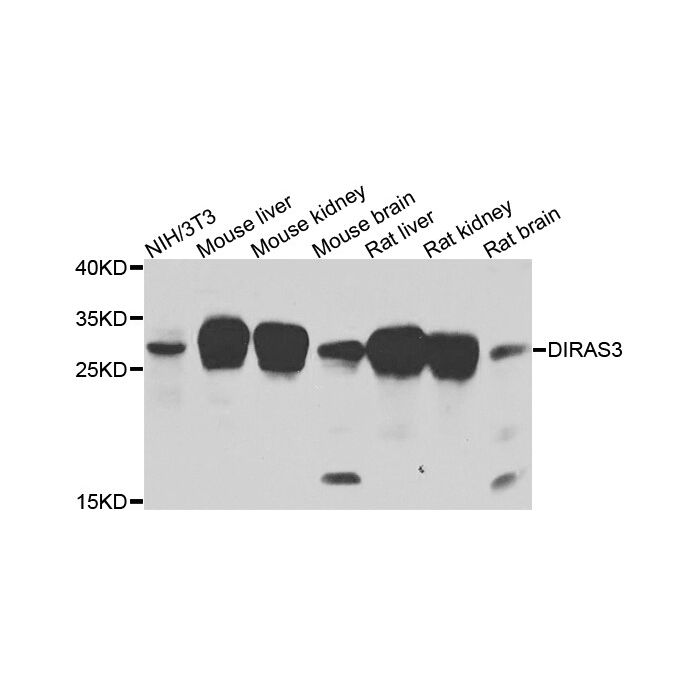
DIRAS3 polyclonal, anti-human, mouse, rat
€388.00
In stock
SKU
BS71012
Background:
This gene is a member of the ras superfamily, and is expressed in normal ovarian and breast epithelial cells, but not in ovarian and breast cancers. It is an imprinted gene, with monoallelic expression of the paternal allele, which is associated with growth suppression. Thus, this gene appears to be a putative tumor suppressor gene whose function is abrogated in ovarian and breast cancers.
Alternative Name:
ARHI, NOEY2,
Application Dilution: WB: 1:500 - 1:2000
Specificity: DIRAS3 polyclonal antibody detects endogenous levels of DIRAS3 protein.
Immunogen:
Recombinant protein of human DIRAS3.
MW: ~ 26 kDa
Swis Prot.: O95661
Purification & Purity:
The antibody was affinity-purified from rabbit antiserum by affinity-chromatography using epitope-specific immunogen and the purity is > 95% (by SDS-PAGE).
Format:
1mg/ml in PBS with 0.02% sodium azide, 50% glycerol, pH7.3.
Storage:
Store at 4°C short term. Aliquot and store at -20°C long term. Avoid freeze-thaw cycles.
For research use only, not for use in diagnostic procedure.
This gene is a member of the ras superfamily, and is expressed in normal ovarian and breast epithelial cells, but not in ovarian and breast cancers. It is an imprinted gene, with monoallelic expression of the paternal allele, which is associated with growth suppression. Thus, this gene appears to be a putative tumor suppressor gene whose function is abrogated in ovarian and breast cancers.
Alternative Name:
ARHI, NOEY2,
Application Dilution: WB: 1:500 - 1:2000
Specificity: DIRAS3 polyclonal antibody detects endogenous levels of DIRAS3 protein.
Immunogen:
Recombinant protein of human DIRAS3.
MW: ~ 26 kDa
Swis Prot.: O95661
Purification & Purity:
The antibody was affinity-purified from rabbit antiserum by affinity-chromatography using epitope-specific immunogen and the purity is > 95% (by SDS-PAGE).
Format:
1mg/ml in PBS with 0.02% sodium azide, 50% glycerol, pH7.3.
Storage:
Store at 4°C short term. Aliquot and store at -20°C long term. Avoid freeze-thaw cycles.
For research use only, not for use in diagnostic procedure.
| Is Featured? | No |
|---|
Write Your Own Review