
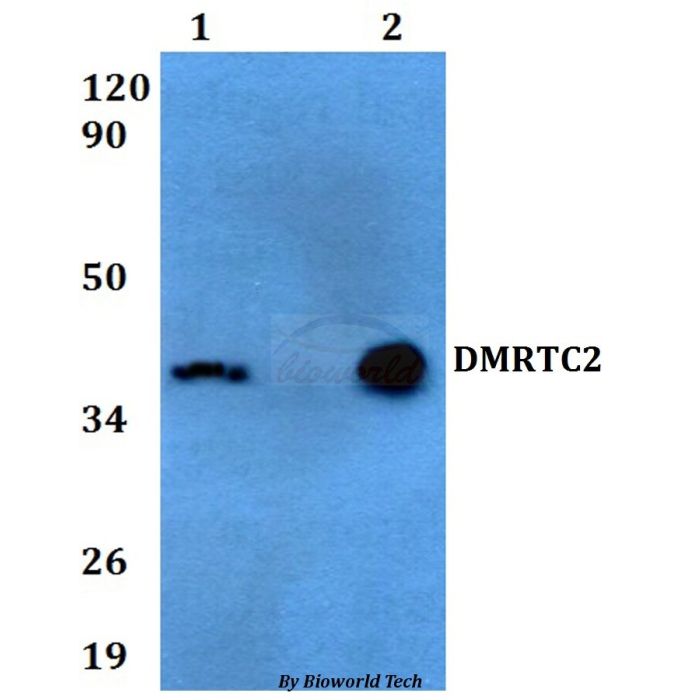
DMRTC2 polyclonal, anti-human, mouse
€305.00
In stock
SKU
BS60602
Background:
In humans, the DMRT (doublesex and mab-3 related transcription factor) genes encode a large family of transcription factors that are related to the Drosophila doublesex proteins. Expressed primarily in the gonads, DMRT proteins contain cysteine-rich DNA-binding motifs and are thought to play an important role in sexual development. DMRTC2 (DMRT-like family C2) is a 367 amino acid nuclear protein that exists as two alternatively spliced isoforms and belongs to the DMRT family. Involved in sexual development, DMRTC2 is expressed in pancreas and testis and contains one DM DNA-binding domain. The gene encoding DMRTC2 maps to human chromosome 19, which consists of over 63 million bases, houses approximately 1,400 genes and is recognized for having the greatest gene density of the human chromosomes. It is the genetic home for a number of immunoglobulin (Ig) superfamily members, including the killer cell and leukocyte Ig-like receptors, a number of ICAMs, the CEACAM and PSG family and Fc receptors (FcRs).
Alternative Name:
Doublesex- and mab-3-related transcription factor C2, DMRTC2
Application Dilution: WB: 1:500~1:1000
Specificity: DMRTC2 polyclonal antibody detects endogenous levels of DMRTC2 protein.
Immunogen:
A synthetic peptide corresponding to residues in Human DMRTC2
MW: ~ 39 kDa
Swis Prot.: Q8IXT2
Purification & Purity:
The antibody was affinity-purified from rabbit antiserum by affinity-chromatography using epitope-specific immunogen and the purity is > 95% (by SDS-PAGE).
Format:
1 mg/ml in Phosphate buffered saline (PBS) with 15 mM sodium azide, approx. pH 7.2.
Storage:
Store at 4°C short term. Aliquot and store at -20°C long term. Avoid freeze-thaw cycles.
For research use only, not for use in diagnostic procedure.
In humans, the DMRT (doublesex and mab-3 related transcription factor) genes encode a large family of transcription factors that are related to the Drosophila doublesex proteins. Expressed primarily in the gonads, DMRT proteins contain cysteine-rich DNA-binding motifs and are thought to play an important role in sexual development. DMRTC2 (DMRT-like family C2) is a 367 amino acid nuclear protein that exists as two alternatively spliced isoforms and belongs to the DMRT family. Involved in sexual development, DMRTC2 is expressed in pancreas and testis and contains one DM DNA-binding domain. The gene encoding DMRTC2 maps to human chromosome 19, which consists of over 63 million bases, houses approximately 1,400 genes and is recognized for having the greatest gene density of the human chromosomes. It is the genetic home for a number of immunoglobulin (Ig) superfamily members, including the killer cell and leukocyte Ig-like receptors, a number of ICAMs, the CEACAM and PSG family and Fc receptors (FcRs).
Alternative Name:
Doublesex- and mab-3-related transcription factor C2, DMRTC2
Application Dilution: WB: 1:500~1:1000
Specificity: DMRTC2 polyclonal antibody detects endogenous levels of DMRTC2 protein.
Immunogen:
A synthetic peptide corresponding to residues in Human DMRTC2
MW: ~ 39 kDa
Swis Prot.: Q8IXT2
Purification & Purity:
The antibody was affinity-purified from rabbit antiserum by affinity-chromatography using epitope-specific immunogen and the purity is > 95% (by SDS-PAGE).
Format:
1 mg/ml in Phosphate buffered saline (PBS) with 15 mM sodium azide, approx. pH 7.2.
Storage:
Store at 4°C short term. Aliquot and store at -20°C long term. Avoid freeze-thaw cycles.
For research use only, not for use in diagnostic procedure.
| Is Featured? | No |
|---|
Write Your Own Review