
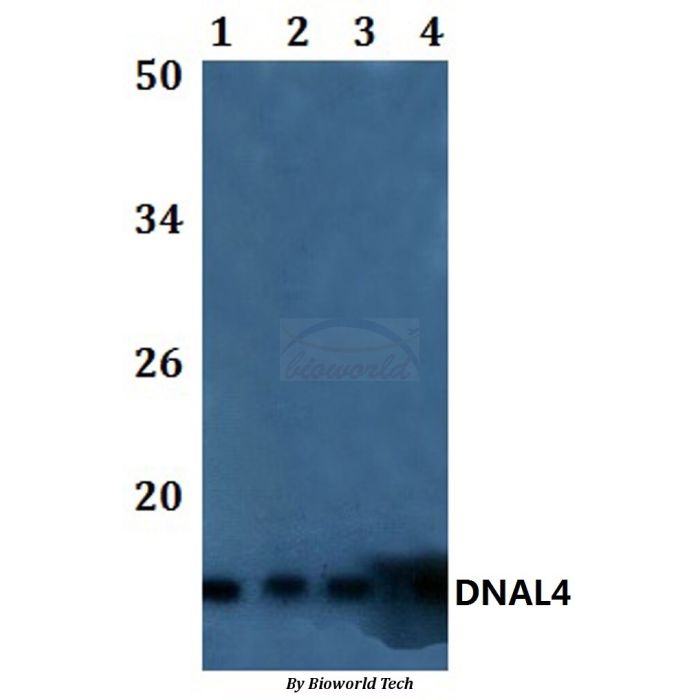
DNAL4 polyclonal, anti-human, mouse, rat
€305.00
In stock
SKU
BS61179
Background:
DNAL4 (dynein, axonemal, light chain 4) is a protein-coding gene. GO annotations related to this gene include microtubule motor activity and ATPase activity, coupled. An important paralog of this gene is DYNLL2.DNAL4 is a component of the dynein motor complex (Iwasaki et al., 2005 (PubMed 15454493)).(supplied by OMIM, Mar 2008)
Alternative Name:
Dynein light chain 4, axonemal, DNAL4
Application Dilution: WB: 1:500~1:1000
Specificity: DNAL4 polyclonal antibody detects endogenous levels of DNAL4 protein.
Immunogen:
A synthetic peptide corresponding to residues in Human DNAL4.
MW: ~ 12 kDa
Swis Prot.: O96015
Purification & Purity:
The antibody was affinity-purified from rabbit antiserum by affinity-chromatography using epitope-specific immunogen and the purity is > 95% (by SDS-PAGE).
Format:
1 mg/ml in Phosphate buffered saline (PBS) with 0.05% sodium azide, approx. pH 7.3.
Storage:
Store at 4°C short term. Aliquot and store at -20°C long term. Avoid freeze-thaw cycles.
For research use only, not for use in diagnostic procedure.
DNAL4 (dynein, axonemal, light chain 4) is a protein-coding gene. GO annotations related to this gene include microtubule motor activity and ATPase activity, coupled. An important paralog of this gene is DYNLL2.DNAL4 is a component of the dynein motor complex (Iwasaki et al., 2005 (PubMed 15454493)).(supplied by OMIM, Mar 2008)
Alternative Name:
Dynein light chain 4, axonemal, DNAL4
Application Dilution: WB: 1:500~1:1000
Specificity: DNAL4 polyclonal antibody detects endogenous levels of DNAL4 protein.
Immunogen:
A synthetic peptide corresponding to residues in Human DNAL4.
MW: ~ 12 kDa
Swis Prot.: O96015
Purification & Purity:
The antibody was affinity-purified from rabbit antiserum by affinity-chromatography using epitope-specific immunogen and the purity is > 95% (by SDS-PAGE).
Format:
1 mg/ml in Phosphate buffered saline (PBS) with 0.05% sodium azide, approx. pH 7.3.
Storage:
Store at 4°C short term. Aliquot and store at -20°C long term. Avoid freeze-thaw cycles.
For research use only, not for use in diagnostic procedure.
| Is Featured? | No |
|---|
Write Your Own Review