
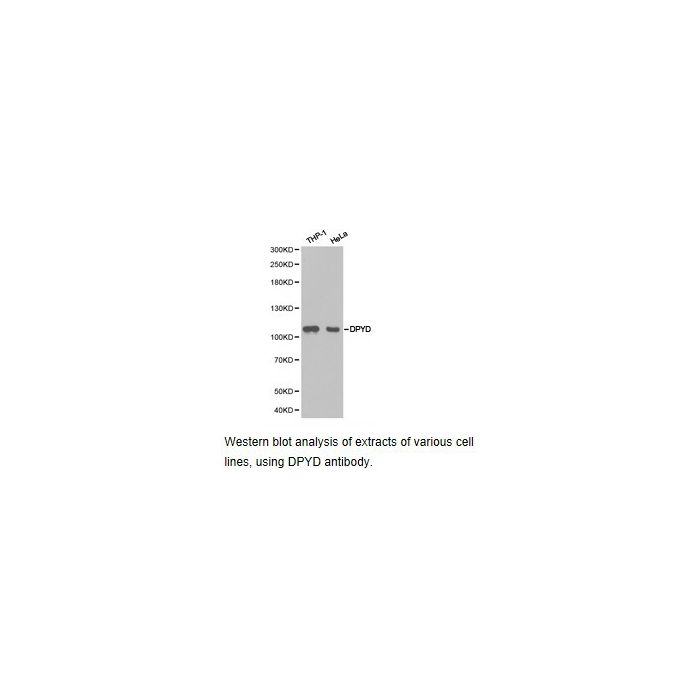
DPYD polyclonal, anti-human, mouse
€388.00
In stock
SKU
BS6847
Background:
Dihydropyrimidine dehydrogenase (DPD, DPYD) catalyzes the initial and rate-limiting step in uracil and thymidine catabolism as well as catabolism of the chemotherapeutic drug 5-fluorouracil (5-FU) and its derivatives. DPYD deficiency, which results from mutations in the DPYD gene, causes errors in pyrimidine metabolism and potentially life-threatening side effects in cancer patients treated with 5-FU (reviewed in 1). As a result, ongoing work examines whether or how DPYD gene variation and protein expression can be used to predict 5-FU toxicity. Several genes that impart resistance to 5-FU were recently identified in human hepatocellular carcinoma (HCC). AEG-1, which is highly expressed in HCC, increases the expression of DPYD. DPYD is expressed more highly in HCC than in normal liver, and this is thought to be one mechanism of 5-FU resistance.
Alternative Name:
Dihydropyrimidine dehydrogenase [NADP(+)], DHPDHase, DPD, Dihydrothymine dehydrogenase, Dihydrouracil dehydrogenase, DPYD
Application Dilution: WB: 1:500 - 1:2000
Specificity: DPYD polyclonal antibody detects endogenous levels of DPYD protein.
Immunogen:
Recombinant full length Human DPYD.
MW: ~ 110 kDa
Swis Prot.: Q12882
Purification & Purity:
The antibody was affinity-purified from rabbit antiserum by affinity-chromatography using epitope-specific immunogen and the purity is > 95% (by SDS-PAGE).
Format:
1 mg/ml in Phosphate buffered saline (PBS) with 0.05% sodium azide, approx. pH 7.2.
Storage:
Store at 4°C short term. Aliquot and store at -20°C long term. Avoid freeze-thaw cycles.
For research use only, not for use in diagnostic procedure.
Dihydropyrimidine dehydrogenase (DPD, DPYD) catalyzes the initial and rate-limiting step in uracil and thymidine catabolism as well as catabolism of the chemotherapeutic drug 5-fluorouracil (5-FU) and its derivatives. DPYD deficiency, which results from mutations in the DPYD gene, causes errors in pyrimidine metabolism and potentially life-threatening side effects in cancer patients treated with 5-FU (reviewed in 1). As a result, ongoing work examines whether or how DPYD gene variation and protein expression can be used to predict 5-FU toxicity. Several genes that impart resistance to 5-FU were recently identified in human hepatocellular carcinoma (HCC). AEG-1, which is highly expressed in HCC, increases the expression of DPYD. DPYD is expressed more highly in HCC than in normal liver, and this is thought to be one mechanism of 5-FU resistance.
Alternative Name:
Dihydropyrimidine dehydrogenase [NADP(+)], DHPDHase, DPD, Dihydrothymine dehydrogenase, Dihydrouracil dehydrogenase, DPYD
Application Dilution: WB: 1:500 - 1:2000
Specificity: DPYD polyclonal antibody detects endogenous levels of DPYD protein.
Immunogen:
Recombinant full length Human DPYD.
MW: ~ 110 kDa
Swis Prot.: Q12882
Purification & Purity:
The antibody was affinity-purified from rabbit antiserum by affinity-chromatography using epitope-specific immunogen and the purity is > 95% (by SDS-PAGE).
Format:
1 mg/ml in Phosphate buffered saline (PBS) with 0.05% sodium azide, approx. pH 7.2.
Storage:
Store at 4°C short term. Aliquot and store at -20°C long term. Avoid freeze-thaw cycles.
For research use only, not for use in diagnostic procedure.
| Is Featured? | No |
|---|
Write Your Own Review