
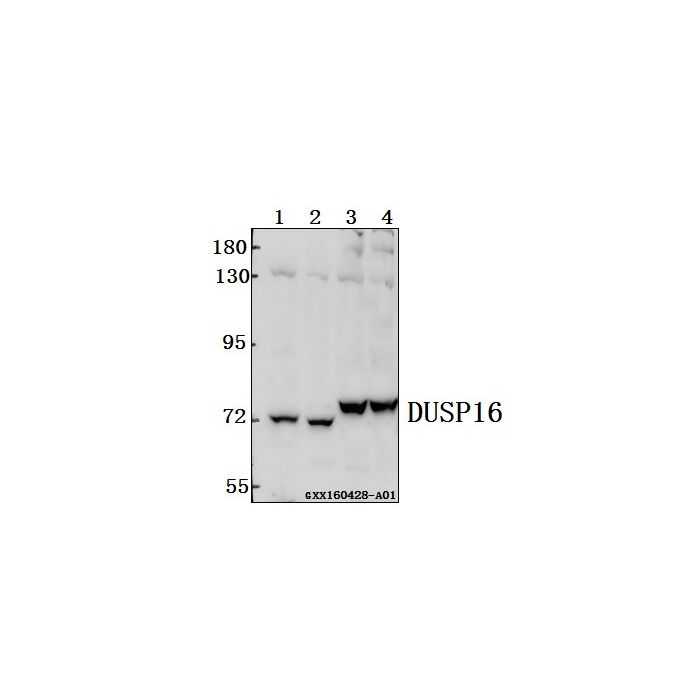
DUSP16 polyclonal, anti-human, mouse, rat
€305.00
In stock
SKU
BS61547
Background:
DUSP16/MKP7 is a negative regulator of the JNK/SAPK family of stress-activated MAP kinases. It inhibits JNK-mediated signaling events by dephosphorylating threonine and tyrosine residues within the activation loop of JNK proteins, effectively preventing further activation of downstream effectors. DUSP16/MKP7 expression has been shown to be upregulated after oxidative stress, presumably as a means of supressing JNK activity in order to return the cells to a homeostatic state. DUSP16 is normally turned over at a high-rate in most cells, but the stability of the protein can be enhanced by Erk1/2-mediated phosphorylation on Ser446, indicating that activation of mitogenic signaling pathways can supress stress-response pathways via stabilization of a JNK phosphatase . Despite demonstrating a substrate preference towards JNK proteins, DUSP16/MKP7 has been shown to interact with other MAPK family members (Erk1/2, p38 MAPKs) as well as scaffolding proteins that may coordinate its activity and specificity.
Alternative Name:
Dual specificity protein phosphatase 16, Mitogen-activated protein kinase phosphatase 7, MAP kinase phosphatase 7, MKP-7
Application Dilution: WB: 1:500~1:1000
Specificity: DUSP16 polyclonal antibody detects endogenous levels of DUSP16 protein.
Immunogen:
Synthetic peptide, corresponding to amino acids 577-621 of Human DUSP16
MW: ~ 73 kDa
Swis Prot.: Q9BY84
Purification & Purity:
The antibody was affinity-purified from rabbit antiserum by affinity-chromatography using epitope-specific immunogen and the purity is > 95% (by SDS-PAGE)
Format:
1 mg/ml in Phosphate buffered saline (PBS) with 0.05% sodium azide, approx. pH 7.3.
Storage:
Store at 4°C short term. Aliquot and store at -20°C long term. Avoid freeze-thaw cycles.
For research use only, not for use in diagnostic procedure.
DUSP16/MKP7 is a negative regulator of the JNK/SAPK family of stress-activated MAP kinases. It inhibits JNK-mediated signaling events by dephosphorylating threonine and tyrosine residues within the activation loop of JNK proteins, effectively preventing further activation of downstream effectors. DUSP16/MKP7 expression has been shown to be upregulated after oxidative stress, presumably as a means of supressing JNK activity in order to return the cells to a homeostatic state. DUSP16 is normally turned over at a high-rate in most cells, but the stability of the protein can be enhanced by Erk1/2-mediated phosphorylation on Ser446, indicating that activation of mitogenic signaling pathways can supress stress-response pathways via stabilization of a JNK phosphatase . Despite demonstrating a substrate preference towards JNK proteins, DUSP16/MKP7 has been shown to interact with other MAPK family members (Erk1/2, p38 MAPKs) as well as scaffolding proteins that may coordinate its activity and specificity.
Alternative Name:
Dual specificity protein phosphatase 16, Mitogen-activated protein kinase phosphatase 7, MAP kinase phosphatase 7, MKP-7
Application Dilution: WB: 1:500~1:1000
Specificity: DUSP16 polyclonal antibody detects endogenous levels of DUSP16 protein.
Immunogen:
Synthetic peptide, corresponding to amino acids 577-621 of Human DUSP16
MW: ~ 73 kDa
Swis Prot.: Q9BY84
Purification & Purity:
The antibody was affinity-purified from rabbit antiserum by affinity-chromatography using epitope-specific immunogen and the purity is > 95% (by SDS-PAGE)
Format:
1 mg/ml in Phosphate buffered saline (PBS) with 0.05% sodium azide, approx. pH 7.3.
Storage:
Store at 4°C short term. Aliquot and store at -20°C long term. Avoid freeze-thaw cycles.
For research use only, not for use in diagnostic procedure.
| Is Featured? | No |
|---|
Write Your Own Review