
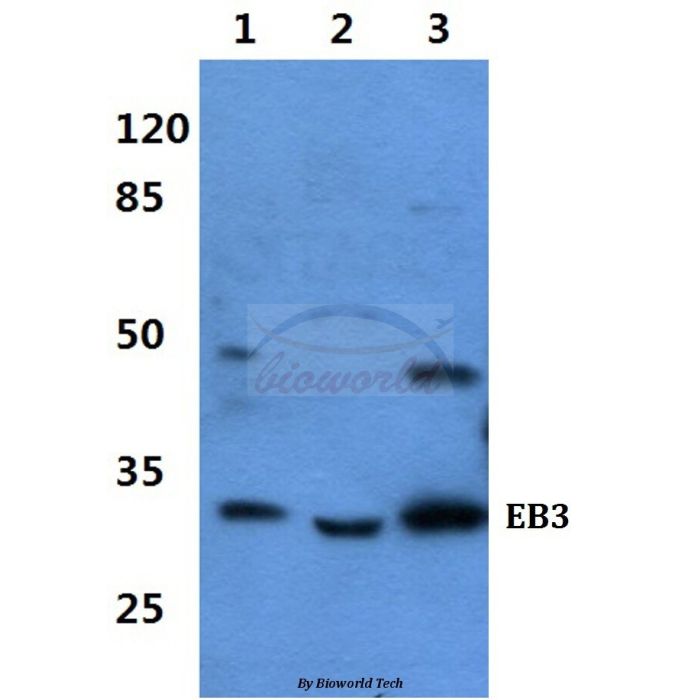
EB3 polyclonal, anti-human, mouse, rat
€305.00
In stock
SKU
BS60423
Background:
EB1 (MAPRE2, microtubule-associated protein, RP/EB family, member 2, EB2, RP1) may influence tumorigenesis of colorectal cancers and proliferative control of normal cells. EB1 may belong to the intermediate/early gene family, involved in the signal transduction cascade downstream of the TCR. Colorectal cancer is caused by the pathologic transformation of normal colonic epithelium to an adenomatous polyp, which can become an invasive cancer. APC (adenomatous polyposis coli) is a tumor suppressor gene, the mutation of which is one of the earliest events in colorectal carcinogenesis. A majority of the mutations result in the loss of the carboxy terminus of APC. EB1 has been shown to bind to the carboxy terminal region of APC, which implicates EB1 in APC suppression of colonic cancer. EB1 overexpression may play a role in the development of human esophageal squamous cell carcinoma (ESCC) by affecting APC function and activating the beta-catenin/TCF pathway. EB3 is related to EB1 and likewise associates with the microtubule cytoskeleton. EB3 is expressed predominantly in the central nervous system and preferentially associates with APCL.
Alternative Name:
Microtubule-associated protein RP/EB family member 3, EB1 protein family member 3, EBF3, End-binding protein 3, EB3, RP3, MAPRE3
Application Dilution: WB: 1:500~1:1000
Specificity: EB3 polyclonal antibody detects endogenous levels of EB3 protein.
Immunogen:
A synthetic peptide corresponding to residues in Human EB3.
MW: ~ 32 kDa
Swis Prot.: Q9UPY8
Purification & Purity:
The antibody was affinity-purified from rabbit antiserum by affinity-chromatography using epitope-specific immunogen and the purity is > 95% (by SDS-PAGE).
Format:
1mg/ml in PBS with 0.1% Sodium Azide, 50% Glycerol.
Storage:
Store at 4°C short term. Aliquot and store at -20°C long term. Avoid freeze-thaw cycles.
For research use only, not for use in diagnostic procedure.
EB1 (MAPRE2, microtubule-associated protein, RP/EB family, member 2, EB2, RP1) may influence tumorigenesis of colorectal cancers and proliferative control of normal cells. EB1 may belong to the intermediate/early gene family, involved in the signal transduction cascade downstream of the TCR. Colorectal cancer is caused by the pathologic transformation of normal colonic epithelium to an adenomatous polyp, which can become an invasive cancer. APC (adenomatous polyposis coli) is a tumor suppressor gene, the mutation of which is one of the earliest events in colorectal carcinogenesis. A majority of the mutations result in the loss of the carboxy terminus of APC. EB1 has been shown to bind to the carboxy terminal region of APC, which implicates EB1 in APC suppression of colonic cancer. EB1 overexpression may play a role in the development of human esophageal squamous cell carcinoma (ESCC) by affecting APC function and activating the beta-catenin/TCF pathway. EB3 is related to EB1 and likewise associates with the microtubule cytoskeleton. EB3 is expressed predominantly in the central nervous system and preferentially associates with APCL.
Alternative Name:
Microtubule-associated protein RP/EB family member 3, EB1 protein family member 3, EBF3, End-binding protein 3, EB3, RP3, MAPRE3
Application Dilution: WB: 1:500~1:1000
Specificity: EB3 polyclonal antibody detects endogenous levels of EB3 protein.
Immunogen:
A synthetic peptide corresponding to residues in Human EB3.
MW: ~ 32 kDa
Swis Prot.: Q9UPY8
Purification & Purity:
The antibody was affinity-purified from rabbit antiserum by affinity-chromatography using epitope-specific immunogen and the purity is > 95% (by SDS-PAGE).
Format:
1mg/ml in PBS with 0.1% Sodium Azide, 50% Glycerol.
Storage:
Store at 4°C short term. Aliquot and store at -20°C long term. Avoid freeze-thaw cycles.
For research use only, not for use in diagnostic procedure.
| Is Featured? | No |
|---|
Write Your Own Review