
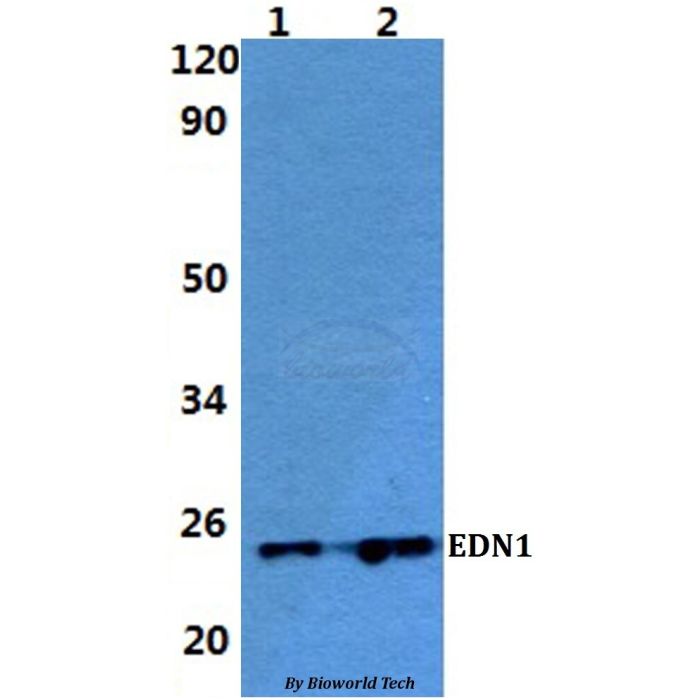
EDN1 polyclonal, anti-human, rat
€305.00
In stock
SKU
BS60842
Background:
The human endothelins represent a gene family comprised of endothelin-1, endothelin-2, and endothelin-3, also known as ET-1, ET-2, and ET-3 . Endothelins can affect the central nervous system and neuronal excitability, and they elicit potent vasoconstrictor action . The two receptor subtypes responsible for inducing vasoconstriction and vasodilation, ETA and ETB, have different receptor affinities for ET-1, ET-2, and ET-3 . Of the three isopeptides, ET-2 has the most potent vasoconstrictor activity . Biologically active ETs are proteolytically generated from a larger precursor, the big-endothelin, by action of the endothelin-converting enzyme (ECE) family. ET-1 is a potent, 21-amino acid vasoconstrictor peptide produced by vascular endothelial cells. The ET-2 cDNA is 1.3 kb in length and encodes a proprotein consisting of 178 amino acid residues. ET3 mRNA encodes a 230-amino acid precursor that includes ET3 and a 15-amino acid homologous segment called the ET3-like sequence.
Alternative Name:
Endothelin-1, Preproendothelin-1, PPET1, Endothelin-1, ET-1, Big endothelin-1, EDN1
Application Dilution: WB: 1:500~1:1000, IHC: 1:50~1:200
Specificity: EDN1 polyclonal antibody detects endogenous levels of EDN1 protein.
Immunogen:
A synthetic peptide corresponding to residues in Human EDN1.
MW: ~ 24 kDa
Swis Prot.: P05305
Purification & Purity:
The antibody was affinity-purified from rabbit antiserum by affinity-chromatography using epitope-specific immunogen and the purity is > 95% (by SDS-PAGE).
Format:
1 mg/ml in Phosphate buffered saline (PBS) with 0.05% sodium azide, approx. pH 7.3.
Storage:
Store at 4°C short term. Aliquot and store at -20°C long term. Avoid freeze-thaw cycles.
For research use only, not for use in diagnostic procedure.
The human endothelins represent a gene family comprised of endothelin-1, endothelin-2, and endothelin-3, also known as ET-1, ET-2, and ET-3 . Endothelins can affect the central nervous system and neuronal excitability, and they elicit potent vasoconstrictor action . The two receptor subtypes responsible for inducing vasoconstriction and vasodilation, ETA and ETB, have different receptor affinities for ET-1, ET-2, and ET-3 . Of the three isopeptides, ET-2 has the most potent vasoconstrictor activity . Biologically active ETs are proteolytically generated from a larger precursor, the big-endothelin, by action of the endothelin-converting enzyme (ECE) family. ET-1 is a potent, 21-amino acid vasoconstrictor peptide produced by vascular endothelial cells. The ET-2 cDNA is 1.3 kb in length and encodes a proprotein consisting of 178 amino acid residues. ET3 mRNA encodes a 230-amino acid precursor that includes ET3 and a 15-amino acid homologous segment called the ET3-like sequence.
Alternative Name:
Endothelin-1, Preproendothelin-1, PPET1, Endothelin-1, ET-1, Big endothelin-1, EDN1
Application Dilution: WB: 1:500~1:1000, IHC: 1:50~1:200
Specificity: EDN1 polyclonal antibody detects endogenous levels of EDN1 protein.
Immunogen:
A synthetic peptide corresponding to residues in Human EDN1.
MW: ~ 24 kDa
Swis Prot.: P05305
Purification & Purity:
The antibody was affinity-purified from rabbit antiserum by affinity-chromatography using epitope-specific immunogen and the purity is > 95% (by SDS-PAGE).
Format:
1 mg/ml in Phosphate buffered saline (PBS) with 0.05% sodium azide, approx. pH 7.3.
Storage:
Store at 4°C short term. Aliquot and store at -20°C long term. Avoid freeze-thaw cycles.
For research use only, not for use in diagnostic procedure.
| Is Featured? | No |
|---|
Write Your Own Review