
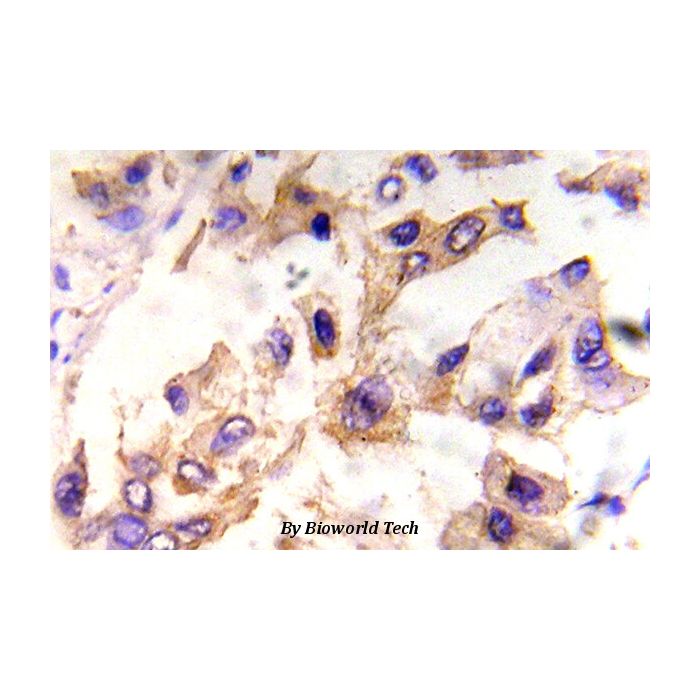
eIF4E (phospho-S209) polyclonal, anti-human, mouse, rat
€328.00
In stock
SKU
BS5015
Background:
eIF4E, a protein modulates translation of maternal mRNAs in early embryos before the onset of zygotic transcription. eIF4E also influences the overall rate of translation. eIF4E binds to the 7 methyl GTP cap structure of eukaryotic mRNAs. Phosphorylation of eIF4E on serine 209 regulates the affinity of this protein for the 7 methyl GTP cap and/or RNA. Phosphorylation also enhances the interaction of eIF4E with eIF4G, which form a complex known as eIF4F. eIF4E phosphorylation is correlated with increased translational rate in a number of cell types. Several kinases are currently being investigated as potential regulators of eIF4E including PKC and/or the MAP kinase activated Mnk.
Alternative Name:
eIF4E ( phospho S209 ), eIF-4E, eIF4E, mRNA cap-binding protein, eIF-4F 25 kDa subunit, EIF4E, 1977, EIF4E, 133440, P06730, CBP, EIF4EL1, EIF4F, MGC111573,
Application Dilution: IHC: 1:50~1:200
Specificity: p-eIF4E (S209) polyclonal antibody detects endogenous levels of eIF4E protein only when phosphorylated at Ser209.
Immunogen:
Synthetic phosphopeptide derived from human eIF4E around the phosphorylation site of Serine 209.
MW: ~ 25 kDa
Swis Prot.: P06730
Purification & Purity:
The antibody was affinity-purified from rabbit antiserum by affinity-chromatography using epitope-specific immunogen and the purity is > 95% (by SDS-PAGE).
Format:
1 mg/ml in Phosphate buffered saline (PBS) with 0.05% sodium azide, approx. pH 7.2.
Storage:
Store at 4°C short term. Aliquot and store at -20°C long term. Avoid freeze-thaw cycles.
For research use only, not for use in diagnostic procedure.
eIF4E, a protein modulates translation of maternal mRNAs in early embryos before the onset of zygotic transcription. eIF4E also influences the overall rate of translation. eIF4E binds to the 7 methyl GTP cap structure of eukaryotic mRNAs. Phosphorylation of eIF4E on serine 209 regulates the affinity of this protein for the 7 methyl GTP cap and/or RNA. Phosphorylation also enhances the interaction of eIF4E with eIF4G, which form a complex known as eIF4F. eIF4E phosphorylation is correlated with increased translational rate in a number of cell types. Several kinases are currently being investigated as potential regulators of eIF4E including PKC and/or the MAP kinase activated Mnk.
Alternative Name:
eIF4E ( phospho S209 ), eIF-4E, eIF4E, mRNA cap-binding protein, eIF-4F 25 kDa subunit, EIF4E, 1977, EIF4E, 133440, P06730, CBP, EIF4EL1, EIF4F, MGC111573,
Application Dilution: IHC: 1:50~1:200
Specificity: p-eIF4E (S209) polyclonal antibody detects endogenous levels of eIF4E protein only when phosphorylated at Ser209.
Immunogen:
Synthetic phosphopeptide derived from human eIF4E around the phosphorylation site of Serine 209.
MW: ~ 25 kDa
Swis Prot.: P06730
Purification & Purity:
The antibody was affinity-purified from rabbit antiserum by affinity-chromatography using epitope-specific immunogen and the purity is > 95% (by SDS-PAGE).
Format:
1 mg/ml in Phosphate buffered saline (PBS) with 0.05% sodium azide, approx. pH 7.2.
Storage:
Store at 4°C short term. Aliquot and store at -20°C long term. Avoid freeze-thaw cycles.
For research use only, not for use in diagnostic procedure.
| Is Featured? | No |
|---|
Write Your Own Review