
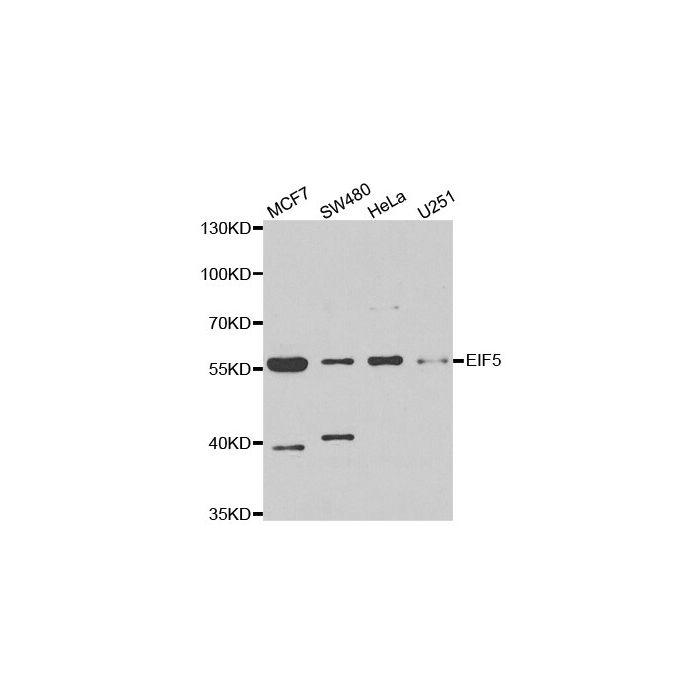
EIF5 polyclonal, anti-human, mouse, rat
€388.00
In stock
SKU
BS8267
Background:
In mammalian cells, translation is controlled at the level of polypeptide chain initiation by initiation factors. The eukaryotic translation initiation factor 5 (eIF5) catalyzes the hydrolysis of GTP bound to the 40S ribosomal subunit, a function necessary for the subsequent joining of the 40S and 60S subunits to form the 80S initiation complex. eIF-4E specifically binds to the mRNA cap to promote unwinding and exposure of the AUG-initiation codon. Overexpression of eIF-4E can lead to cell transformation and tumorigenesis. An additional initiation factor, eIF-2, is present as a heterotrimer composed of eIF-2a, eIF-2b and eIF-2g subunits. This heterotrimer forms a complex with GTP and tRNA which then binds to the 40S ribosomal subunit. After the formation of the 80S initiation complex, eIF-2 is hydrolyzed and eIF-2-GDP is released from the complex. eIF-2-GDP is subsequently converted to eIF-2-GTP, a reaction catalyzed by eIF-2B, and is then available to catalyze another round of initiation.
Alternative Name:
Eukaryotic translation initiation factor 5, eIF-5, EIF5
Application Dilution: WB: 1:500~1:2000, IF: 1:50~1:200
Specificity: EIF5 polyclonal antibody detects endogenous levels of EIF5 protein.
Immunogen:
Recombinant full length Human EIF5.
MW: ~ 49 kDa
Swis Prot.: P55010
Purification & Purity:
The antibody was affinity-purified from rabbit antiserum by affinity-chromatography using epitope-specific immunogen and the purity is > 95% (by SDS-PAGE).
Format:
1mg/ml in PBS with 0.1% Sodium Azide, 50% Glycerol.
Storage:
Store at 4°C short term. Aliquot and store at -20°C long term. Avoid freeze-thaw cycles.
For research use only, not for use in diagnostic procedure.
In mammalian cells, translation is controlled at the level of polypeptide chain initiation by initiation factors. The eukaryotic translation initiation factor 5 (eIF5) catalyzes the hydrolysis of GTP bound to the 40S ribosomal subunit, a function necessary for the subsequent joining of the 40S and 60S subunits to form the 80S initiation complex. eIF-4E specifically binds to the mRNA cap to promote unwinding and exposure of the AUG-initiation codon. Overexpression of eIF-4E can lead to cell transformation and tumorigenesis. An additional initiation factor, eIF-2, is present as a heterotrimer composed of eIF-2a, eIF-2b and eIF-2g subunits. This heterotrimer forms a complex with GTP and tRNA which then binds to the 40S ribosomal subunit. After the formation of the 80S initiation complex, eIF-2 is hydrolyzed and eIF-2-GDP is released from the complex. eIF-2-GDP is subsequently converted to eIF-2-GTP, a reaction catalyzed by eIF-2B, and is then available to catalyze another round of initiation.
Alternative Name:
Eukaryotic translation initiation factor 5, eIF-5, EIF5
Application Dilution: WB: 1:500~1:2000, IF: 1:50~1:200
Specificity: EIF5 polyclonal antibody detects endogenous levels of EIF5 protein.
Immunogen:
Recombinant full length Human EIF5.
MW: ~ 49 kDa
Swis Prot.: P55010
Purification & Purity:
The antibody was affinity-purified from rabbit antiserum by affinity-chromatography using epitope-specific immunogen and the purity is > 95% (by SDS-PAGE).
Format:
1mg/ml in PBS with 0.1% Sodium Azide, 50% Glycerol.
Storage:
Store at 4°C short term. Aliquot and store at -20°C long term. Avoid freeze-thaw cycles.
For research use only, not for use in diagnostic procedure.
| Is Featured? | No |
|---|
Write Your Own Review