
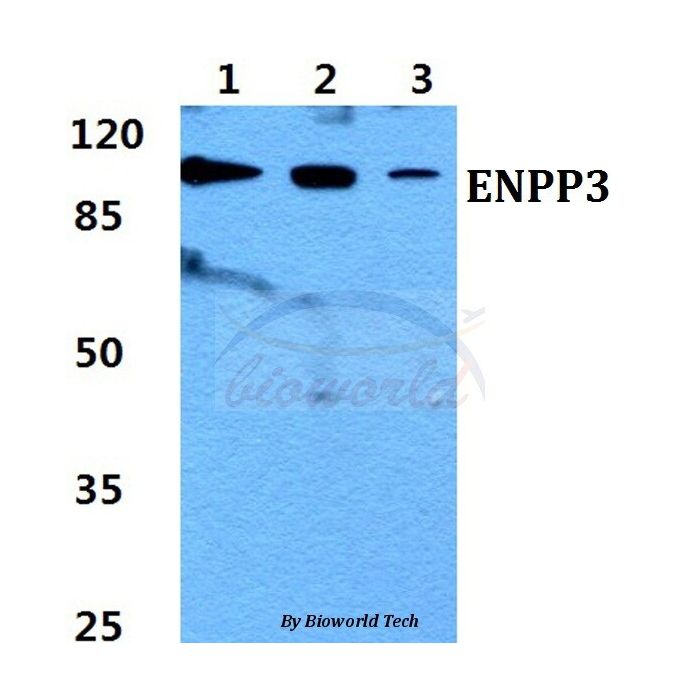
CD203c (ENPP3) polyclonal, anti-human, mouse, rat
€305.00
In stock
SKU
BS60438
Background:
Ecto-nucleotide pyrophosphatase/phospho-diesterase-I enzymes (E-NPP), a group of type II transmembrane proteins, cleave phosphodiester and phosphosulfate bonds in deoxynucleotides, NAD, and nucleotide sugars. There exist three closely related proteins in mammalian species: E-NPP1 (PC-1), E-NPP2 (PDNP2), and E-NPP-3, also known as CD203c, each expressed in different cells or at different locations in the same cells. Basophils, a type of major proinflammatory effector cells involved in diverse pathologic reactions, exhibit CD203c expression. For instance, CD203c expression increases in response to a variety of allergens, including cat dander, latex, and bee and wasp venom. Hovever, these allergies are not the only condition associated with CD203c upregulation; CD203c upregulation may also serve as a tumor marker for colon carcinoma.
Alternative Name:
Ectonucleotide pyrophosphatase/phosphodiesterase family member 3, E-NPP 3, ENPP 3, ENPP-3, E-NPP3, Phosphodiesterase I beta, PD-Ibeta, Phosphodiesterase I/nucleotide pyrophosphatase 3, CD203c, Alkaline phosphodiesterase I, Nucleotide pyrophosphatase, NPPase, PDNP3
Application Dilution: WB: 1:500~1:1000
Specificity: ENPP3 polyclonal antibody detects endogenous levels of ENPP3 protein.
Immunogen:
A synthetic peptide corresponding to residues in Human ENPP3.
MW: ~ 100 kDa
Swis Prot.: O14638
Purification & Purity:
The antibody was affinity-purified from rabbit antiserum by affinity-chromatography using epitope-specific immunogen and the purity is > 95% (by SDS-PAGE).
Format:
1mg/ml in PBS with 0.1% Sodium Azide, 50% Glycerol.
Storage:
Store at 4°C short term. Aliquot and store at -20°C long term. Avoid freeze-thaw cycles.
For research use only, not for use in diagnostic procedure.
Ecto-nucleotide pyrophosphatase/phospho-diesterase-I enzymes (E-NPP), a group of type II transmembrane proteins, cleave phosphodiester and phosphosulfate bonds in deoxynucleotides, NAD, and nucleotide sugars. There exist three closely related proteins in mammalian species: E-NPP1 (PC-1), E-NPP2 (PDNP2), and E-NPP-3, also known as CD203c, each expressed in different cells or at different locations in the same cells. Basophils, a type of major proinflammatory effector cells involved in diverse pathologic reactions, exhibit CD203c expression. For instance, CD203c expression increases in response to a variety of allergens, including cat dander, latex, and bee and wasp venom. Hovever, these allergies are not the only condition associated with CD203c upregulation; CD203c upregulation may also serve as a tumor marker for colon carcinoma.
Alternative Name:
Ectonucleotide pyrophosphatase/phosphodiesterase family member 3, E-NPP 3, ENPP 3, ENPP-3, E-NPP3, Phosphodiesterase I beta, PD-Ibeta, Phosphodiesterase I/nucleotide pyrophosphatase 3, CD203c, Alkaline phosphodiesterase I, Nucleotide pyrophosphatase, NPPase, PDNP3
Application Dilution: WB: 1:500~1:1000
Specificity: ENPP3 polyclonal antibody detects endogenous levels of ENPP3 protein.
Immunogen:
A synthetic peptide corresponding to residues in Human ENPP3.
MW: ~ 100 kDa
Swis Prot.: O14638
Purification & Purity:
The antibody was affinity-purified from rabbit antiserum by affinity-chromatography using epitope-specific immunogen and the purity is > 95% (by SDS-PAGE).
Format:
1mg/ml in PBS with 0.1% Sodium Azide, 50% Glycerol.
Storage:
Store at 4°C short term. Aliquot and store at -20°C long term. Avoid freeze-thaw cycles.
For research use only, not for use in diagnostic procedure.
| Is Featured? | No |
|---|
Write Your Own Review