
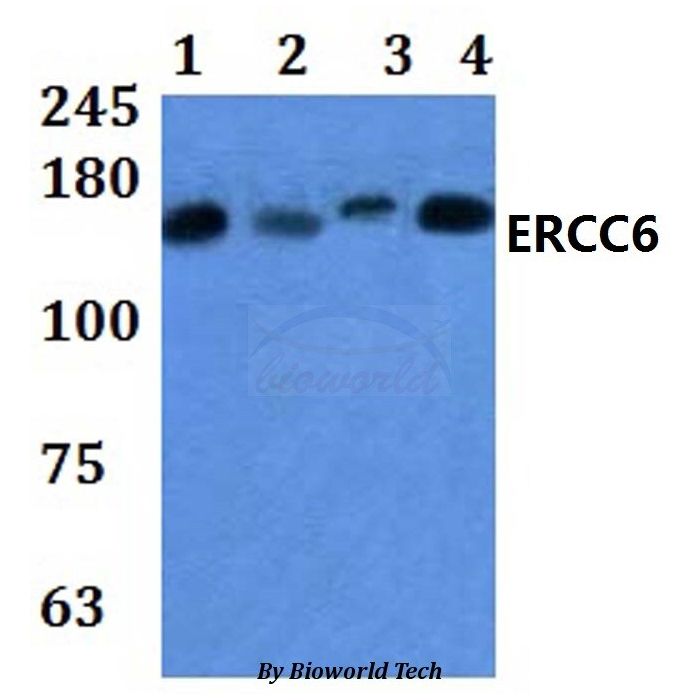
ERCC6 polyclonal, anti-human, mouse, rat
€305.00
In stock
SKU
BS61035
Background:
Nucleotide excision repair of DNA lesions occurs more rapidly and at a higher frequency on the template, or the transcribed, strand of DNA and to a much lesser extent on the coding, or the non-transcribed, strand or on transcriptionally inactive DNA. CSA and CSB are two related genes that are responsible for directing this preferential DNA repair pattern, known as transcriptional-repair coupling. Cells from patients with the UV-sensitive nucleotide excision repair disorder Cockayne's syndrome (CS) have specific mutations affecting these genes and results in defects of the preferential repair on the transcribed strand of activated genes. CSA is a protein that belongs in the "WD-repeat" family of proteins. CSB, which is also designated excision repair cross-complementing protein-6 (ERCC-6), is the homolog of the yeast Rad26 protein. CSB belongs in the SWI/SNF family of proteins as it contains helicase motifs and ATPase activity.
Alternative Name:
DNA excision repair protein ERCC-6 (EC:3.6.4.-), ATP-dependent helicase ERCC6, Cockayne syndrome protein CSB, ERCC6, CSB
Application Dilution: WB: 1:500~1:1000
Specificity: ERCC6 polyclonal antibody detects endogenous levels of ERCC6 protein.
Immunogen:
A synthetic peptide corresponding to residues in Human ERCC6.
MW: ~ 168 kDa
Swis Prot.: Q03468
Purification & Purity:
The antibody was affinity-purified from rabbit antiserum by affinity-chromatography using epitope-specific immunogen and the purity is > 95% (by SDS-PAGE).
Format:
1 mg/ml in Phosphate buffered saline (PBS) with 0.05% sodium azide, approx. pH 7.3.
Storage:
Store at 4°C short term. Aliquot and store at -20°C long term. Avoid freeze-thaw cycles.
For research use only, not for use in diagnostic procedure.
Nucleotide excision repair of DNA lesions occurs more rapidly and at a higher frequency on the template, or the transcribed, strand of DNA and to a much lesser extent on the coding, or the non-transcribed, strand or on transcriptionally inactive DNA. CSA and CSB are two related genes that are responsible for directing this preferential DNA repair pattern, known as transcriptional-repair coupling. Cells from patients with the UV-sensitive nucleotide excision repair disorder Cockayne's syndrome (CS) have specific mutations affecting these genes and results in defects of the preferential repair on the transcribed strand of activated genes. CSA is a protein that belongs in the "WD-repeat" family of proteins. CSB, which is also designated excision repair cross-complementing protein-6 (ERCC-6), is the homolog of the yeast Rad26 protein. CSB belongs in the SWI/SNF family of proteins as it contains helicase motifs and ATPase activity.
Alternative Name:
DNA excision repair protein ERCC-6 (EC:3.6.4.-), ATP-dependent helicase ERCC6, Cockayne syndrome protein CSB, ERCC6, CSB
Application Dilution: WB: 1:500~1:1000
Specificity: ERCC6 polyclonal antibody detects endogenous levels of ERCC6 protein.
Immunogen:
A synthetic peptide corresponding to residues in Human ERCC6.
MW: ~ 168 kDa
Swis Prot.: Q03468
Purification & Purity:
The antibody was affinity-purified from rabbit antiserum by affinity-chromatography using epitope-specific immunogen and the purity is > 95% (by SDS-PAGE).
Format:
1 mg/ml in Phosphate buffered saline (PBS) with 0.05% sodium azide, approx. pH 7.3.
Storage:
Store at 4°C short term. Aliquot and store at -20°C long term. Avoid freeze-thaw cycles.
For research use only, not for use in diagnostic procedure.
| Is Featured? | No |
|---|
Write Your Own Review