
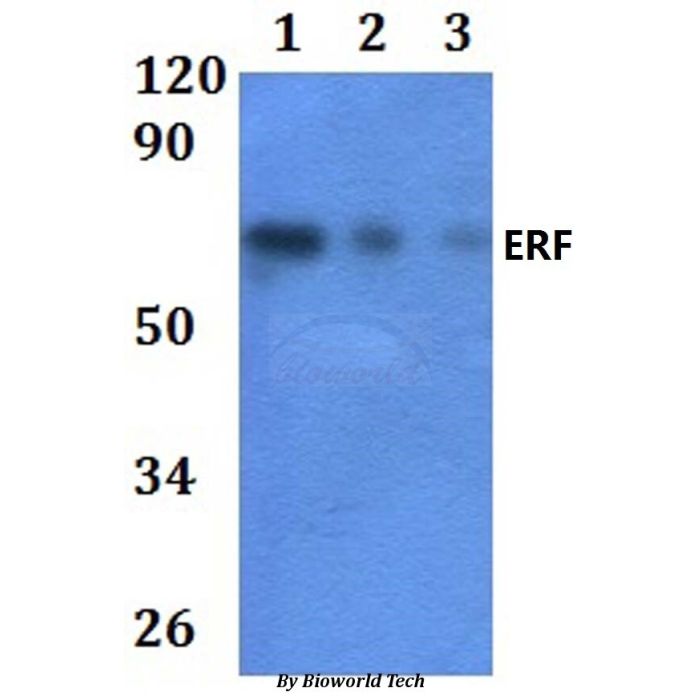
ERF polyclonal, anti-human, mouse, rat
€305.00
In stock
SKU
BS61028
Background:
Translation is carried out by the ribosome and several associated protein factors through three consecutive steps: initiation, elongation and termination. Termination of protein synthesis takes place when the ribosomal A site is occupied simultaneously by one of three stop codons and by a class 1 translation termination factor. In eukaryotes, this termination factor is the eukaryotic release factor 1 (eRF1), a protein that promotes hydrolysis of the last peptidyl-tRNA on the ribosome. eRF1 activity is stimulated by the association with the GTP-binding protein eRF3. eRF1 forms a quaternary complex with eRF3, GTP and the ribosome. Subunits of eRF3 are eRF3b and eRF3a, which belong to the GTP-binding elongation factor family and are involved in the regulation of cell growth, specifically via control of translation termination.
Alternative Name:
ETS domain-containing transcription factor ERF, Ets2 repressor factor, PE-2, ERF
Application Dilution: WB: 1:500~1:1000
Specificity: ERF polyclonal antibody detects endogenous levels of ERF protein.
Immunogen:
A synthetic peptide corresponding to residues in Human ERF.
MW: ~ 60 kDa
Swis Prot.: P50548
Purification & Purity:
The antibody was affinity-purified from rabbit antiserum by affinity-chromatography using epitope-specific immunogen and the purity is > 95% (by SDS-PAGE).
Format:
1 mg/ml in Phosphate buffered saline (PBS) with 0.05% sodium azide, approx. pH 7.3.
Storage:
Store at 4°C short term. Aliquot and store at -20°C long term. Avoid freeze-thaw cycles.
For research use only, not for use in diagnostic procedure.
Translation is carried out by the ribosome and several associated protein factors through three consecutive steps: initiation, elongation and termination. Termination of protein synthesis takes place when the ribosomal A site is occupied simultaneously by one of three stop codons and by a class 1 translation termination factor. In eukaryotes, this termination factor is the eukaryotic release factor 1 (eRF1), a protein that promotes hydrolysis of the last peptidyl-tRNA on the ribosome. eRF1 activity is stimulated by the association with the GTP-binding protein eRF3. eRF1 forms a quaternary complex with eRF3, GTP and the ribosome. Subunits of eRF3 are eRF3b and eRF3a, which belong to the GTP-binding elongation factor family and are involved in the regulation of cell growth, specifically via control of translation termination.
Alternative Name:
ETS domain-containing transcription factor ERF, Ets2 repressor factor, PE-2, ERF
Application Dilution: WB: 1:500~1:1000
Specificity: ERF polyclonal antibody detects endogenous levels of ERF protein.
Immunogen:
A synthetic peptide corresponding to residues in Human ERF.
MW: ~ 60 kDa
Swis Prot.: P50548
Purification & Purity:
The antibody was affinity-purified from rabbit antiserum by affinity-chromatography using epitope-specific immunogen and the purity is > 95% (by SDS-PAGE).
Format:
1 mg/ml in Phosphate buffered saline (PBS) with 0.05% sodium azide, approx. pH 7.3.
Storage:
Store at 4°C short term. Aliquot and store at -20°C long term. Avoid freeze-thaw cycles.
For research use only, not for use in diagnostic procedure.
| Is Featured? | No |
|---|
Write Your Own Review