
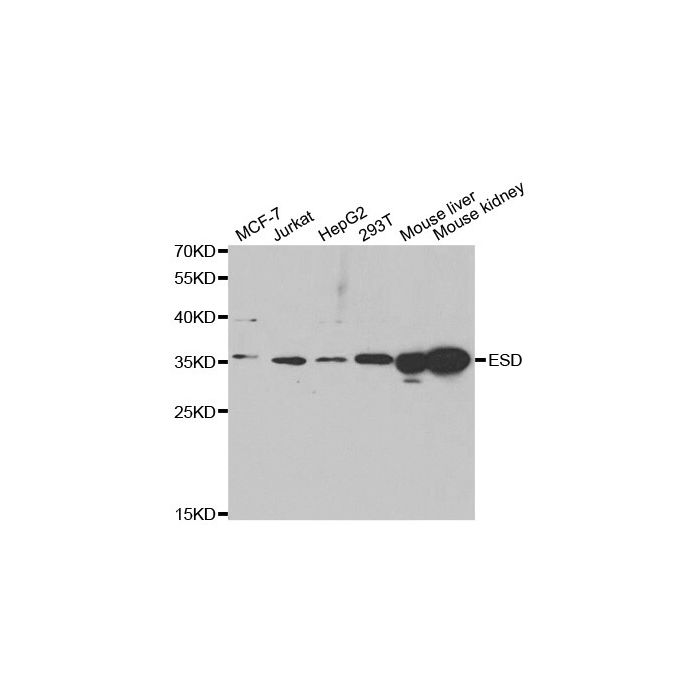
ESD polyclonal, anti-human, mouse
€388.00
In stock
SKU
BS7975
Background:
ESD (esterase D) is also known as S-formylglutathione hydrolase and is a 282 amino acid protein that is a member of the esterase D family. ESD is highly expressed in placenta, kidney, liver and erythrocytes, and is localized to the cytoplasm, as well as to cytoplasmic vesicles. The main function of ESD is to detoxify formaldehyde while providing energy. Formaldehyde is oxidized by ADH5 which yields S-formylglutathione. ESD then catalyzes the hydrolysis of S-formylglutathione to the reduced forms of formic acid and glutathione. In addition, ESD hydrolyzes a variety of different neutral ester substrates and can act as a carboxylesterase. ESD may also act as a cysteine hydrolase which is inactivated by thiol alkylating agents. ESD gene polymorphism can lead to reduced enzymatic activity which may cause susceptibility to many conditions, including toxic liver cirrhosis, retinoblastoma, obesity and autism.
Alternative Name:
Es-10, Es10, ESD, ESTD_HUMAN, Esterase 10, Esterase D, Esterase D formylglutathione hydrolase, FGH, FGH, included, FLJ11763, Methylumbelliferyl acetate deacetylase, MGC139609, S formylglutathione hydrolase, S-formylglutathione hydrolase, S-formylglutathione hydrolase, included, Sid 478, sid478,
Application Dilution: WB: 1:500~1:2000, IHC: 1:50~1:200
Specificity: ESD polyclonal antibody detects endogenous levels of ESD protein.
Immunogen:
Recombinant full length Human ESD.
MW: ~ 31 kDa
Swis Prot.: P10768
Purification & Purity:
The antibody was affinity-purified from rabbit antiserum by affinity-chromatography using epitope-specific immunogen and the purity is > 95% (by SDS-PAGE).
Format:
1mg/ml in PBS with 0.1% Sodium Azide, 50% Glycerol.
Storage:
Store at 4°C short term. Aliquot and store at -20°C long term. Avoid freeze-thaw cycles.
For research use only, not for use in diagnostic procedure.
ESD (esterase D) is also known as S-formylglutathione hydrolase and is a 282 amino acid protein that is a member of the esterase D family. ESD is highly expressed in placenta, kidney, liver and erythrocytes, and is localized to the cytoplasm, as well as to cytoplasmic vesicles. The main function of ESD is to detoxify formaldehyde while providing energy. Formaldehyde is oxidized by ADH5 which yields S-formylglutathione. ESD then catalyzes the hydrolysis of S-formylglutathione to the reduced forms of formic acid and glutathione. In addition, ESD hydrolyzes a variety of different neutral ester substrates and can act as a carboxylesterase. ESD may also act as a cysteine hydrolase which is inactivated by thiol alkylating agents. ESD gene polymorphism can lead to reduced enzymatic activity which may cause susceptibility to many conditions, including toxic liver cirrhosis, retinoblastoma, obesity and autism.
Alternative Name:
Es-10, Es10, ESD, ESTD_HUMAN, Esterase 10, Esterase D, Esterase D formylglutathione hydrolase, FGH, FGH, included, FLJ11763, Methylumbelliferyl acetate deacetylase, MGC139609, S formylglutathione hydrolase, S-formylglutathione hydrolase, S-formylglutathione hydrolase, included, Sid 478, sid478,
Application Dilution: WB: 1:500~1:2000, IHC: 1:50~1:200
Specificity: ESD polyclonal antibody detects endogenous levels of ESD protein.
Immunogen:
Recombinant full length Human ESD.
MW: ~ 31 kDa
Swis Prot.: P10768
Purification & Purity:
The antibody was affinity-purified from rabbit antiserum by affinity-chromatography using epitope-specific immunogen and the purity is > 95% (by SDS-PAGE).
Format:
1mg/ml in PBS with 0.1% Sodium Azide, 50% Glycerol.
Storage:
Store at 4°C short term. Aliquot and store at -20°C long term. Avoid freeze-thaw cycles.
For research use only, not for use in diagnostic procedure.
| Is Featured? | No |
|---|
Write Your Own Review