
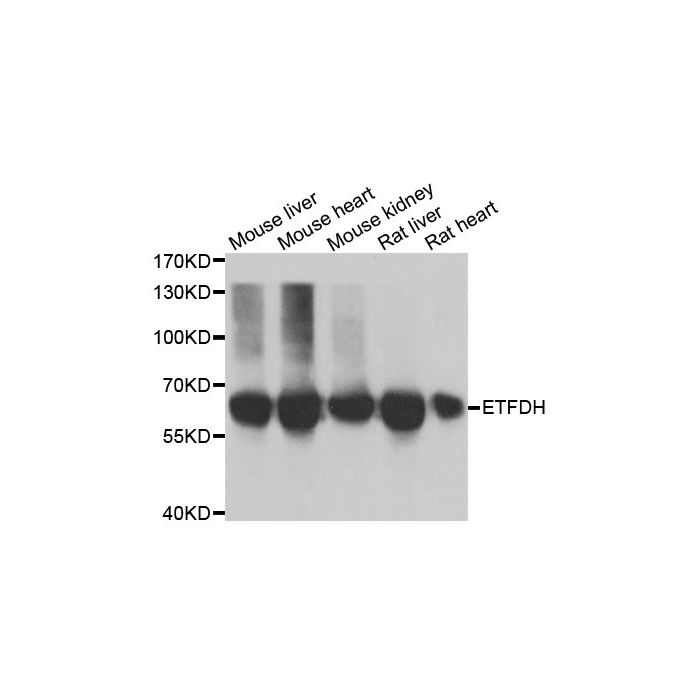
ETFDH polyclonal, anti-human, mouse, rat
€388.00
In stock
SKU
BS8269
Background:
ETFDH (electron-transferring-flavoprotein dehydrogenase), also known as electron transfer flavoprotein-ubiquinone oxidoreductase, MADD or ETFQO, is a 617 amino acid membrane-bound electron transfer protein that exists as a monomer, localizes to the mitochondrial inner membrane and belongs to the ETF-QO/fixC family. ETFDH accepts electrons from electron-transfer flavoprotein (ETF) in the mitochondrial matrix while reducing ubiquinone in the mitochondrial membrane. ETFDH is encoded by a gene mapping to human chromosome 4q32.1, and contains one molecule of FAD and a 4Fe-4S cluster. As a result of alternative splicing events, two ETFDH isoforms exist. Defects in ETFDH are responsible for an autosomal recessive disorder of amino acid, fatty acid and choline metabolism known as glutaric aciduria type 2C (GA2C) or multiple acyl-CoA dehydrogenation deficiency (MADD). GA2C is characterized by severe hypoketotic hypoglycemia and acidosis.
Alternative Name:
Electron transfer flavoprotein-ubiquinone oxidoreductase, mitochondrial, ETF-QO, ETF-ubiquinone oxidoreductase, Electron-transferring-flavoprotein dehydrogenase, ETF dehydrogenase, ETFDH
Application Dilution: WB: 1:500 - 1:2000
Specificity: ETFDH polyclonal antibody detects endogenous levels of ETFDH protein.
Immunogen:
Recombinant full length Human ETFDH.
MW: ~ 68 kDa
Swis Prot.: Q16134
Purification & Purity:
The antibody was affinity-purified from rabbit antiserum by affinity-chromatography using epitope-specific immunogen and the purity is > 95% (by SDS-PAGE).
Format:
1mg/ml in PBS with 0.1% Sodium Azide, 50% Glycerol.
Storage:
Store at 4°C short term. Aliquot and store at -20°C long term. Avoid freeze-thaw cycles.
For research use only, not for use in diagnostic procedure.
ETFDH (electron-transferring-flavoprotein dehydrogenase), also known as electron transfer flavoprotein-ubiquinone oxidoreductase, MADD or ETFQO, is a 617 amino acid membrane-bound electron transfer protein that exists as a monomer, localizes to the mitochondrial inner membrane and belongs to the ETF-QO/fixC family. ETFDH accepts electrons from electron-transfer flavoprotein (ETF) in the mitochondrial matrix while reducing ubiquinone in the mitochondrial membrane. ETFDH is encoded by a gene mapping to human chromosome 4q32.1, and contains one molecule of FAD and a 4Fe-4S cluster. As a result of alternative splicing events, two ETFDH isoforms exist. Defects in ETFDH are responsible for an autosomal recessive disorder of amino acid, fatty acid and choline metabolism known as glutaric aciduria type 2C (GA2C) or multiple acyl-CoA dehydrogenation deficiency (MADD). GA2C is characterized by severe hypoketotic hypoglycemia and acidosis.
Alternative Name:
Electron transfer flavoprotein-ubiquinone oxidoreductase, mitochondrial, ETF-QO, ETF-ubiquinone oxidoreductase, Electron-transferring-flavoprotein dehydrogenase, ETF dehydrogenase, ETFDH
Application Dilution: WB: 1:500 - 1:2000
Specificity: ETFDH polyclonal antibody detects endogenous levels of ETFDH protein.
Immunogen:
Recombinant full length Human ETFDH.
MW: ~ 68 kDa
Swis Prot.: Q16134
Purification & Purity:
The antibody was affinity-purified from rabbit antiserum by affinity-chromatography using epitope-specific immunogen and the purity is > 95% (by SDS-PAGE).
Format:
1mg/ml in PBS with 0.1% Sodium Azide, 50% Glycerol.
Storage:
Store at 4°C short term. Aliquot and store at -20°C long term. Avoid freeze-thaw cycles.
For research use only, not for use in diagnostic procedure.
| Is Featured? | No |
|---|
Write Your Own Review