
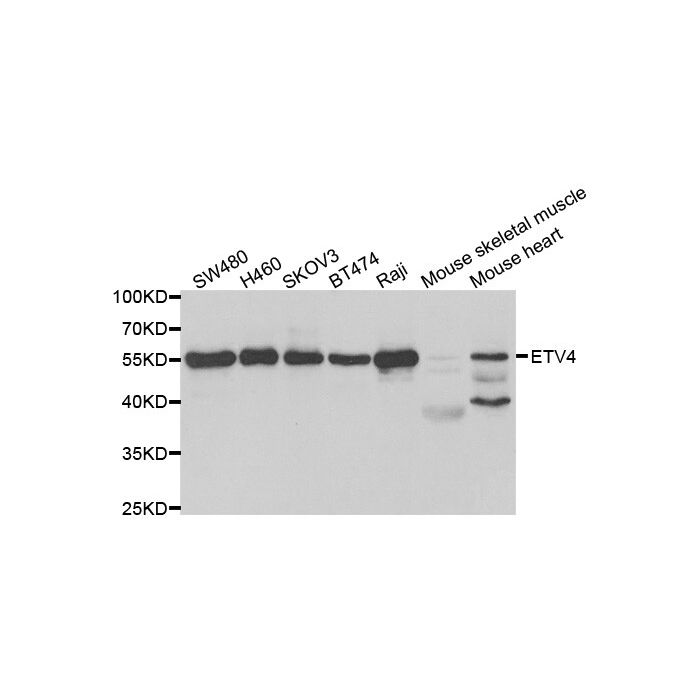
ETV4 polyclonal, anti-human, mouse
€388.00
In stock
SKU
BS7864
Background:
Several members of the Ets gene family are known to encode sequence-specific DNA binding proteins. These include mouse PU.1, mouse and human Ets-1, Drosophila E74, chicken and human Ets-2 and rat GABP-a. Each of these proteins recognizes similar motifs in DNA that share a centrally located 5'-GGAA-3' element. For instance, PEA3 binds the motif 5'-AGGAAG-3' (the PEA-3 motif), but does not bind to the sequence 5'-AGGAAC-3', recognized by PU.1, although PU.1 binds equally well to both sequences. It appears that all of the Ets proteins recognize the same central core sequence but that each protein interacts with unique sequences that flank this core. PEA3 is expressed at readily detectable levels in cells of epithelial and fibroblastic origin but is not expressed in hematopoietic cells. This is in contrast to other members of the Ets gene family, such as Ets-1, Ets-2 and Fli-1, each of which is expressed primarily in cells of hematopoietic origin.
Alternative Name:
Adenovirus E1A enhancer binding protein, Adenovirus E1A enhancer-binding protein, E1A F, E1A-F, ETS translocation variant 4, ets variant gene 4 (E1A enhancer binding protein E1AF), ETV4, ETV4_HUMAN, PEA3, PEA3 protein, PEAS3, Polyomavirus enhancer activator 3, Polyomavirus enhancer activator 3 homolog, Protein PEA3,
Application Dilution: WB: 1:500~1:2000, IF: 1:50~1:200
Specificity: ETV4 polyclonal antibody detects endogenous levels of ETV4 protein.
Immunogen:
Recombinant full length Human ETV4.
MW: ~ 54 kDa
Swis Prot.: P43268
Purification & Purity:
The antibody was affinity-purified from rabbit antiserum by affinity-chromatography using epitope-specific immunogen and the purity is > 95% (by SDS-PAGE).
Format:
1mg/ml in PBS with 0.1% Sodium Azide, 50% Glycerol.
Storage:
Store at 4°C short term. Aliquot and store at -20°C long term. Avoid freeze-thaw cycles.
For research use only, not for use in diagnostic procedure.
Several members of the Ets gene family are known to encode sequence-specific DNA binding proteins. These include mouse PU.1, mouse and human Ets-1, Drosophila E74, chicken and human Ets-2 and rat GABP-a. Each of these proteins recognizes similar motifs in DNA that share a centrally located 5'-GGAA-3' element. For instance, PEA3 binds the motif 5'-AGGAAG-3' (the PEA-3 motif), but does not bind to the sequence 5'-AGGAAC-3', recognized by PU.1, although PU.1 binds equally well to both sequences. It appears that all of the Ets proteins recognize the same central core sequence but that each protein interacts with unique sequences that flank this core. PEA3 is expressed at readily detectable levels in cells of epithelial and fibroblastic origin but is not expressed in hematopoietic cells. This is in contrast to other members of the Ets gene family, such as Ets-1, Ets-2 and Fli-1, each of which is expressed primarily in cells of hematopoietic origin.
Alternative Name:
Adenovirus E1A enhancer binding protein, Adenovirus E1A enhancer-binding protein, E1A F, E1A-F, ETS translocation variant 4, ets variant gene 4 (E1A enhancer binding protein E1AF), ETV4, ETV4_HUMAN, PEA3, PEA3 protein, PEAS3, Polyomavirus enhancer activator 3, Polyomavirus enhancer activator 3 homolog, Protein PEA3,
Application Dilution: WB: 1:500~1:2000, IF: 1:50~1:200
Specificity: ETV4 polyclonal antibody detects endogenous levels of ETV4 protein.
Immunogen:
Recombinant full length Human ETV4.
MW: ~ 54 kDa
Swis Prot.: P43268
Purification & Purity:
The antibody was affinity-purified from rabbit antiserum by affinity-chromatography using epitope-specific immunogen and the purity is > 95% (by SDS-PAGE).
Format:
1mg/ml in PBS with 0.1% Sodium Azide, 50% Glycerol.
Storage:
Store at 4°C short term. Aliquot and store at -20°C long term. Avoid freeze-thaw cycles.
For research use only, not for use in diagnostic procedure.
| Is Featured? | No |
|---|
Write Your Own Review