
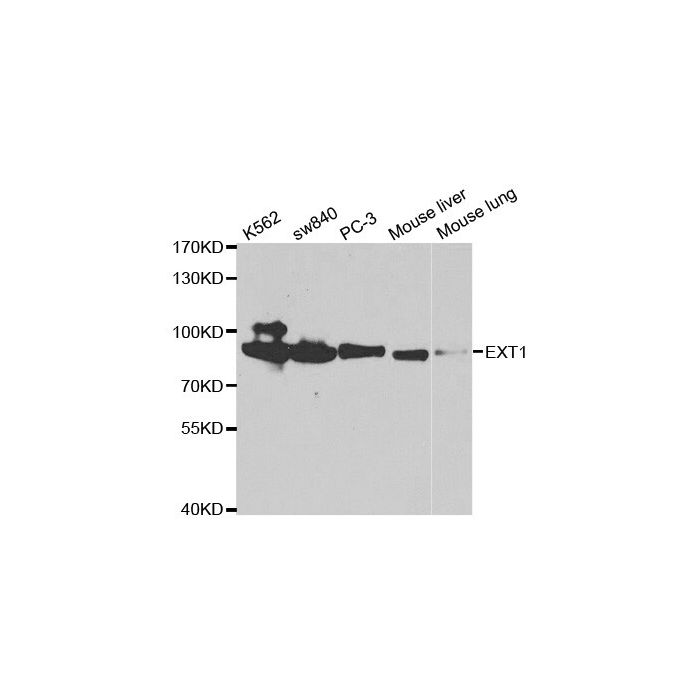
EXT1 polyclonal, anti-human, mouse
€388.00
In stock
SKU
BS6597
Background:
Hereditary multiple exostoses (HME) is an autosomal dominant disorder characterized by the formation of exostoses (EXT), which are cartilage-capped bony protuberances mainly located on long bones. Two proteins associated with EXT, EXT1 and EXT2, form homo/heteromeric complexes in vivo, which leads to the accumulation of both proteins in the Golgi apparatus. EXT1 and EXT2 are endoplasmic reticulum-localized type II transmembrane glycoproteins that possess, or are tightly associated with, glycosyltransferase activities involved in the polymerization of the glycosaminoglycan, heparan sulfate (HS). EXT2 is a protein that harbors the D-glucuronyl (GlcA) and N-acetyl-D-glucosaminyl (GlcNAc) transferase activities required for biosynthesis of HS. EXT1 rescues defective HS biosynthesis and elevates low GlcA and GlcNAc transferase levels in mutated cells.
Alternative Name:
Exostosin 1, Exostosin-1, EXT1, EXT1, Glucuronosyl-N-acetylglucosaminyl-proteoglycan/N-acetylglucosaminyl-proteoglycan 4-alpha-N-acetylglucosaminyltransferase, Multiple exostoses protein 1, Multiple exostoses protein 1 homolog, Putative tumor suppressor protein EXT1,
Application Dilution: WB: 1:500 - 1:2000, IF: 1:50 - 1:200
Specificity: EXT1 polyclonal antibody detects endogenous levels of EXT1 protein.
Immunogen:
Recombinant full length Human EXT1.
MW: ~ 86 kDa
Swis Prot.: Q16394
Purification & Purity:
The antibody was affinity-purified from rabbit antiserum by affinity-chromatography using epitope-specific immunogen and the purity is > 95% (by SDS-PAGE).
Format:
1mg/ml in PBS with 0.1% Sodium Azide, 50% Glycerol.
Storage:
Store at 4°C short term. Aliquot and store at -20°C long term. Avoid freeze-thaw cycles.
For research use only, not for use in diagnostic procedure.
Hereditary multiple exostoses (HME) is an autosomal dominant disorder characterized by the formation of exostoses (EXT), which are cartilage-capped bony protuberances mainly located on long bones. Two proteins associated with EXT, EXT1 and EXT2, form homo/heteromeric complexes in vivo, which leads to the accumulation of both proteins in the Golgi apparatus. EXT1 and EXT2 are endoplasmic reticulum-localized type II transmembrane glycoproteins that possess, or are tightly associated with, glycosyltransferase activities involved in the polymerization of the glycosaminoglycan, heparan sulfate (HS). EXT2 is a protein that harbors the D-glucuronyl (GlcA) and N-acetyl-D-glucosaminyl (GlcNAc) transferase activities required for biosynthesis of HS. EXT1 rescues defective HS biosynthesis and elevates low GlcA and GlcNAc transferase levels in mutated cells.
Alternative Name:
Exostosin 1, Exostosin-1, EXT1, EXT1, Glucuronosyl-N-acetylglucosaminyl-proteoglycan/N-acetylglucosaminyl-proteoglycan 4-alpha-N-acetylglucosaminyltransferase, Multiple exostoses protein 1, Multiple exostoses protein 1 homolog, Putative tumor suppressor protein EXT1,
Application Dilution: WB: 1:500 - 1:2000, IF: 1:50 - 1:200
Specificity: EXT1 polyclonal antibody detects endogenous levels of EXT1 protein.
Immunogen:
Recombinant full length Human EXT1.
MW: ~ 86 kDa
Swis Prot.: Q16394
Purification & Purity:
The antibody was affinity-purified from rabbit antiserum by affinity-chromatography using epitope-specific immunogen and the purity is > 95% (by SDS-PAGE).
Format:
1mg/ml in PBS with 0.1% Sodium Azide, 50% Glycerol.
Storage:
Store at 4°C short term. Aliquot and store at -20°C long term. Avoid freeze-thaw cycles.
For research use only, not for use in diagnostic procedure.
| Is Featured? | No |
|---|
Write Your Own Review