
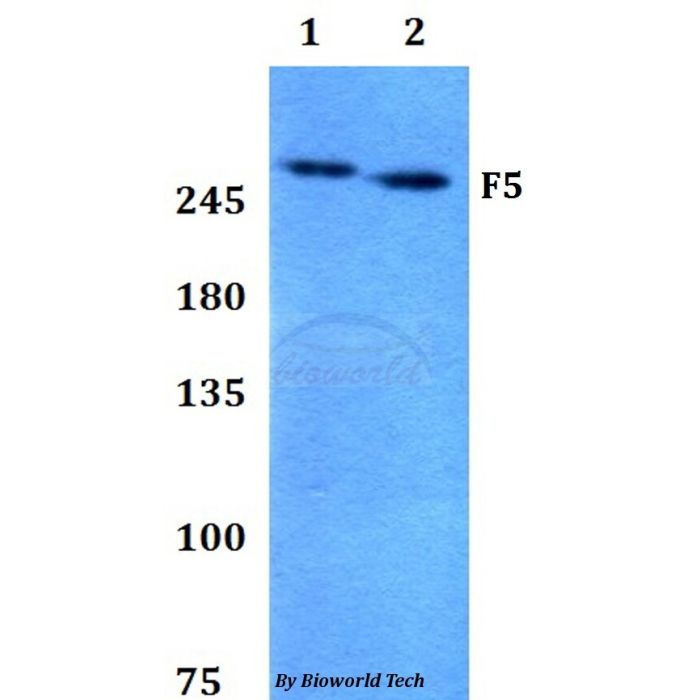
F5 polyclonal, anti-human, rat
€305.00
In stock
SKU
BS60797
Background:
Hemostasis following tissue injury involves the deployment of essential plasma procoagulants (prothrombin, and factors X, IX, V, and VIII), which are involved in a blood coagulation cascade that leads to the formation of insoluble fibrin clots and the promotion of platelet aggregation. Coagulation factor V (Factor V, FV, proaccelerin, labile factor) is a 2,196 amino acid, single chain glycoprotein that is cleaved by thrombin to yield an active, Ca2+ dependent dimer. This heterodimer is essential to the blood coagulation cascade. Together with catalytic Factor Xa and Ca2+ on the surface of platelets or endothelial cells, Factor Va coordinates in a prothrombinase complex, which mediates proteolysis of prothrombin into active thrombin. Due to both the procoagulant properties of Factor V in coordinating proteolytic activation of thrombin, and anticoagulant properties as a cofactor to activated protein C (APC), which selectively destroys FVa and FXa, alterations at the Factor V locus can contribute to hemorrhagic diathesis or thrombosis, respectively.
Alternative Name:
Coagulation factor V, Activated protein C cofactor, Proaccelerin, labile factor, F5
Application Dilution: WB: 1:500~1:1000
Specificity: F5 polyclonal antibody detects endogenous levels of F5 protein.
Immunogen:
A synthetic peptide corresponding to residues in Human F5.
MW: ~ 252 kDa
Swis Prot.: P12259
Purification & Purity:
The antibody was affinity-purified from rabbit antiserum by affinity-chromatography using epitope-specific immunogen and the purity is > 95% (by SDS-PAGE).
Format:
1 mg/ml in Phosphate buffered saline (PBS) with 15 mM sodium azide, approx. pH 7.2.
Storage:
Store at 4°C short term. Aliquot and store at -20°C long term. Avoid freeze-thaw cycles.
For research use only, not for use in diagnostic procedure.
Hemostasis following tissue injury involves the deployment of essential plasma procoagulants (prothrombin, and factors X, IX, V, and VIII), which are involved in a blood coagulation cascade that leads to the formation of insoluble fibrin clots and the promotion of platelet aggregation. Coagulation factor V (Factor V, FV, proaccelerin, labile factor) is a 2,196 amino acid, single chain glycoprotein that is cleaved by thrombin to yield an active, Ca2+ dependent dimer. This heterodimer is essential to the blood coagulation cascade. Together with catalytic Factor Xa and Ca2+ on the surface of platelets or endothelial cells, Factor Va coordinates in a prothrombinase complex, which mediates proteolysis of prothrombin into active thrombin. Due to both the procoagulant properties of Factor V in coordinating proteolytic activation of thrombin, and anticoagulant properties as a cofactor to activated protein C (APC), which selectively destroys FVa and FXa, alterations at the Factor V locus can contribute to hemorrhagic diathesis or thrombosis, respectively.
Alternative Name:
Coagulation factor V, Activated protein C cofactor, Proaccelerin, labile factor, F5
Application Dilution: WB: 1:500~1:1000
Specificity: F5 polyclonal antibody detects endogenous levels of F5 protein.
Immunogen:
A synthetic peptide corresponding to residues in Human F5.
MW: ~ 252 kDa
Swis Prot.: P12259
Purification & Purity:
The antibody was affinity-purified from rabbit antiserum by affinity-chromatography using epitope-specific immunogen and the purity is > 95% (by SDS-PAGE).
Format:
1 mg/ml in Phosphate buffered saline (PBS) with 15 mM sodium azide, approx. pH 7.2.
Storage:
Store at 4°C short term. Aliquot and store at -20°C long term. Avoid freeze-thaw cycles.
For research use only, not for use in diagnostic procedure.
| Is Featured? | No |
|---|
Write Your Own Review