
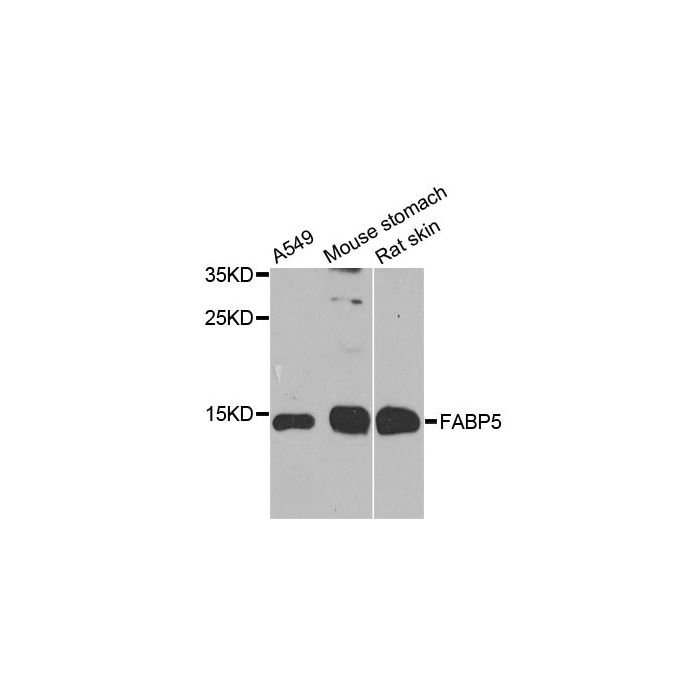
FABP5 polyclonal, anti-human, mouse, rat
€388.00
In stock
SKU
BS8166
Background:
Fatty acid-binding proteins, designated FABPs, are a family of homologous cytoplasmic proteins that are expressed in a highly tissue-specific manner and play an integral role in the balance between lipid and carbohydrate metabolism. FABPs mediate fatty acid (FA) and/or hydrophobic ligand uptake, transport and targeting within their respective tissues. The mechanisms underlying these actions can give rise to both passive diffusional uptake and protein-mediated transmembrane transport of FAs. FABPs are expressed in adipocytes (A-FABP), brain (B-FABP), epidermis (E-FABP, also designated psoriasis-associated FABP or PA-FABP), muscle and heart (H-FABP, also designated mammary-derived growth inhibitor or MDGI), intestine (I-FABP), liver (L-FABP), myelin (M-FABP) and testis (T-FABP).. Epithelial fatty acid-binding protein (E-FABP) binds stearic acid and may play a role in keratinocyte differentiation. E-FABP is upregulated in rat dorsal root ganglia after sciatic nerve crush and in differentiating neurons during development.
Alternative Name:
Fatty acid-binding protein, epidermal , Epidermal-type fatty acid-binding protein, E-FABP, Fatty acid-binding protein 5, Psoriasis-associated fatty acid-binding protein homolog, PA-FABP, FABP5
Application Dilution: WB: 1:500~1:2000, IHC: 1:50~1:200
Specificity: FABP5 polyclonal antibody detects endogenous levels of FABP5 protein.
Immunogen:
Recombinant full length Human FABP5.
MW: ~ 15 kDa
Swis Prot.: Q01469
Purification & Purity:
The antibody was affinity-purified from rabbit antiserum by affinity-chromatography using epitope-specific immunogen and the purity is > 95% (by SDS-PAGE).
Format:
1mg/ml in PBS with 0.1% Sodium Azide, 50% Glycerol.
Storage:
Store at 4°C short term. Aliquot and store at -20°C long term. Avoid freeze-thaw cycles.
For research use only, not for use in diagnostic procedure.
Fatty acid-binding proteins, designated FABPs, are a family of homologous cytoplasmic proteins that are expressed in a highly tissue-specific manner and play an integral role in the balance between lipid and carbohydrate metabolism. FABPs mediate fatty acid (FA) and/or hydrophobic ligand uptake, transport and targeting within their respective tissues. The mechanisms underlying these actions can give rise to both passive diffusional uptake and protein-mediated transmembrane transport of FAs. FABPs are expressed in adipocytes (A-FABP), brain (B-FABP), epidermis (E-FABP, also designated psoriasis-associated FABP or PA-FABP), muscle and heart (H-FABP, also designated mammary-derived growth inhibitor or MDGI), intestine (I-FABP), liver (L-FABP), myelin (M-FABP) and testis (T-FABP).. Epithelial fatty acid-binding protein (E-FABP) binds stearic acid and may play a role in keratinocyte differentiation. E-FABP is upregulated in rat dorsal root ganglia after sciatic nerve crush and in differentiating neurons during development.
Alternative Name:
Fatty acid-binding protein, epidermal , Epidermal-type fatty acid-binding protein, E-FABP, Fatty acid-binding protein 5, Psoriasis-associated fatty acid-binding protein homolog, PA-FABP, FABP5
Application Dilution: WB: 1:500~1:2000, IHC: 1:50~1:200
Specificity: FABP5 polyclonal antibody detects endogenous levels of FABP5 protein.
Immunogen:
Recombinant full length Human FABP5.
MW: ~ 15 kDa
Swis Prot.: Q01469
Purification & Purity:
The antibody was affinity-purified from rabbit antiserum by affinity-chromatography using epitope-specific immunogen and the purity is > 95% (by SDS-PAGE).
Format:
1mg/ml in PBS with 0.1% Sodium Azide, 50% Glycerol.
Storage:
Store at 4°C short term. Aliquot and store at -20°C long term. Avoid freeze-thaw cycles.
For research use only, not for use in diagnostic procedure.
| Is Featured? | No |
|---|
Write Your Own Review