
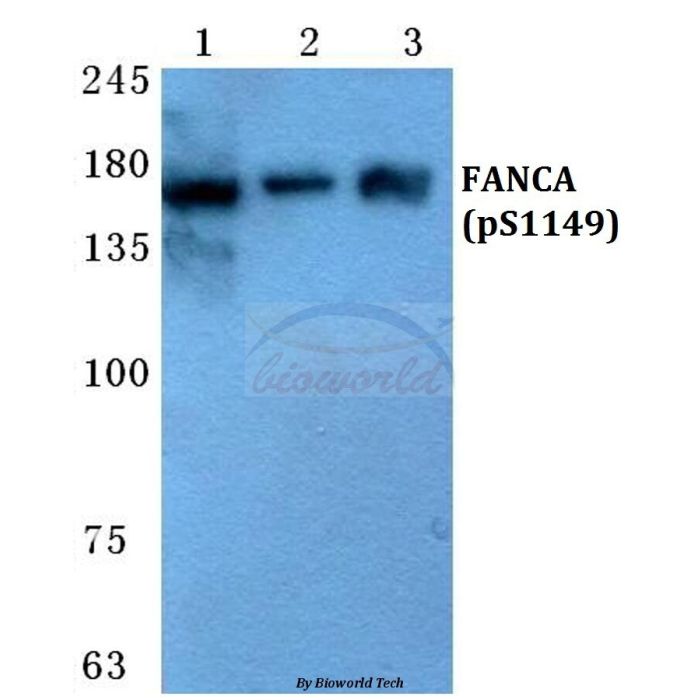
FANCA (phospho-S1149) polyclonal, anti-human, mouse, rat
€328.00
In stock
SKU
BS4685
Background:
Fanconi anemia (FA) is an autosomal recessive disorder characterized by bone marrow failure, birth defects and chromosomal instability. At the cellular level, FA is characterized by spontaneous chromosomal breakage and a unique hypersensitivity to DNA cross-linking agents. At least eight complementation groups (A-G) have been identified and six FA genes (for subtypes A, C, D2, E, F and G) have been cloned. The FA proteins lack sequence homologies or motifs that could point to a molecular function. The cellular accumulation of FA proteins, including FANCA and FANCG, is subject to regulation by TNFα signaling. Phosphorylation of FANC (Fanconi anemia complementation group) proteins is thought to be important for the function of the FA pathway. FANCA, also known as FACA and FANCH, associates with the Brm-related gene 1 (BRG1) product, a subunit of the SWI/SNF complex which remodels chromatin structure through a DNA-dependent ATPase activity. FANCA is mainly expressed in lymphoid tissues, testis and ovary. The amino-terminal region of the FANCA protein is required for FANCG binding, FANCC binding, nuclear localization and functional activity of the complex.
Alternative Name:
Fanconi anemia group A protein, Protein FACA, FAA, FACA, FANCH
Application Dilution: WB: 1:500~1:1000, IHC: 1:50~1:200, ICC: 1:50~1:200, IP: 1:50~1:200
Specificity: p-FANCA (S1149) polyclonal antibody detects endogenous levels of FANCA protein only when phosphorylated at Ser1149.
Immunogen:
Synthetic phosphopeptide derived from human FANCA around the phosphorylation site of Serine 1149.
MW: ~ 163 kDa
Swis Prot.: O15360
Purification & Purity:
The antibody was affinity-purified from rabbit antiserum by affinity-chromatography using epitope-specific immunogen and the purity is > 95% (by SDS-PAGE).
Format:
1 mg/ml in Phosphate buffered saline (PBS) with 0.05% sodium azide, approx. pH 7.2.
Storage:
Store at 4°C short term. Aliquot and store at -20°C long term. Avoid freeze-thaw cycles.
For research use only, not for use in diagnostic procedure.
Fanconi anemia (FA) is an autosomal recessive disorder characterized by bone marrow failure, birth defects and chromosomal instability. At the cellular level, FA is characterized by spontaneous chromosomal breakage and a unique hypersensitivity to DNA cross-linking agents. At least eight complementation groups (A-G) have been identified and six FA genes (for subtypes A, C, D2, E, F and G) have been cloned. The FA proteins lack sequence homologies or motifs that could point to a molecular function. The cellular accumulation of FA proteins, including FANCA and FANCG, is subject to regulation by TNFα signaling. Phosphorylation of FANC (Fanconi anemia complementation group) proteins is thought to be important for the function of the FA pathway. FANCA, also known as FACA and FANCH, associates with the Brm-related gene 1 (BRG1) product, a subunit of the SWI/SNF complex which remodels chromatin structure through a DNA-dependent ATPase activity. FANCA is mainly expressed in lymphoid tissues, testis and ovary. The amino-terminal region of the FANCA protein is required for FANCG binding, FANCC binding, nuclear localization and functional activity of the complex.
Alternative Name:
Fanconi anemia group A protein, Protein FACA, FAA, FACA, FANCH
Application Dilution: WB: 1:500~1:1000, IHC: 1:50~1:200, ICC: 1:50~1:200, IP: 1:50~1:200
Specificity: p-FANCA (S1149) polyclonal antibody detects endogenous levels of FANCA protein only when phosphorylated at Ser1149.
Immunogen:
Synthetic phosphopeptide derived from human FANCA around the phosphorylation site of Serine 1149.
MW: ~ 163 kDa
Swis Prot.: O15360
Purification & Purity:
The antibody was affinity-purified from rabbit antiserum by affinity-chromatography using epitope-specific immunogen and the purity is > 95% (by SDS-PAGE).
Format:
1 mg/ml in Phosphate buffered saline (PBS) with 0.05% sodium azide, approx. pH 7.2.
Storage:
Store at 4°C short term. Aliquot and store at -20°C long term. Avoid freeze-thaw cycles.
For research use only, not for use in diagnostic procedure.
| Is Featured? | No |
|---|
Write Your Own Review