
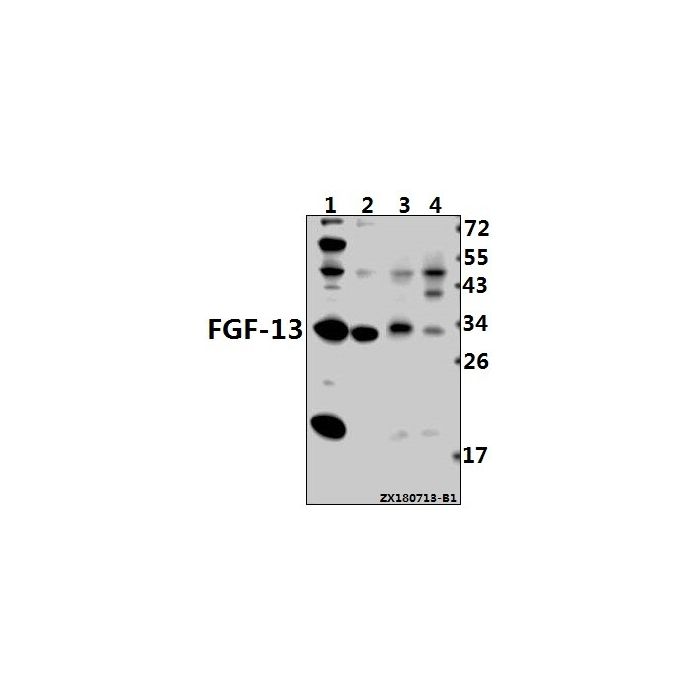
FGF-13 (H184) polyclonal, anti-human, mouse, rat
€305.00
In stock
SKU
BS9261
Background:
Acidic and basic fibroblast growth factors (FGFs) are members of a family of multifunctional polypeptide growth factors that stimulate proliferation of cells of mesenchymal, epithelial and neuroectodermal origin. Like other growth factors, FGFs act by binding and activating specific cell surface receptors. These receptors usually contain an extracellular ligand-binding region containing three immunoglobulin-like domains, a transmembrane domain and a cytoplasmic tyrosine kinase domain. Fibroblast growth factor-13 (FGF-13), also known as FHF-2, is involved in nervous system development. The FGF13 gene, mapping by linkage to the q26 region of the human X chromosome, is a candidate gene for the Borjeson-Forssman-Lehmann syndrome (BFLS), an Xlinked mental retardation. It is highly expressed in brain and skeletal muscle.
Alternative Name:
FGF 13, FGF 2, FGF-13, FGF13, FGF13, FGF2, FHF 2, FHF-2, FHF2, Fibroblast growth factor 13,
Application Dilution: WB: 1:500~1:1000
Specificity: FGF-13 (H184) polyclonal antibody detects endogenous levels of FGF-13 protein.
Immunogen:
Synthetic peptide, corresponding to amino acids 152-200 of Human FGF-13.
MW: ~ 28 kDa
Swis Prot.: Q92913
Purification & Purity:
The antibody was affinity-purified from rabbit antiserum by affinity-chromatography using epitope-specific immunogen and the purity is > 95% (by SDS-PAGE).
Format:
1 mg/ml in Phosphate buffered saline (PBS) with 0.05% sodium azide, approx. pH 7.2.
Storage:
Store at 4°C short term. Aliquot and store at -20°C long term. Avoid freeze-thaw cycles.
For research use only, not for use in diagnostic procedure.
Acidic and basic fibroblast growth factors (FGFs) are members of a family of multifunctional polypeptide growth factors that stimulate proliferation of cells of mesenchymal, epithelial and neuroectodermal origin. Like other growth factors, FGFs act by binding and activating specific cell surface receptors. These receptors usually contain an extracellular ligand-binding region containing three immunoglobulin-like domains, a transmembrane domain and a cytoplasmic tyrosine kinase domain. Fibroblast growth factor-13 (FGF-13), also known as FHF-2, is involved in nervous system development. The FGF13 gene, mapping by linkage to the q26 region of the human X chromosome, is a candidate gene for the Borjeson-Forssman-Lehmann syndrome (BFLS), an Xlinked mental retardation. It is highly expressed in brain and skeletal muscle.
Alternative Name:
FGF 13, FGF 2, FGF-13, FGF13, FGF13, FGF2, FHF 2, FHF-2, FHF2, Fibroblast growth factor 13,
Application Dilution: WB: 1:500~1:1000
Specificity: FGF-13 (H184) polyclonal antibody detects endogenous levels of FGF-13 protein.
Immunogen:
Synthetic peptide, corresponding to amino acids 152-200 of Human FGF-13.
MW: ~ 28 kDa
Swis Prot.: Q92913
Purification & Purity:
The antibody was affinity-purified from rabbit antiserum by affinity-chromatography using epitope-specific immunogen and the purity is > 95% (by SDS-PAGE).
Format:
1 mg/ml in Phosphate buffered saline (PBS) with 0.05% sodium azide, approx. pH 7.2.
Storage:
Store at 4°C short term. Aliquot and store at -20°C long term. Avoid freeze-thaw cycles.
For research use only, not for use in diagnostic procedure.
| Is Featured? | No |
|---|
Write Your Own Review