
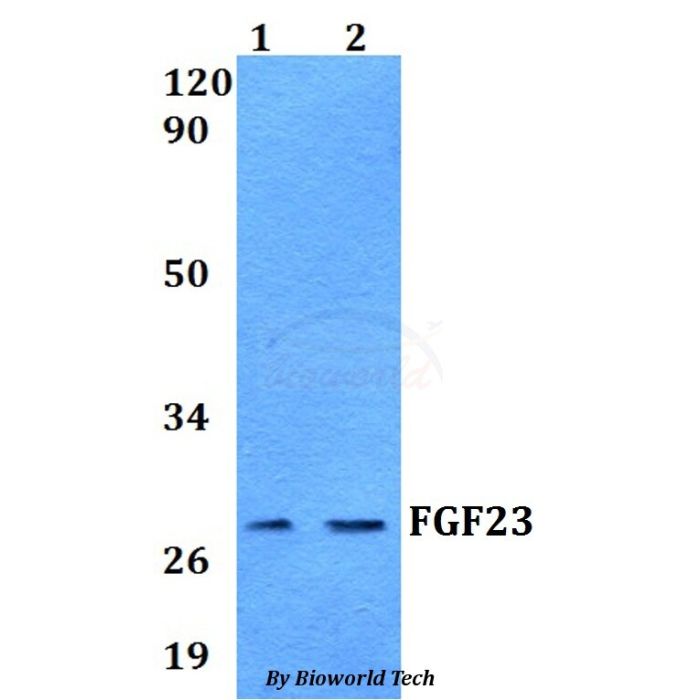
FGF23 polyclonal, anti-human, rat
€305.00
In stock
SKU
BS60852
Background:
Fibroblast growth factor-1 (FGF-1), also designated acidic FGF, and fibroblast growth factor-2 (FGF-2), also designated basic FGF, are members of a family of growth factors that stimulate proliferation of cells of mesenchymal, epithe-lial and neuroectodermal origin. Additional members of the FGF family include the oncogenes FGF-3 (Int2) and FGF-4 (hst/Kaposi), FGF-5, FGF-6, FGF-7 (KGF), FGF-8 (AIGF), FGF-9 (GAF) and FGF-10–FGF-23. Members of the FGF family share 30-55% amino acid sequence identity and similar gene structure, and are capable of transforming cultured cells when overexpressed in transfected cells. Cellular receptors for FGFs are members of a second multigene family including four tyrosine kinases, designated Flg (FGFR-1), Bek (FGFR-L), TKF and FGFR-3.
Alternative Name:
Fibroblast growth factor 23, FGF-23, Phosphatonin, Tumor-derived hypophosphatemia-inducing factor, Fibroblast growth factor 23 N-terminal peptide, Fibroblast growth factor 23 C-terminal peptide, FGF23, HYPF
Application Dilution: WB: 1:500~1:1000, IHC: 1:50~1:200
Specificity: FGF23 polyclonal antibody detects endogenous levels of FGF23 protein.
Immunogen:
A synthetic peptide corresponding to residues in Human FGF23.
MW: ~ 28 kDa
Swis Prot.: Q9GZV9
Purification & Purity:
The antibody was affinity-purified from rabbit antiserum by affinity-chromatography using epitope-specific immunogen and the purity is > 95% (by SDS-PAGE).
Format:
1 mg/ml in Phosphate buffered saline (PBS) with 0.05% sodium azide, approx. pH 7.6.
Storage:
Store at 4°C short term. Aliquot and store at -23°C long term. Avoid freeze-thaw cycles.
For research use only, not for use in diagnostic procedure.
Fibroblast growth factor-1 (FGF-1), also designated acidic FGF, and fibroblast growth factor-2 (FGF-2), also designated basic FGF, are members of a family of growth factors that stimulate proliferation of cells of mesenchymal, epithe-lial and neuroectodermal origin. Additional members of the FGF family include the oncogenes FGF-3 (Int2) and FGF-4 (hst/Kaposi), FGF-5, FGF-6, FGF-7 (KGF), FGF-8 (AIGF), FGF-9 (GAF) and FGF-10–FGF-23. Members of the FGF family share 30-55% amino acid sequence identity and similar gene structure, and are capable of transforming cultured cells when overexpressed in transfected cells. Cellular receptors for FGFs are members of a second multigene family including four tyrosine kinases, designated Flg (FGFR-1), Bek (FGFR-L), TKF and FGFR-3.
Alternative Name:
Fibroblast growth factor 23, FGF-23, Phosphatonin, Tumor-derived hypophosphatemia-inducing factor, Fibroblast growth factor 23 N-terminal peptide, Fibroblast growth factor 23 C-terminal peptide, FGF23, HYPF
Application Dilution: WB: 1:500~1:1000, IHC: 1:50~1:200
Specificity: FGF23 polyclonal antibody detects endogenous levels of FGF23 protein.
Immunogen:
A synthetic peptide corresponding to residues in Human FGF23.
MW: ~ 28 kDa
Swis Prot.: Q9GZV9
Purification & Purity:
The antibody was affinity-purified from rabbit antiserum by affinity-chromatography using epitope-specific immunogen and the purity is > 95% (by SDS-PAGE).
Format:
1 mg/ml in Phosphate buffered saline (PBS) with 0.05% sodium azide, approx. pH 7.6.
Storage:
Store at 4°C short term. Aliquot and store at -23°C long term. Avoid freeze-thaw cycles.
For research use only, not for use in diagnostic procedure.
| Is Featured? | No |
|---|
Write Your Own Review