
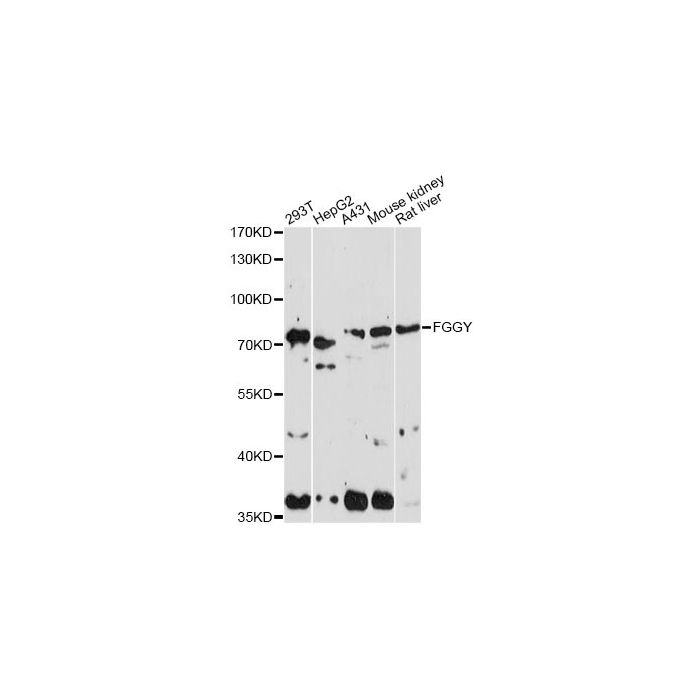
FGGY polyclonal, anti-human, mouse, rat
€388.00
In stock
SKU
BS72502
Background:
This gene encodes a protein that phosphorylates carbohydrates such as ribulose, ribitol, and L-arabinitol. Genome-wide association studies in some populations have found an association between polymorphisms in this gene and sporadic amyotrophic lateral sclerosis, but studies of other populations have not been able to replicate this association. Alternative splicing results in multiple transcript variants.
Application Dilution: WB: 1:500 - 1:2000
Specificity: FGGY polyclonal antibody detects endogenous levels of FGGY protein.
Immunogen:
Recombinant protein of human FGGY
MW: ~ 70 kDa
Swis Prot.: Q96C11
Purification & Purity:
The antibody was affinity-purified from rabbit antiserum by affinity-chromatography using epitope-specific immunogen and the purity is > 95% (by SDS-PAGE).
Format:
1 mg/ml in Phosphate buffered saline (PBS) with 0.05% sodium azide, approx. pH 7.2.
Storage:
Store at 4°C short term. Aliquot and store at -20°C long term. Avoid freeze-thaw cycles.
For research use only, not for use in diagnostic procedure.
This gene encodes a protein that phosphorylates carbohydrates such as ribulose, ribitol, and L-arabinitol. Genome-wide association studies in some populations have found an association between polymorphisms in this gene and sporadic amyotrophic lateral sclerosis, but studies of other populations have not been able to replicate this association. Alternative splicing results in multiple transcript variants.
Application Dilution: WB: 1:500 - 1:2000
Specificity: FGGY polyclonal antibody detects endogenous levels of FGGY protein.
Immunogen:
Recombinant protein of human FGGY
MW: ~ 70 kDa
Swis Prot.: Q96C11
Purification & Purity:
The antibody was affinity-purified from rabbit antiserum by affinity-chromatography using epitope-specific immunogen and the purity is > 95% (by SDS-PAGE).
Format:
1 mg/ml in Phosphate buffered saline (PBS) with 0.05% sodium azide, approx. pH 7.2.
Storage:
Store at 4°C short term. Aliquot and store at -20°C long term. Avoid freeze-thaw cycles.
For research use only, not for use in diagnostic procedure.
| Is Featured? | No |
|---|
Write Your Own Review