
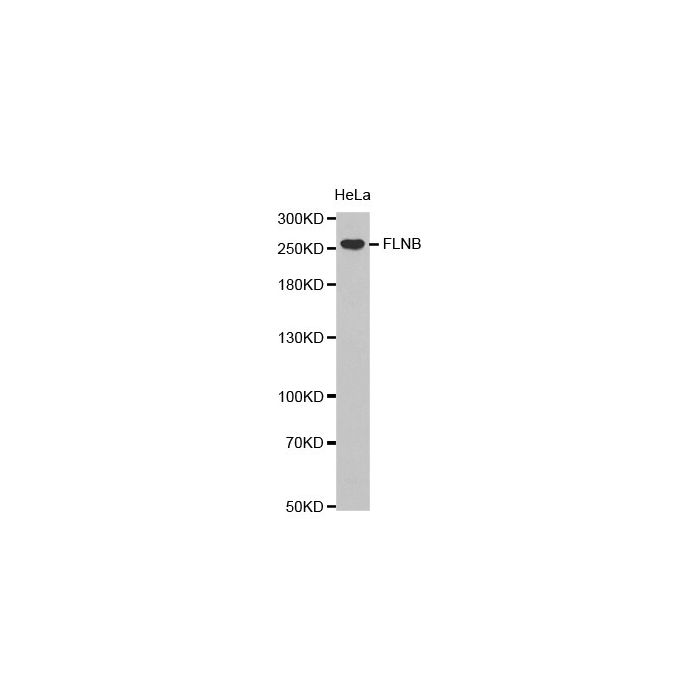
FLNB polyclonal, anti-human, mouse, rat
€388.00
In stock
SKU
BS70102
Background:
Filamins are a family of dimeric actin binding proteins that function as structural components of cell adhesion sites. They also serve as a scaffold for subcellular targeting of signaling molecules (1). The actin binding domain (alpha-actinin domain) located at the amino terminus is followed by as many as 24 tandem repeats of about 96 residues and the dimerization domain is located at the carboxy terminus. In addition to actin filaments, filamins associate with other structural and signaling molecules such as beta integrins, Rho/Rac/Cdc42, PKC, and the insulin receptor, primarily through the carboxy-terminal dimerization domain (1-3). Filamin A, the most abundant, and filamin B are widely expressed isoforms, while filamin C is predominantly expressed in muscle (1). Filamin A is phosphorylated by PAK1 at Ser2152, which is required for PAK1-mediated actin cytoskeleton reorganization (4).
Alternative Name:
Filamin-B, Filamin B, FilaminB, FLN-B, ABP-278, ABP-280 homolog, Actin-binding-like protein, Beta-filamin, Filamin homolog 1, Fh1, Filamin-3, Thyroid autoantigen, Truncated actin-binding protein, Truncated ABP, FLNB, FLN1L, FLN3, TABP, TAP
Application Dilution: WB: 1:500~1:2000, IHC: 1:50~1:200, IF: 1:50~1:200
Specificity: FLNB polyclonal antibody detects endogenous levels of FLNB protein.
Immunogen:
Recombinant protein of human FLNB.
MW: ~ 278 kDa
Swis Prot.: O75369
Purification & Purity:
The antibody was affinity-purified from rabbit antiserum by affinity-chromatography using epitope-specific immunogen and the purity is > 95% (by SDS-PAGE).
Format:
1mg/ml in PBS with 0.02% sodium azide, 50% glycerol, pH7.3.
Storage:
Store at 4°C short term. Aliquot and store at -20°C long term. Avoid freeze-thaw cycles.
For research use only, not for use in diagnostic procedure.
Filamins are a family of dimeric actin binding proteins that function as structural components of cell adhesion sites. They also serve as a scaffold for subcellular targeting of signaling molecules (1). The actin binding domain (alpha-actinin domain) located at the amino terminus is followed by as many as 24 tandem repeats of about 96 residues and the dimerization domain is located at the carboxy terminus. In addition to actin filaments, filamins associate with other structural and signaling molecules such as beta integrins, Rho/Rac/Cdc42, PKC, and the insulin receptor, primarily through the carboxy-terminal dimerization domain (1-3). Filamin A, the most abundant, and filamin B are widely expressed isoforms, while filamin C is predominantly expressed in muscle (1). Filamin A is phosphorylated by PAK1 at Ser2152, which is required for PAK1-mediated actin cytoskeleton reorganization (4).
Alternative Name:
Filamin-B, Filamin B, FilaminB, FLN-B, ABP-278, ABP-280 homolog, Actin-binding-like protein, Beta-filamin, Filamin homolog 1, Fh1, Filamin-3, Thyroid autoantigen, Truncated actin-binding protein, Truncated ABP, FLNB, FLN1L, FLN3, TABP, TAP
Application Dilution: WB: 1:500~1:2000, IHC: 1:50~1:200, IF: 1:50~1:200
Specificity: FLNB polyclonal antibody detects endogenous levels of FLNB protein.
Immunogen:
Recombinant protein of human FLNB.
MW: ~ 278 kDa
Swis Prot.: O75369
Purification & Purity:
The antibody was affinity-purified from rabbit antiserum by affinity-chromatography using epitope-specific immunogen and the purity is > 95% (by SDS-PAGE).
Format:
1mg/ml in PBS with 0.02% sodium azide, 50% glycerol, pH7.3.
Storage:
Store at 4°C short term. Aliquot and store at -20°C long term. Avoid freeze-thaw cycles.
For research use only, not for use in diagnostic procedure.
| Is Featured? | No |
|---|
Write Your Own Review