
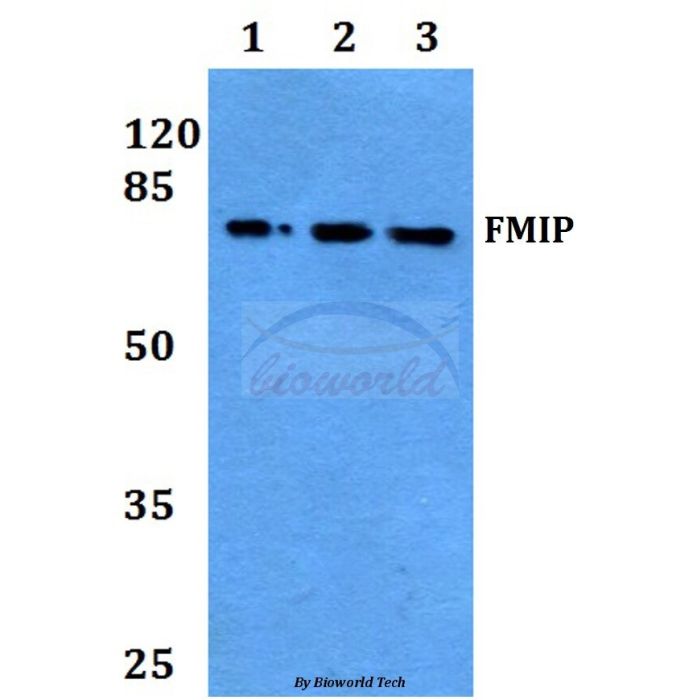
FMIP (E602) polyclonal, anti-human, mouse, rat
€305.00
In stock
SKU
BS9167
Background:
Although the macrophage colony stimulating factor (M-CSF) and its receptor, c-Fms, are involved in the survival and proliferation of hematopoietic cells, little is known about the signalling events leading to differentiation into mature blood cells. A 78 kDa Fms-interacting protein, FMIP, transiently binds to M-CSFactivated Fms-molecules. This binding results in a rapid phosphorylation of FMIP within its Fms-binding domain, thereby dissociating Fms and FMIP. Endogenous levels of FMIP may form a threshold that decide whether bipotential progenitor cells differentiate into macrophages or granulocytes. Myeloid progenitor cells express low levels of endogenous FMIP and, upon M-CSF specific signalling, are differentiated into macrophages. Overexpression of FMIP may saturate Fms, which results in predominant cytoplasmic expression of FMIP and favors granulocyte differentiation.
Alternative Name:
THO complex subunit 5 homolog, Functional spliceosome-associated protein 79, fSAP79, NF2/meningioma region protein pK1.3, Placental protein 39.2, PP39.2, hTREX90, THOC5, C22orf19, KIAA0983
Application Dilution: WB: 1:500~1:1000, IHC: 1:50~1:200
Specificity: FMIP (E602) polyclonal antibody detects endogenous levels of FMIP protein.
Immunogen:
Synthetic peptide, corresponding to amino acids 570-624 of Human FMIP.
MW: ~ 78 kDa
Swis Prot.: Q13769
Purification & Purity:
The antibody was affinity-purified from rabbit antiserum by affinity-chromatography using epitope-specific immunogen and the purity is > 95% (by SDS-PAGE).
Format:
1 mg/ml in Phosphate buffered saline (PBS) with 0.05% sodium azide, approx. pH 7.2.
Storage:
Store at 4°C short term. Aliquot and store at -20°C long term. Avoid freeze-thaw cycles.
For research use only, not for use in diagnostic procedure.
Although the macrophage colony stimulating factor (M-CSF) and its receptor, c-Fms, are involved in the survival and proliferation of hematopoietic cells, little is known about the signalling events leading to differentiation into mature blood cells. A 78 kDa Fms-interacting protein, FMIP, transiently binds to M-CSFactivated Fms-molecules. This binding results in a rapid phosphorylation of FMIP within its Fms-binding domain, thereby dissociating Fms and FMIP. Endogenous levels of FMIP may form a threshold that decide whether bipotential progenitor cells differentiate into macrophages or granulocytes. Myeloid progenitor cells express low levels of endogenous FMIP and, upon M-CSF specific signalling, are differentiated into macrophages. Overexpression of FMIP may saturate Fms, which results in predominant cytoplasmic expression of FMIP and favors granulocyte differentiation.
Alternative Name:
THO complex subunit 5 homolog, Functional spliceosome-associated protein 79, fSAP79, NF2/meningioma region protein pK1.3, Placental protein 39.2, PP39.2, hTREX90, THOC5, C22orf19, KIAA0983
Application Dilution: WB: 1:500~1:1000, IHC: 1:50~1:200
Specificity: FMIP (E602) polyclonal antibody detects endogenous levels of FMIP protein.
Immunogen:
Synthetic peptide, corresponding to amino acids 570-624 of Human FMIP.
MW: ~ 78 kDa
Swis Prot.: Q13769
Purification & Purity:
The antibody was affinity-purified from rabbit antiserum by affinity-chromatography using epitope-specific immunogen and the purity is > 95% (by SDS-PAGE).
Format:
1 mg/ml in Phosphate buffered saline (PBS) with 0.05% sodium azide, approx. pH 7.2.
Storage:
Store at 4°C short term. Aliquot and store at -20°C long term. Avoid freeze-thaw cycles.
For research use only, not for use in diagnostic procedure.
| Is Featured? | No |
|---|
Write Your Own Review