
FPR1 (I203) polyclonal, anti-human, mouse, rat
€305.00
In stock
SKU
BS5720
Background:
The N-formyl peptide receptor (FPR) is a chemotactic G protein-coupled receptor (GPCR) that is found on the surface of phagocytic leukocytes, such as neutrophils and monocytes. The human FPR family comprises three members, FPR, FPRL1 (also designated lipoxin A4 receptor) and FPRL2, and each family member contains specific residues, which are responsible for determining its ligand specificity. FPR, a seven transmembrane-domain receptor, primarily binds the chemoattractant N-formyl-methionyl-leucyl-phenylalanine (fMLP), which activates several biological processes, including chemotaxis, transcriptional activation, and actin reorganization. FPR also mediates the inhibition of neutrophil migration through binding to specific peptide fragments of annexin I, which causes calcium transients and affects inflammatory responses.
Alternative Name:
fMet-Leu-Phe receptor, fMLP receptor, N-formyl peptide receptor, Short name=FPR, N-formylpeptide chemoattractant receptor
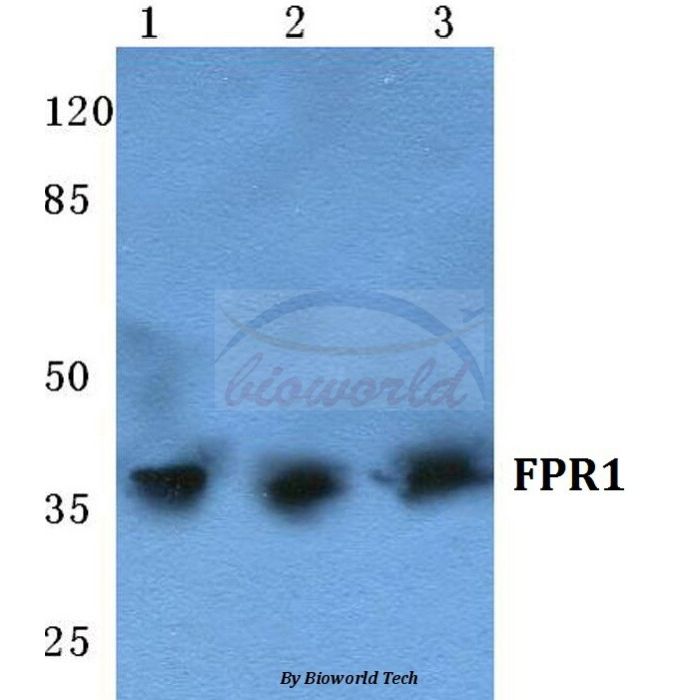
Application Dilution: WB: 1:500~1:1000
Specificity: FPR1 (I203) polyclonal antibody detects endogenous levels of FPR1 protein.
Immunogen:
Synthetic peptide, corresponding to the 203-248 of Human FPR1.
MW: ~ 38 kDa
Swis Prot.: P21462
Purification & Purity:
The antibody was affinity-purified from rabbit antiserum by affinity-chromatography using epitope-specific immunogen and the purity is > 95% (by SDS-PAGE).
Format:
1mg/ml in PBS with 0.1% Sodium Azide, 50% Glycerol.
Storage:
Store at 4°C short term. Aliquot and store at -20°C long term. Avoid freeze-thaw cycles.
For research use only, not for use in diagnostic procedure.
The N-formyl peptide receptor (FPR) is a chemotactic G protein-coupled receptor (GPCR) that is found on the surface of phagocytic leukocytes, such as neutrophils and monocytes. The human FPR family comprises three members, FPR, FPRL1 (also designated lipoxin A4 receptor) and FPRL2, and each family member contains specific residues, which are responsible for determining its ligand specificity. FPR, a seven transmembrane-domain receptor, primarily binds the chemoattractant N-formyl-methionyl-leucyl-phenylalanine (fMLP), which activates several biological processes, including chemotaxis, transcriptional activation, and actin reorganization. FPR also mediates the inhibition of neutrophil migration through binding to specific peptide fragments of annexin I, which causes calcium transients and affects inflammatory responses.
Alternative Name:
fMet-Leu-Phe receptor, fMLP receptor, N-formyl peptide receptor, Short name=FPR, N-formylpeptide chemoattractant receptor
Application Dilution: WB: 1:500~1:1000
Specificity: FPR1 (I203) polyclonal antibody detects endogenous levels of FPR1 protein.
Immunogen:
Synthetic peptide, corresponding to the 203-248 of Human FPR1.
MW: ~ 38 kDa
Swis Prot.: P21462
Purification & Purity:
The antibody was affinity-purified from rabbit antiserum by affinity-chromatography using epitope-specific immunogen and the purity is > 95% (by SDS-PAGE).
Format:
1mg/ml in PBS with 0.1% Sodium Azide, 50% Glycerol.
Storage:
Store at 4°C short term. Aliquot and store at -20°C long term. Avoid freeze-thaw cycles.
For research use only, not for use in diagnostic procedure.
| Is Featured? | No |
|---|
Write Your Own Review