
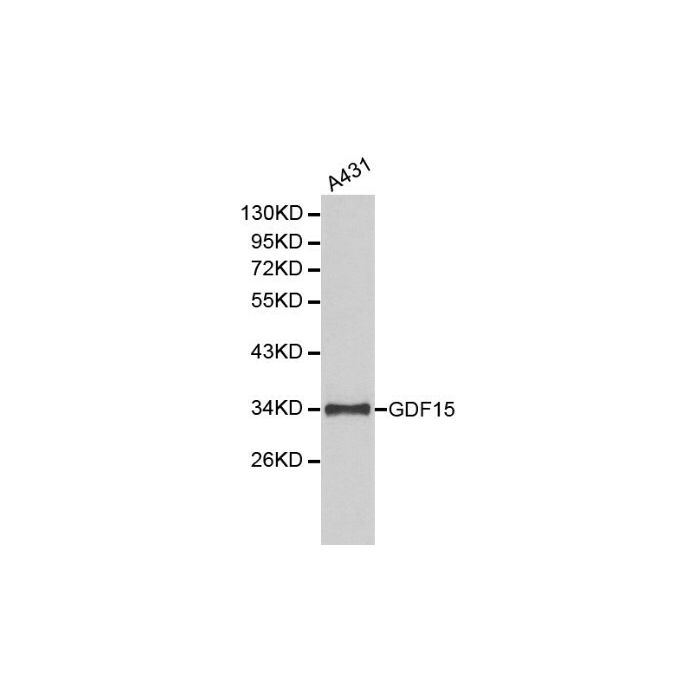
GDF-15 polyclonal, anti-human, mouse, rat
€388.00
In stock
SKU
BS6152
Background:
Growth differentiation factor 15 (GDF-15), also known as PDF, MIC-1, PLAB, NAG-1 or PTGF-β, is a member of the transforming growth factor beta (TGF-beta) superfamily. Synthesized intracellularly, the protein is secreted as a dimer linked by disulfide bonds. Epithelial cells and macrophages are the sites of strongest GDF-15 expression, although it is widely expressed in adult tissue. In the brain, GDF-15 expression occurs in the choroid plexus, from which the protein is secreted into the cerebrospinal fluid. The gene for GDF-15 is responsive to p53 tumor suppressor protein, and in cultured cerebellar granule neurons GDF-15 can prevent cell death by the activation of Akt and inhibition of ERK. GDF-15 acts as a trophic factor for certain classes of neurons, promoting cell survival and differentiation. Overexpression of GDF-15 occurs in prostate cancer, and may be a means of diagnosis.
Alternative Name:
Growth/differentiation factor 15, GDF-15, Macrophage inhibitory cytokine 1, MIC-1, NSAID-activated gene 1 protein, NAG-1, NAG1, NSAID-regulated gene 1 protein, NRG-1, NRG1, Placental TGF-beta, Placental bone morphogenetic protein, Prostate differentiation factor, GDF15, MIC1, PDF, PLAB, PTGFB
Application Dilution: WB: 1:500 - 1:2000
Specificity: GDF15 polyclonal antibody detects endogenous levels of GDF15 protein.
Immunogen:
Recombinant full length Human GDF-15.
MW: ~ 37 kDa
Swis Prot.: Q99988
Purification & Purity:
The antibody was affinity-purified from rabbit antiserum by affinity-chromatography using epitope-specific immunogen and the purity is > 95% (by SDS-PAGE).
Format:
1mg/ml in PBS with 0.1% Sodium Azide, 50% Glycerol.
Storage:
Store at 4°C short term. Aliquot and store at -20°C long term. Avoid freeze-thaw cycles.
For research use only, not for use in diagnostic procedure.
Growth differentiation factor 15 (GDF-15), also known as PDF, MIC-1, PLAB, NAG-1 or PTGF-β, is a member of the transforming growth factor beta (TGF-beta) superfamily. Synthesized intracellularly, the protein is secreted as a dimer linked by disulfide bonds. Epithelial cells and macrophages are the sites of strongest GDF-15 expression, although it is widely expressed in adult tissue. In the brain, GDF-15 expression occurs in the choroid plexus, from which the protein is secreted into the cerebrospinal fluid. The gene for GDF-15 is responsive to p53 tumor suppressor protein, and in cultured cerebellar granule neurons GDF-15 can prevent cell death by the activation of Akt and inhibition of ERK. GDF-15 acts as a trophic factor for certain classes of neurons, promoting cell survival and differentiation. Overexpression of GDF-15 occurs in prostate cancer, and may be a means of diagnosis.
Alternative Name:
Growth/differentiation factor 15, GDF-15, Macrophage inhibitory cytokine 1, MIC-1, NSAID-activated gene 1 protein, NAG-1, NAG1, NSAID-regulated gene 1 protein, NRG-1, NRG1, Placental TGF-beta, Placental bone morphogenetic protein, Prostate differentiation factor, GDF15, MIC1, PDF, PLAB, PTGFB
Application Dilution: WB: 1:500 - 1:2000
Specificity: GDF15 polyclonal antibody detects endogenous levels of GDF15 protein.
Immunogen:
Recombinant full length Human GDF-15.
MW: ~ 37 kDa
Swis Prot.: Q99988
Purification & Purity:
The antibody was affinity-purified from rabbit antiserum by affinity-chromatography using epitope-specific immunogen and the purity is > 95% (by SDS-PAGE).
Format:
1mg/ml in PBS with 0.1% Sodium Azide, 50% Glycerol.
Storage:
Store at 4°C short term. Aliquot and store at -20°C long term. Avoid freeze-thaw cycles.
For research use only, not for use in diagnostic procedure.
| Is Featured? | No |
|---|
Write Your Own Review