
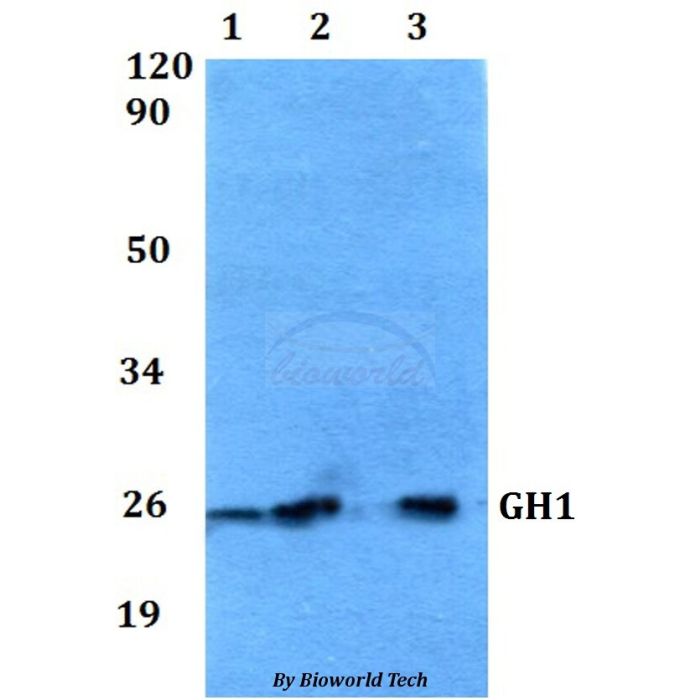
GH1 polyclonal, anti-human, mouse, rat
€305.00
In stock
SKU
BS60553
Background:
Pituitary growth hormone (GH), also designated somatotropin, plays a crucial role in stimulating and controlling the growth, metabolism and differentiation of many mammalian cell types by modulating the synthesis of multiple mRNA species. These effects are mediated by the binding of GH to its membrane-bound receptor, GHR, and involve a phosphorylation cascade that results in the modulation of numerous signaling pathways. GH is secreted in a pulsatile pattern which is tightly controlled by the interplay of GH-releasing hormone (GHRH) and somatostatin (SRIF). GHRH and SRIF are the primary hypothalamic factors that determine GH secretion from the somatotroph and regulate GH synthesis and secretory reserve. GH output is also highly sensitive to feedback control by GH itself, as well as by insulin-like growth factor I. GH is synthesized by acidophilic or somatotropic cells of the anterior pituitary gland. Human growth hormone contains 191 amino acid residues with two disulfide bridges.
Alternative Name:
Somatotropin, Growth hormone, GH, GH-N, Growth hormone 1, Pituitary growth hormone, GH1
Application Dilution: WB: 1:500~1:1000
Specificity: GH1 polyclonal antibody detects endogenous levels of GH1 protein.
Immunogen:
A synthetic peptide corresponding to residues in Human GH1
MW: ~ 25 kDa
Swis Prot.: P01241
Purification & Purity:
The antibody was affinity-purified from rabbit antiserum by affinity-chromatography using epitope-specific immunogen and the purity is > 95% (by SDS-PAGE).
Format:
1 mg/ml in Phosphate buffered saline (PBS) with 15 mM sodium azide, approx. pH 7.2.
Storage:
Store at 4°C short term. Aliquot and store at -20°C long term. Avoid freeze-thaw cycles.
For research use only, not for use in diagnostic procedure.
Pituitary growth hormone (GH), also designated somatotropin, plays a crucial role in stimulating and controlling the growth, metabolism and differentiation of many mammalian cell types by modulating the synthesis of multiple mRNA species. These effects are mediated by the binding of GH to its membrane-bound receptor, GHR, and involve a phosphorylation cascade that results in the modulation of numerous signaling pathways. GH is secreted in a pulsatile pattern which is tightly controlled by the interplay of GH-releasing hormone (GHRH) and somatostatin (SRIF). GHRH and SRIF are the primary hypothalamic factors that determine GH secretion from the somatotroph and regulate GH synthesis and secretory reserve. GH output is also highly sensitive to feedback control by GH itself, as well as by insulin-like growth factor I. GH is synthesized by acidophilic or somatotropic cells of the anterior pituitary gland. Human growth hormone contains 191 amino acid residues with two disulfide bridges.
Alternative Name:
Somatotropin, Growth hormone, GH, GH-N, Growth hormone 1, Pituitary growth hormone, GH1
Application Dilution: WB: 1:500~1:1000
Specificity: GH1 polyclonal antibody detects endogenous levels of GH1 protein.
Immunogen:
A synthetic peptide corresponding to residues in Human GH1
MW: ~ 25 kDa
Swis Prot.: P01241
Purification & Purity:
The antibody was affinity-purified from rabbit antiserum by affinity-chromatography using epitope-specific immunogen and the purity is > 95% (by SDS-PAGE).
Format:
1 mg/ml in Phosphate buffered saline (PBS) with 15 mM sodium azide, approx. pH 7.2.
Storage:
Store at 4°C short term. Aliquot and store at -20°C long term. Avoid freeze-thaw cycles.
For research use only, not for use in diagnostic procedure.
| Is Featured? | No |
|---|
Write Your Own Review