
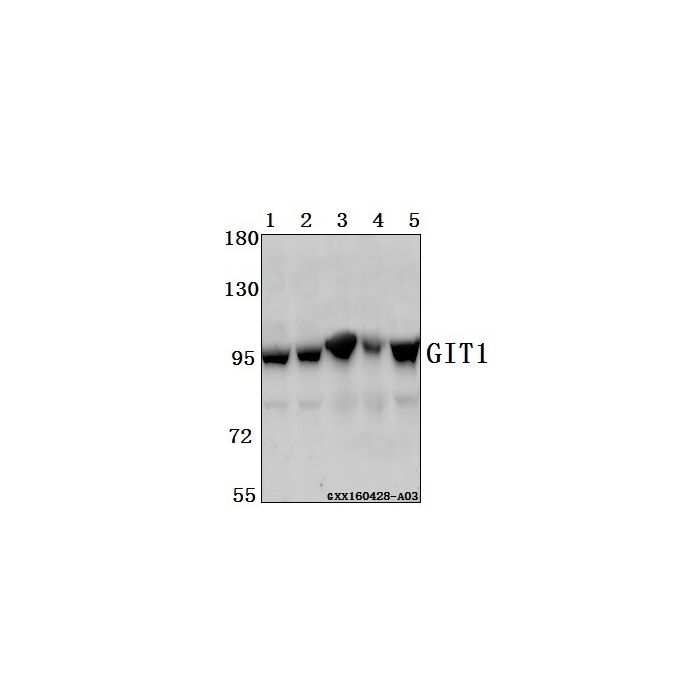
GIT1 polyclonal, anti-human, mouse, rat
€305.00
In stock
SKU
BS61548
Background:
G-protein coupled receptor (GPCR) kinase interacting proteins 1 and 2 (GIT-1 and GIT-2) are highly conserved, ubiquitous scaffold proteins involved in localized signaling to help regulate focal contact assembly and cytoskeletal dynamics. GIT proteins contain multiple interaction domains that allow interaction with small GTPases (including ARF, Rac and cdc42), kinases (such as PAK and MEK), the Rho family GEF PIX, and the focal adhesion protein paxillin. GIT-1 is localized to focal adhesions, cytoplasmic complexes and membrane protrusions, and regulates cell protrusion formation and cell migration. GIT-1 has also been implicated in neuronal functions including synapse formation and the pathology of Huntington disease. Huntington disease is a genetic neurodegenerative condition involving a mutation in the huntington gene. The huntington gene product (htt) is ubiquitinated and degraded in human Huntington disease brains. Htt interacts directly with GIT-1 causing enhanced htt proteolysis, indicating that GIT-1 distribution and function may contribute to Huntington disease pathology.
Alternative Name:
ARF GTPase-activating protein GIT1, ARF GAP GIT1, Cool-associated and tyrosine-phosphorylated protein 1, CAT-1, CAT1, G protein-coupled receptor kinase-interactor 1, GRK-interacting protein 1
Application Dilution: WB: 1:500~1:1000
Specificity: GIT1 polyclonal antibody detects endogenous levels of GIT1 protein.
Immunogen:
Synthetic peptide, corresponding to amino acids 566-610 of Human GIT1
MW: ~ 95 kDa
Swis Prot.: Q9Y2X7
Purification & Purity:
The antibody was affinity-purified from rabbit antiserum by affinity-chromatography using epitope-specific immunogen and the purity is > 95% (by SDS-PAGE)
Format:
1 mg/ml in Phosphate buffered saline (PBS) with 0.05% sodium azide, approx. pH 7.3.
Storage:
Store at 4°C short term. Aliquot and store at -20°C long term. Avoid freeze-thaw cycles.
For research use only, not for use in diagnostic procedure.
G-protein coupled receptor (GPCR) kinase interacting proteins 1 and 2 (GIT-1 and GIT-2) are highly conserved, ubiquitous scaffold proteins involved in localized signaling to help regulate focal contact assembly and cytoskeletal dynamics. GIT proteins contain multiple interaction domains that allow interaction with small GTPases (including ARF, Rac and cdc42), kinases (such as PAK and MEK), the Rho family GEF PIX, and the focal adhesion protein paxillin. GIT-1 is localized to focal adhesions, cytoplasmic complexes and membrane protrusions, and regulates cell protrusion formation and cell migration. GIT-1 has also been implicated in neuronal functions including synapse formation and the pathology of Huntington disease. Huntington disease is a genetic neurodegenerative condition involving a mutation in the huntington gene. The huntington gene product (htt) is ubiquitinated and degraded in human Huntington disease brains. Htt interacts directly with GIT-1 causing enhanced htt proteolysis, indicating that GIT-1 distribution and function may contribute to Huntington disease pathology.
Alternative Name:
ARF GTPase-activating protein GIT1, ARF GAP GIT1, Cool-associated and tyrosine-phosphorylated protein 1, CAT-1, CAT1, G protein-coupled receptor kinase-interactor 1, GRK-interacting protein 1
Application Dilution: WB: 1:500~1:1000
Specificity: GIT1 polyclonal antibody detects endogenous levels of GIT1 protein.
Immunogen:
Synthetic peptide, corresponding to amino acids 566-610 of Human GIT1
MW: ~ 95 kDa
Swis Prot.: Q9Y2X7
Purification & Purity:
The antibody was affinity-purified from rabbit antiserum by affinity-chromatography using epitope-specific immunogen and the purity is > 95% (by SDS-PAGE)
Format:
1 mg/ml in Phosphate buffered saline (PBS) with 0.05% sodium azide, approx. pH 7.3.
Storage:
Store at 4°C short term. Aliquot and store at -20°C long term. Avoid freeze-thaw cycles.
For research use only, not for use in diagnostic procedure.
| Is Featured? | No |
|---|
Write Your Own Review