
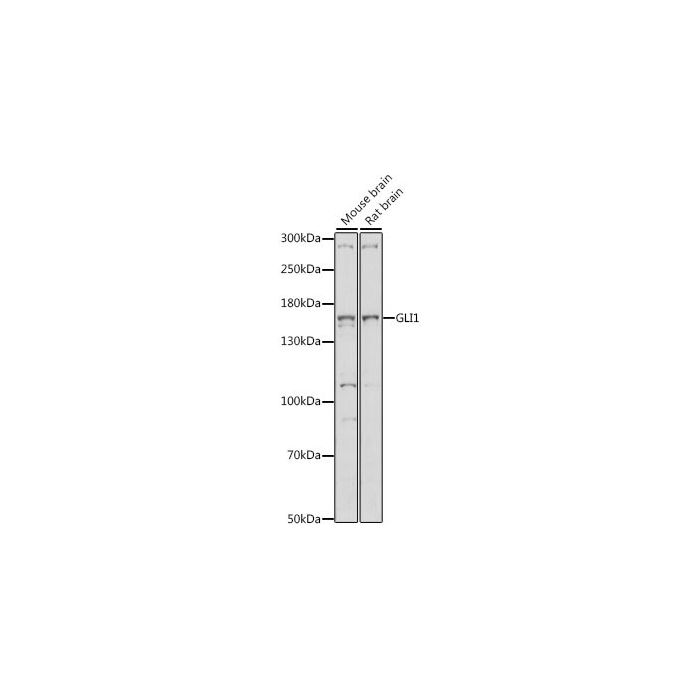
GLI1 polyclonal, anti-human, mouse, rat
€388.00
In stock
SKU
BS72669
Background:
This gene encodes a member of the Kruppel family of zinc finger proteins. The encoded transcription factor is activated by the sonic hedgehog signal transduction cascade and regulates stem cell proliferation. The activity and nuclear localization of this protein is negatively regulated by p53 in an inhibitory loop. Multiple transcript variants encoding different isoforms have been found for this gene.
Alternative Name:
GLI
Application Dilution: WB: 1:500 - 1:2000, IHC: 1:50 - 1:200, IF: 1:50 - 1:200
Specificity: GLI1 polyclonal antibody detects endogenous levels of GLI1 protein.
Immunogen:
A synthetic peptide of human GLI1
MW: 150kDa
Swis Prot.: P08151
Purification & Purity:
The antibody was affinity-purified from rabbit antiserum by affinity-chromatography using epitope-specific immunogen and the purity is > 95% (by SDS-PAGE).
Format:
1mg/ml in PBS, 50% glycerol, pH7.3.
Storage:
Store at 4°C short term. Aliquot and store at -20°C long term. Avoid freeze-thaw cycles.
For research use only, not for use in diagnostic procedure.
This gene encodes a member of the Kruppel family of zinc finger proteins. The encoded transcription factor is activated by the sonic hedgehog signal transduction cascade and regulates stem cell proliferation. The activity and nuclear localization of this protein is negatively regulated by p53 in an inhibitory loop. Multiple transcript variants encoding different isoforms have been found for this gene.
Alternative Name:
GLI
Application Dilution: WB: 1:500 - 1:2000, IHC: 1:50 - 1:200, IF: 1:50 - 1:200
Specificity: GLI1 polyclonal antibody detects endogenous levels of GLI1 protein.
Immunogen:
A synthetic peptide of human GLI1
MW: 150kDa
Swis Prot.: P08151
Purification & Purity:
The antibody was affinity-purified from rabbit antiserum by affinity-chromatography using epitope-specific immunogen and the purity is > 95% (by SDS-PAGE).
Format:
1mg/ml in PBS, 50% glycerol, pH7.3.
Storage:
Store at 4°C short term. Aliquot and store at -20°C long term. Avoid freeze-thaw cycles.
For research use only, not for use in diagnostic procedure.
| Is Featured? | No |
|---|
Write Your Own Review