
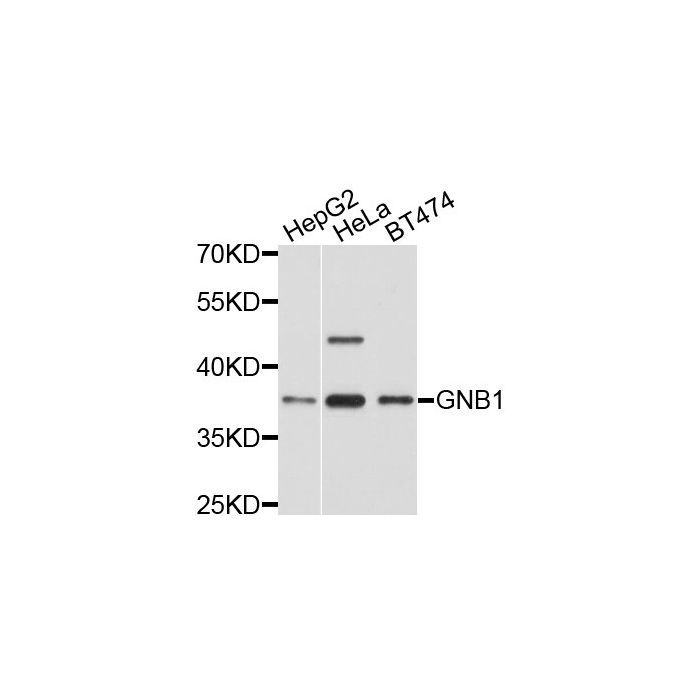
GNB1 polyclonal, anti-human, mouse, rat
€388.00
In stock
SKU
BS8046
Background:
Heterotrimeric G proteins function to relay information from cell surface receptors to intracellular effectors. Each of a very broad range of receptors specifically detects an extracellular stimulus (i.e., a photon, pheromone, odorant, hormone or neurotransmitter), while the effectors (e.g., adenyl cyclase), which act to generate one or more intracellular messengers, are less numerous. In mammals, G protein a, b and g polypeptides are encoded by at least 16, 4 and 7 genes, respectively. Most interest in G proteins has been focused on their a subunits, since these proteins bind and hydrolyze GTP and most obviously regulate the activity of the best studied effectors. Evidence, however, has established an important regulatory role for the b and g subunits. The G protein b subunits are important regulators of G protein a subunits as well as of certain signal transduction receptors and effectors. In mammals, there are five different members of the b subunit family
Alternative Name:
Guanine nucleotide-binding protein G(I)/G(S)/G(T) subunit beta-1, Transducin beta chain 1, GNB1
Application Dilution: WB: 1:1000 - 1:4000
Specificity: GNB1 polyclonal antibody detects endogenous levels of GNB1 protein.
Immunogen:
Recombinant full length Human GNB1.
MW: ~ 37 kDa
Swis Prot.: P62873
Purification & Purity:
The antibody was affinity-purified from rabbit antiserum by affinity-chromatography using epitope-specific immunogen and the purity is > 95% (by SDS-PAGE).
Format:
1mg/ml in PBS with 0.1% Sodium Azide, 50% Glycerol.
Storage:
Store at 4°C short term. Aliquot and store at -20°C long term. Avoid freeze-thaw cycles.
For research use only, not for use in diagnostic procedure.
Heterotrimeric G proteins function to relay information from cell surface receptors to intracellular effectors. Each of a very broad range of receptors specifically detects an extracellular stimulus (i.e., a photon, pheromone, odorant, hormone or neurotransmitter), while the effectors (e.g., adenyl cyclase), which act to generate one or more intracellular messengers, are less numerous. In mammals, G protein a, b and g polypeptides are encoded by at least 16, 4 and 7 genes, respectively. Most interest in G proteins has been focused on their a subunits, since these proteins bind and hydrolyze GTP and most obviously regulate the activity of the best studied effectors. Evidence, however, has established an important regulatory role for the b and g subunits. The G protein b subunits are important regulators of G protein a subunits as well as of certain signal transduction receptors and effectors. In mammals, there are five different members of the b subunit family
Alternative Name:
Guanine nucleotide-binding protein G(I)/G(S)/G(T) subunit beta-1, Transducin beta chain 1, GNB1
Application Dilution: WB: 1:1000 - 1:4000
Specificity: GNB1 polyclonal antibody detects endogenous levels of GNB1 protein.
Immunogen:
Recombinant full length Human GNB1.
MW: ~ 37 kDa
Swis Prot.: P62873
Purification & Purity:
The antibody was affinity-purified from rabbit antiserum by affinity-chromatography using epitope-specific immunogen and the purity is > 95% (by SDS-PAGE).
Format:
1mg/ml in PBS with 0.1% Sodium Azide, 50% Glycerol.
Storage:
Store at 4°C short term. Aliquot and store at -20°C long term. Avoid freeze-thaw cycles.
For research use only, not for use in diagnostic procedure.
| Is Featured? | No |
|---|
Write Your Own Review