
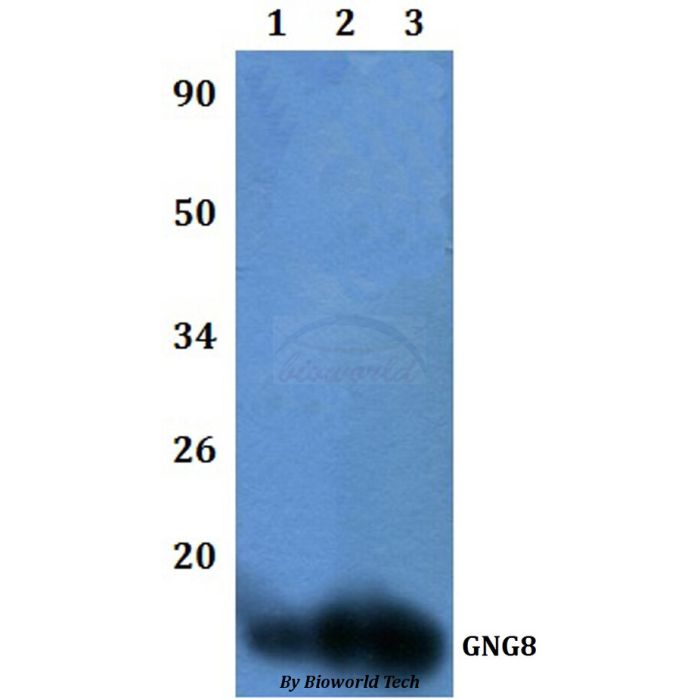
GNG8 polyclonal, anti-human, mouse, rat
€305.00
In stock
SKU
BS61310
Background:
Heterotrimeric G proteins function to relay information from cell surface receptors to intracellular effectors. Each of a very broad range of receptors specifically detects an extracellular stimulus (a photon, pheromone, odorant, hormone or neurotransmitter) while the effectors (e.g., adenyl cyclase), which act to generate one or more intracellular messengers, are less numerous. In mammals, G protein α, β and γ polypeptides are encoded by at least 16, 4 and 7 genes, respectively. Most interest in G proteins has been focused on their α subunits, since these proteins bind and hydrolyze GTP and most obviously regulate the activity of the best studied effectors. Evidence, however, has established an important regulatory role for the βγ subunits. It is becoming increasingly clear that different G protein complexes expressed in different tissues carry structurally distinct members of the γ as well as the α and β subunits and that preferential associations between members of subunit families increase G protein functional diversity.
Alternative Name:
Guanine nucleotide-binding protein G(I)/G(S)/G(O) subunit gamma-8, Gamma-9, GNG8, GNG9, GNGT9
Application Dilution: WB: 1:500~1:1000
Specificity: GNG8 polyclonal antibody detects endogenous levels of GNG8 protein.
Immunogen:
A synthetic peptide corresponding to residues in Human GNG8.
MW: ~ 8 kDa
Swis Prot.: Q9UK08
Purification & Purity:
The antibody was affinity-purified from rabbit antiserum by affinity-chromatography using epitope-specific immunogen and the purity is > 95% (by SDS-PAGE).
Format:
1 mg/ml in Phosphate buffered saline (PBS) with 0.05% sodium azide, approx. pH 7.3.
Storage:
Store at 4°C short term. Aliquot and store at -20°C long term. Avoid freeze-thaw cycles.
For research use only, not for use in diagnostic procedure.
Heterotrimeric G proteins function to relay information from cell surface receptors to intracellular effectors. Each of a very broad range of receptors specifically detects an extracellular stimulus (a photon, pheromone, odorant, hormone or neurotransmitter) while the effectors (e.g., adenyl cyclase), which act to generate one or more intracellular messengers, are less numerous. In mammals, G protein α, β and γ polypeptides are encoded by at least 16, 4 and 7 genes, respectively. Most interest in G proteins has been focused on their α subunits, since these proteins bind and hydrolyze GTP and most obviously regulate the activity of the best studied effectors. Evidence, however, has established an important regulatory role for the βγ subunits. It is becoming increasingly clear that different G protein complexes expressed in different tissues carry structurally distinct members of the γ as well as the α and β subunits and that preferential associations between members of subunit families increase G protein functional diversity.
Alternative Name:
Guanine nucleotide-binding protein G(I)/G(S)/G(O) subunit gamma-8, Gamma-9, GNG8, GNG9, GNGT9
Application Dilution: WB: 1:500~1:1000
Specificity: GNG8 polyclonal antibody detects endogenous levels of GNG8 protein.
Immunogen:
A synthetic peptide corresponding to residues in Human GNG8.
MW: ~ 8 kDa
Swis Prot.: Q9UK08
Purification & Purity:
The antibody was affinity-purified from rabbit antiserum by affinity-chromatography using epitope-specific immunogen and the purity is > 95% (by SDS-PAGE).
Format:
1 mg/ml in Phosphate buffered saline (PBS) with 0.05% sodium azide, approx. pH 7.3.
Storage:
Store at 4°C short term. Aliquot and store at -20°C long term. Avoid freeze-thaw cycles.
For research use only, not for use in diagnostic procedure.
| Is Featured? | No |
|---|
Write Your Own Review