
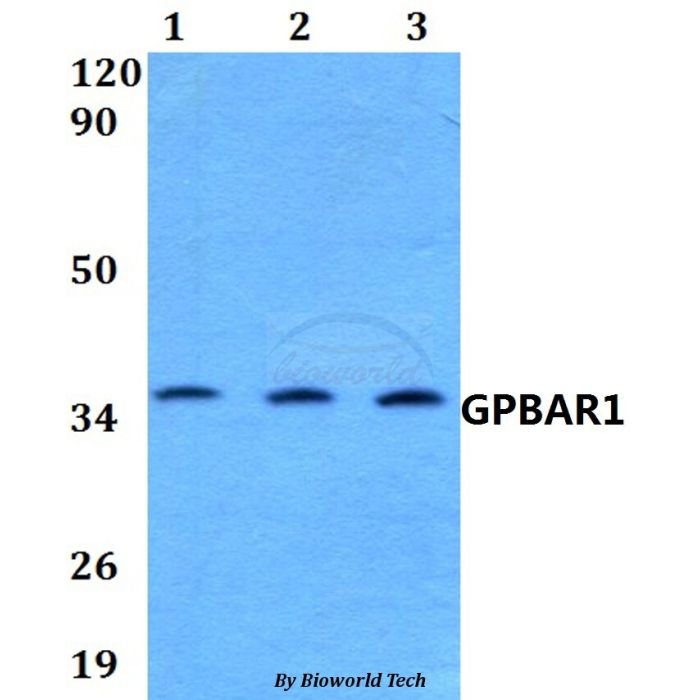
GPBAR1 polyclonal, anti-human, mouse, rat
€305.00
In stock
SKU
BS60582
Background:
The G protein-coupled receptor TGR5 is a 330-amino acid protein that is almost universally expressed in human tissues including heart, skeletal muscle, spleen, kidney, liver, small intestine, placenta, and leukocytes, but not in brain, colon (without mucosa), thymus, or lung. TGR5 is sensitive to bile acids and responds through a significant mechanism that coordinates energy homeostasis. Bile acids activate mitogen-activated protein (MAP) kinase pathways, specifically induce TGR5 internalization, promote an increase of guanosine 5'-O-3-thio-triphosphate binding in membrane fractions, and cause rapid intracellular cAMP production. Bile acids also provoke TGR5 to suppress macrophage functions. TGR5-controlled signaling pathways may be good candidates for drug targets to treat common metabolic diseases, such as obesity, type II diabetes, hyperlipidemia, and atherosclerosis.
Alternative Name:
G-protein coupled bile acid receptor 1, G-protein coupled receptor GPCR19, hGPCR19, Membrane-type receptor for bile acids, M-BAR, hBG37, BG37, GPBAR1, TGR5
Application Dilution: WB: 1:500~1:1000
Specificity: GPBAR1 polyclonal antibody detects endogenous levels of GPBAR1 protein.
Immunogen:
A synthetic peptide corresponding to residues in Human GPBAR1
MW: ~ 35 kDa
Swis Prot.: Q8TDU6
Purification & Purity:
The antibody was affinity-purified from rabbit antiserum by affinity-chromatography using epitope-specific immunogen and the purity is > 95% (by SDS-PAGE).
Format:
1 mg/ml in Phosphate buffered saline (PBS) with 15 mM sodium azide, approx. pH 7.2.
Storage:
Store at 4°C short term. Aliquot and store at -20°C long term. Avoid freeze-thaw cycles.
For research use only, not for use in diagnostic procedure.
The G protein-coupled receptor TGR5 is a 330-amino acid protein that is almost universally expressed in human tissues including heart, skeletal muscle, spleen, kidney, liver, small intestine, placenta, and leukocytes, but not in brain, colon (without mucosa), thymus, or lung. TGR5 is sensitive to bile acids and responds through a significant mechanism that coordinates energy homeostasis. Bile acids activate mitogen-activated protein (MAP) kinase pathways, specifically induce TGR5 internalization, promote an increase of guanosine 5'-O-3-thio-triphosphate binding in membrane fractions, and cause rapid intracellular cAMP production. Bile acids also provoke TGR5 to suppress macrophage functions. TGR5-controlled signaling pathways may be good candidates for drug targets to treat common metabolic diseases, such as obesity, type II diabetes, hyperlipidemia, and atherosclerosis.
Alternative Name:
G-protein coupled bile acid receptor 1, G-protein coupled receptor GPCR19, hGPCR19, Membrane-type receptor for bile acids, M-BAR, hBG37, BG37, GPBAR1, TGR5
Application Dilution: WB: 1:500~1:1000
Specificity: GPBAR1 polyclonal antibody detects endogenous levels of GPBAR1 protein.
Immunogen:
A synthetic peptide corresponding to residues in Human GPBAR1
MW: ~ 35 kDa
Swis Prot.: Q8TDU6
Purification & Purity:
The antibody was affinity-purified from rabbit antiserum by affinity-chromatography using epitope-specific immunogen and the purity is > 95% (by SDS-PAGE).
Format:
1 mg/ml in Phosphate buffered saline (PBS) with 15 mM sodium azide, approx. pH 7.2.
Storage:
Store at 4°C short term. Aliquot and store at -20°C long term. Avoid freeze-thaw cycles.
For research use only, not for use in diagnostic procedure.
| Is Featured? | No |
|---|
Write Your Own Review