
GPC3 Polyclonal Antibody
€0.00
In stock
SKU
E-AB-40358
Catalog Number: E-AB-40358
Isotype: Rabbit IgG
Reactivity: mouse
Applications: WB
Datasheet, Questions? Contact us!
Isotype: Rabbit IgG
Reactivity: mouse
Applications: WB
Datasheet, Questions? Contact us!
Background:
Cell surface heparan sulfate proteoglycans are composed of a membrane-associated protein core substituted with a variable number of heparan sulfate chains. Members of the glypican-related integral membrane proteoglycan family (GRIPS) contain a core protein anchored to the cytoplasmic membrane via a glycosyl phosphatidylinositol linkage. These proteins may play a role in the control of cell division and growth regulation. The protein encoded by this gene can bind to and inhibit the dipeptidyl peptidase activity of CD26, and it can induce apoptosis in certain cell types. Deletion mutations in this gene are associated with Simpson-Golabi-Behmel syndrome, also known as Simpson dysmorphia syndrome. Alternative splicing results in multiple transcript variants.
Research Area: Cancer, Stem Cells, Signal Transduction, Developmental Biology
Synonyms:
DGSX, Glypican proteoglycan 3, Glypican-3 [Precursor], Gpc3, GPC3, GTR2 2, GTR2-2, Heparan sulphate proteoglycan, Intestinal protein OCI 5, Intestinal protein OCI-5, MXR7, OCI 5, OCI-5, OCI5, SDYS, Secreted glypican-3, SGB, SGBS, SGBS1
Immunogen: Recombinant Mouse Glypican-3 protein
Swissprot: Q8CFZ4
Gene ID: 14734
Calculated MW: 67 kDa
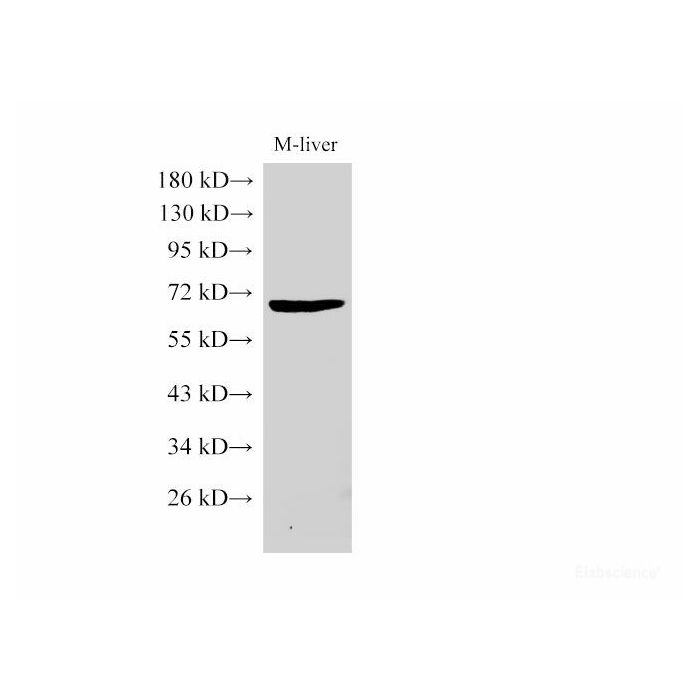
Observed MW: 67 kDa
Purification Method: Antigen Affinity Purification
Buffer: PBS with 0.05% Proclin300, 50% glycerol, pH7.3
Concentration: 0.95 mg/mL
Dilution: WB 1:500-1:1000
Storage:
Store at -20°C. Avoid freeze / thaw cycles.
Cell surface heparan sulfate proteoglycans are composed of a membrane-associated protein core substituted with a variable number of heparan sulfate chains. Members of the glypican-related integral membrane proteoglycan family (GRIPS) contain a core protein anchored to the cytoplasmic membrane via a glycosyl phosphatidylinositol linkage. These proteins may play a role in the control of cell division and growth regulation. The protein encoded by this gene can bind to and inhibit the dipeptidyl peptidase activity of CD26, and it can induce apoptosis in certain cell types. Deletion mutations in this gene are associated with Simpson-Golabi-Behmel syndrome, also known as Simpson dysmorphia syndrome. Alternative splicing results in multiple transcript variants.
Research Area: Cancer, Stem Cells, Signal Transduction, Developmental Biology
Synonyms:
DGSX, Glypican proteoglycan 3, Glypican-3 [Precursor], Gpc3, GPC3, GTR2 2, GTR2-2, Heparan sulphate proteoglycan, Intestinal protein OCI 5, Intestinal protein OCI-5, MXR7, OCI 5, OCI-5, OCI5, SDYS, Secreted glypican-3, SGB, SGBS, SGBS1
Immunogen: Recombinant Mouse Glypican-3 protein
Swissprot: Q8CFZ4
Gene ID: 14734
Calculated MW: 67 kDa
Observed MW: 67 kDa
Purification Method: Antigen Affinity Purification
Buffer: PBS with 0.05% Proclin300, 50% glycerol, pH7.3
Concentration: 0.95 mg/mL
Dilution: WB 1:500-1:1000
Storage:
Store at -20°C. Avoid freeze / thaw cycles.
| Is Featured? | No |
|---|
Write Your Own Review